


Powering economic stability
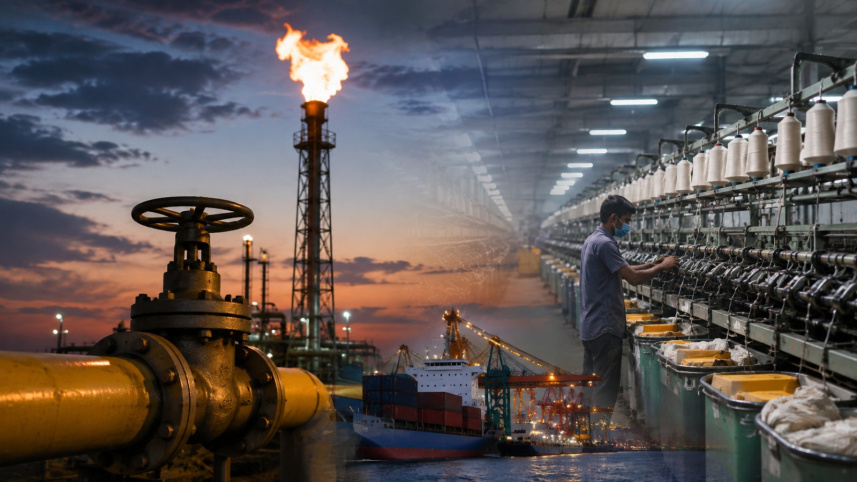
Ask a factory owner in Gazipur what keeps him up at night. He will not say exchange rates. He will not say interest rates either. He will say gas pressure, and that tells you something about where the real pressure points of this economy sit.
Energy sounds like a technical subject. It is not, not really. It is closer to a kitchen-table issue than anything in a policy brief. When gas flows the way it is supposed to, factories run full shifts, ships leave Chattogram on time, and families bring home a steady wage. Simple enough.

But when that flow breaks, the damage does not show up immediately. It moves through the economy quietly, and by the time it lands in an official chart, it has already been felt for months on the ground. That is why the current energy situation deserves more than a passing headline.
The numbers, at least, are blunt. We need somewhere between 3,800 and 4,000 million cubic feet of gas a day. What we actually get, on a good day, is closer to 2,600 MMCFD.
That gap was never comfortable, and it turned into something closer to a crisis when one of the floating LNG terminals went offline recently. Supply was gradually restored. But the episode showed how thin the margin has become between running normally and grinding to a halt.
Go to Gazipur, Ashulia, Savar, Narayanganj, wherever the factories are, and you will hear the same thing. Gas pressure is too low to run machines properly. Over a hundred spinning mills reportedly stopped production altogether, industry groups say, and others limped along at 60 to 70 percent capacity. Not a rounding error. Real output lost, real orders put at risk.
Why does this matter so much? Garments are not just another line item in our export basket; they basically are the export economy. RMG alone brings in more than 80 percent of merchandise export earnings and employs close to four million people directly.
Add the transport workers, packaging suppliers, bank staff processing LC payments, small vendors camped outside every gate, and the number of people whose income depends on this sector gets a lot bigger, fast.
Economic pain rarely stays where it starts, though. It spreads, and usually in a fairly predictable order.
Lower gas pressure slows production lines, delays shipments, and pushes factories towards diesel generators, which cost more and defeat the whole point. Buyers comparing Bangladesh with Vietnam or Cambodia are not only looking at price anymore. They are asking something simpler: will the order actually ship on time?
Then it hits paychecks. Less output usually means less overtime, fewer new hires, and expansion plans quietly shelved. Once household income tightens, spending slows well past the factory gates, at the tea stall, the local market, everywhere really.
And eventually, it works into the wider economy. Weaker exports mean fewer dollars coming in, which puts pressure on reserves and on the taka. A softer taka makes imported fuel and machinery pricier, which feeds right back into inflation. It is a loop, and not an easy one to break once it starts turning.
None of this happens on its own. We are still heavily dependent on imported LNG, so a flare-up in the Middle East or a shipping disruption thousands of miles away can quietly turn into a higher bill at home.
That exposure is not going away through wishful thinking. It can be managed: faster domestic gas exploration, stronger LNG infrastructure, less wastage in transmission, and a real push to diversify the energy mix before the next shock hits.
We have weathered worse, honestly. What is needed now is not more firefighting. It is foresight, so energy quietly goes back to being a strength instead of a headline, and businesses can get on with building rather than just keeping the lights on.
The writer is the co-founder and CEO of Accfintax and an associate director at Hoda Vasi Chowdhury & Co.
 For all latest news, follow The Daily Star's Google News channel.
Comments