


Power generation to go up by 12,853MW in five years

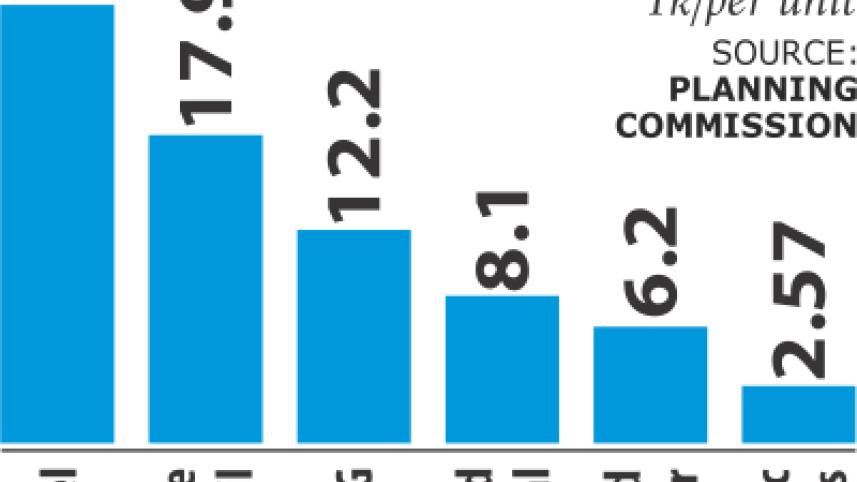
The government plans to increase power generation by 12,853 megawatts over the next five years, 40 percent of which will be provided by the private sector.
However, much of the private investment in power production will be relatively large-scale, with no additional rental power contracts, according to the draft of the seventh five-year plan.

The draft plan was placed at a consultative meeting yesterday at the National Economic Council with Planning Minister AHM Mustafa Kamal in the chair.
The power sector will require investments of Tk 165,500 crore over the next five years, 50 percent of which will come from the private sector, according to the draft presented by Shamsul Alam, a member of the General Economics Division.
The high-cost fuel-based power generation will be gradually phased out and so will the low-cost gas-based ones, it said.
In the last two years of the five-year plan, around 6,000MW of fresh power will be added to the national grid, most of which will be from imported coal and liquefied natural gas or LNG.
On an average, Bangladesh now produces 7,500 MW of electricity against the country's installed capacity of 11,500MW, according to the Power Division. Although the power generation doubled in the last six years, about 40 percent of the population does not have electricity connection yet.
During the 2016-2020 plan period, domestic gas will be replaced as the primary source of energy, as its reserves are drying.
The plan said the first nuclear-based power plant, Rooppur power project, will be commissioned during the seventh five-year plan. Vietnam generates 34,000MW of electricity and has plans to increase it to 72,000MW over the next five years, Kamal said.
“Though it seems impossible they are likely to make it happen,” the minister said, adding that if Vietnam can achieve their target, so should Bangladesh.
To achieve the target, the specific timeframe for commissioning the power plants have to be met.
“Often we take good plans but those remain unimplemented,” said MA Mannan, state minister for finance and planning.
Courageous leadership is required to implement the plans, which is a challenge, he said.
To implement the plans for the energy sector, the government should urgently finalise and adopt the long-pending National Energy Policy, or alternatively develop an energy master plan, Kamal said.
The master plan should address the policies for gas allocation and domestic gas exploration, domestic coal utilisation, energy import, improved cooking stove and energy subsidy pricing, according to the draft.
The plan said the challenges in the energy sector are enormous and much of these relate to policy and institutional reform. These are tough reforms and a strong political will is necessary, especially regarding the adoption of domestic coal policy.
Yet the importance of timely implementation of these reforms cannot be overstated, it said.
The successful implementation and efficient power generation strategy is critically dependent on the implementation of these reforms tied to primary energy.
 For all latest news, follow The Daily Star's Google News channel.
 In addition to a strong political will and leadership, improvements are also needed in the technical and negotiation capacity of the ministry and associate energy agencies, it said.
Comments