


Rate cuts on the way after three years

The central bank is set to cut its policy rates for the first time in three years in an effort to spur investment in the economy.
The repo and reverse repo rates are likely to be slashed by 50 basis points in the monetary policy statement for the second half of the fiscal year, due to be announced today.

The repo and reverse repo rates have remained unchanged at 7.25 percent and 5.25 percent since February 2013.
The repo rate is the rate at which the central bank lends to commercial banks. A cut in the repo rate helps the commercial banks get money at a cheaper rate in the event of a fund shortfall.
When inflation rises, the central bank tends to increase the repo rate as it acts as a disincentive for banks to borrow from the central bank. This ultimately reduces the money supply in the economy and eases inflation. The central bank takes the contrary position in the event of a fall in inflationary pressure.
The reverse repo rate is the rate at which Bangladesh Bank borrows funds from commercial banks to control money supply.
The upcoming monetary policy is highly expected to be expansionary as the BB succeeded in containing inflation.
The monetary policy statement for the July-December period set the average inflation target at 6.2 percent for fiscal 2015-16. As of December, the average rate was 6.21 percent.
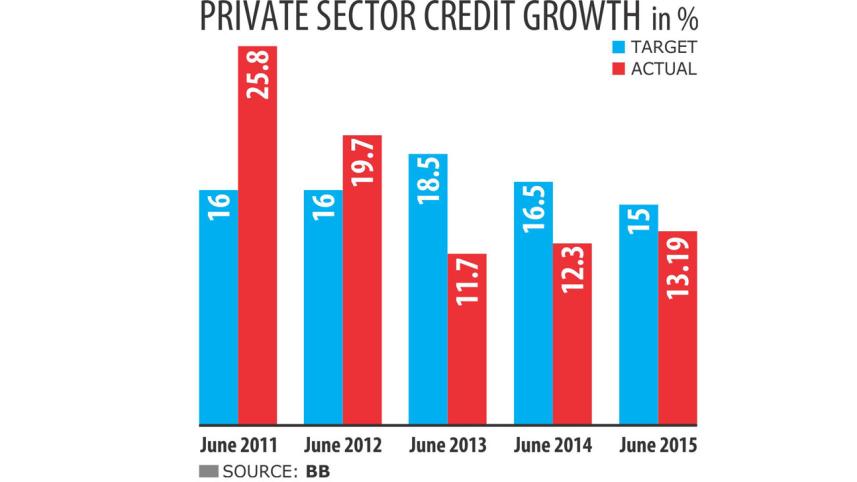
The private sector credit growth target is likely to be brought down in today's statement to a feasible level, said a Bangladesh Bank official.
The target set for the first half was 15 percent and as of November, private sector credit growth stood at 13.72 percent.
“If the target for the second half can be achieved, it might be enough to hit 7 percent economic growth this fiscal year,” the official added.
MA Mannan, state minister for finance and planning, called for a slightly expansionary MPS this time to meet the 7 percent GDP growth target.
“The central bank should create space for increasing private investment,” he added.
Mohammed Farashuddin, a former central bank governor, said Bangladesh Bank needs to look at its monetary policy now that political stability is returning.
“Monetary policy should not be restrictive or accommodating. Rather, it should be expansionary. Although there will be some risks of inflation, but it can be dealt with subsequently. What we need is a lot of investment.”
The central bank has had very good success in containing inflation, he said, citing that inflation was in double digits in 2011 but has now come down to nearly 6 percent.
“So now, the central bank should liberalise itself a little bit so that investment increases,” he added.
BB Chief Economist Biru Paksha Paul said the next monetary policy will be pro-growth and pro-investment.
“Some people may say that it is nothing new. But that is especially new and why so? We are enjoying some favourable environment in the background such as political stability, low inflation, low commodity prices, India's growth prospects and high stability in the economy.”
India's GDP growth has a positive ripple effect on the Bangladesh economy and the neighbouring country is forecast to clock in the best figures in 2016 by US news organisation Bloomberg.
 For all latest news, follow The Daily Star's Google News channel.
Comments