


Surplus in BoP more than doubles

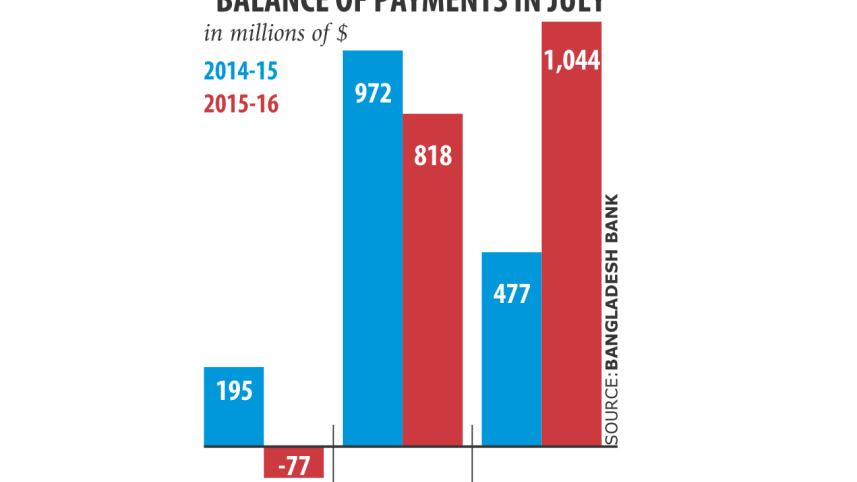
The balance of payments (BoP) surplus more than doubled in the first month of the fiscal year on the back of less spending on petroleum and slower growth of industrial raw material imports.
In July, the overall surplus stood at $1.04 billion in contrast to $477 million a year earlier, according to central bank statistics.

The surplus increased mainly due to a fall in imports, which dropped 3.21 percent year-on-year in the first month of fiscal 2015-16.
In July, the import of petroleum dropped about 61 percent and food grain 31 percent. Industrial raw materials, which have the highest share in the import basket, grew only 0.58 percent.
Zahid Hussain, lead economist of the World Bank's Dhaka office, said the surplus reflects an increase in financial account surplus and an increase in unaccounted inflows (errors and omissions).
The financial account was $86 million in the surplus, whereas in July last year it was $151 million in the deficit.
The increased financial account surplus reflected the decrease in outflows on account of trade credit, decrease in repayment of medium and long term official borrowings and increase in foreign direct investment.
The turnaround in errors and omissions from $352 million outflows in July last year to $136 million inflows in July this year perhaps reflects some success in restricting capital flight, he said.
Decrease in outflows on account of trade credit is probably a reflection of a large fall in export shipment in July, he said.
Exports dropped 12.18 percent year-on-year in July to take the trade balance to $77 million in the deficit. At the same time last fiscal year, it was $195 million in the surplus.
The current account also had a surplus but less than in July last year: $818 million as opposed to $972 million a year earlier.
There is some not so good news hidden in this surplus. Exports, imports and remittances declined, which is not good news for the economy, Hussain said. The decline in payments exceeded the decline in receipts, resulting in the surplus, he added.
 For all latest news, follow The Daily Star's Google News channel.
Comments