


Transport sector gets priority in five-year plan

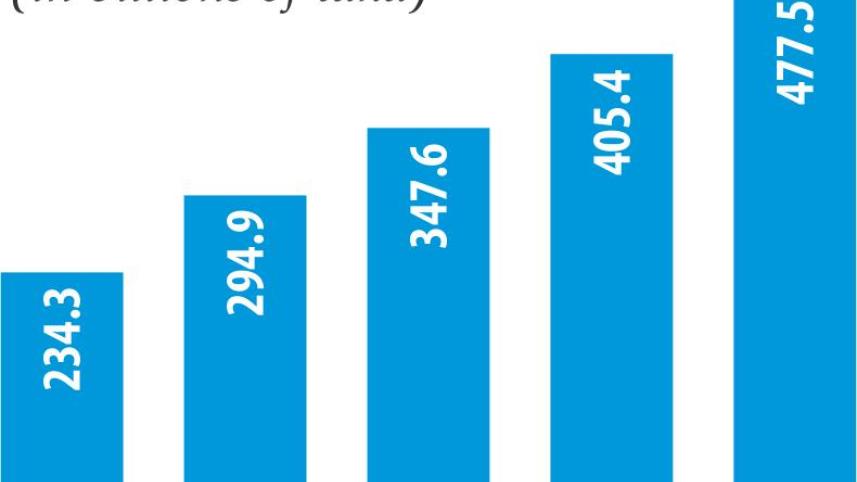
The government plans to almost double the funds for the transport sector each fiscal year until 2020 to achieve 8 percent economic growth.
The projection has been made in the seventh five-year plan, which will be placed at a meeting of the National Economic Council for approval today.

The draft plan recommended spending 3 percent of the gross domestic product, on average, on the transport sector including air, river and land routes each fiscal year during the five-year period.
In fiscal 2014-15, the financing in the transport sector was 1.6 percent of GDP.
Of the 3 percent, 2 percent will be through the annual development programme and 1 percent through public-private partnership, according to the plan.
The government has already identified a good number of high-priority projects in the transport sector, such as completion of the Padma bridge construction by 2018 and setting up a tunnel underneath the Karnaphuli river in Chittagong.
Conversion of nationally important highways into four lanes gradually, connecting important economic activity hubs such as Payra Port and economic zones to national highways, and construction of circular rail track around Dhaka city have also been included.
Apart from these, the big plans include constructions of a third sea port at Payra in Patuakhali, a third terminal at Hazrat Shahjalal International Airport and a new one named Khan Jahan Ali Airport in Khulna.
Feasibility study for the construction of Bangabandhu Sheikh Mujib International Airport has also been put down.
However, different quarters in the government have indicated that the Sonadia deep-sea port project may not be taken forward, but the plan also proposed a government-to-government initiative for the port.
The plan said the aim of the new transport system is to increase communication between the remote and urban areas, which would increase the income of the people and reduce poverty.
On the other hand, trans-Asian road projects have been stressed to boost international trade.
In the seventh five-year plan, river and rail roads will be given the highest emphasis as these are environment-friendly and low-cost. Over the next five years, 856 kilometres of new rail tracks will be laid out.
Besides, a massive plan has been taken for the rehabilitation of the old lines, while 100 new locomotives and 1,120 passenger coaches will be purchased. To strengthen the shipping routes, 6,000km of inland waterways and 1,000km of coastal waters will be surveyed.
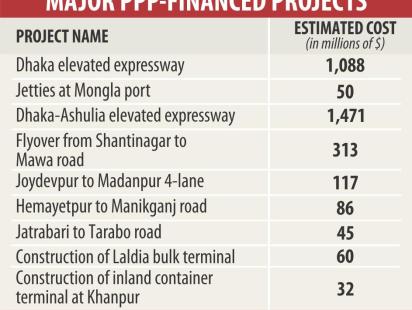
The government has planned to bring a big change in the transport sector through PPP. The new plan has stressed 15 projects involving $10.42 billion under it.
The five-year plan has presented a picture of the previous plans' successes.
The sixth five-year plan (2011-2015) recorded the highest GDP, which is 86 percent of the target. The second highest, 84 percent of the target, could be achieved in the fourth plan (1990-1995).
In the last year of the seventh plan, an 8 percent target has been set for GDP growth.
For achieving the target the amount of total investment has been estimated to be Tk 31,903 billion, of which the private sector will contribute 77 percent.
 For all latest news, follow The Daily Star's Google News channel.
Comments