


How academic obligations affect Eid celebrations
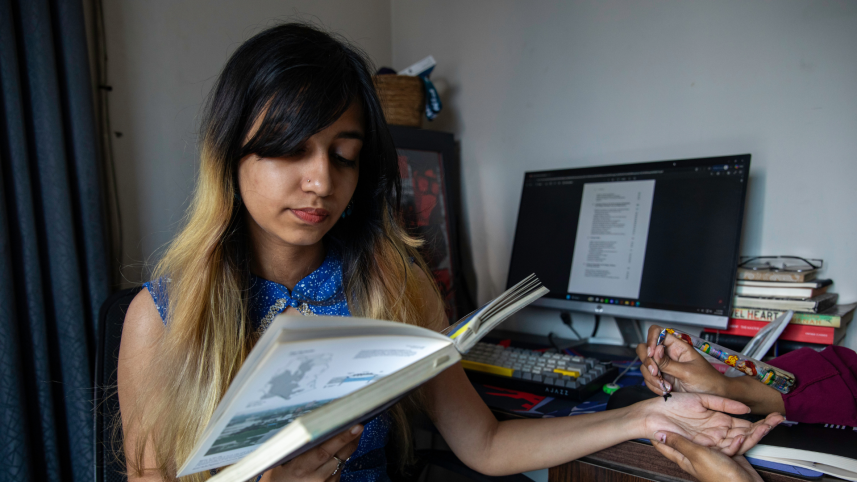
Eid is meant to be a day of celebration with family and friends after a month of fasting. It’s supposed to mean new clothes in shopping bags, kitchens filled with the smell of food, late-night laughter with mehedi-stained hands, waking up early to visit relatives, crowded dining tables, and long afternoons with cousins.
But for many students, the joy of Eid is diminished by academic pressure. As upcoming exams, assignments, lab reports, and other submission deadlines loom at the edge of the festivities, it is quite difficult to switch off during the holidays.

Fatema Tuz Zohra, a class seven student at Rajuk Uttara Model College, thought that the long Ramadan break would be the perfect lead-up to Eid, but instead, she’s busy with homework. “My parents remind me to study every day, and my tutors keep giving me more and more work,” Fatema comments. “I spend most of my time studying now, so the excitement for Eid isn’t there anymore.”
Some feel an internal urge to study even when their parents encourage them to take a break. Sadman Tasin, a ninth-grader at Glenrich International School, shares, “My parents think vacations are meant to free your mind from the year-long stress. They believe it’s extremely important to take a break instead of piling on more work.”
Still, stepping away from his studies is not easy for him. “Exam anxiety and stress randomly kick in, even when I’m trying to enjoy the holidays,” Sadman admits. To manage his anxiety, he tries to finish as much of his studies as he can before Eid to be able to spend more time with his family.
Eid briefly becomes peaceful only after a major academic phase ends. For Ruhama Radia Mahbub, who will begin classes at the University of Asia Pacific this July, this year’s Eid carries a special meaning. She sees it as her first and last carefree Eid before university life begins.
If my cousins come over, I can forget about deadlines and exams for a while. But with almost anyone else, it doesn’t feel the same, and the stress stays with me.
In previous years, when exams were near, she barely cared about buying Eid dresses, meeting friends, or visiting relatives. “This year I want to do all the things I couldn’t do before and focus on having fun without worrying about anything,” Ruhama notes. “I plan to meet my friends, as all of us are finally free now.”
The shift becomes clearer when students enter university. With midterms and semester finals scheduled immediately after Eid, celebration takes a backseat to exam preparation. Mayesha Hasin, a third-year Industrial and Production Engineering (IPE) student at Islamic University of Technology (IUT), expects to spend all of the holiday studying. She also plans to use the break to prepare for future internships.
“I'm not at all excited about Eid this time,” Mayesha states. “I'm very worried about how much I still need to study. With exams so close after, I don't have the luxury to slack off or relax.”
Nafisa Anjum, a third-year student of the Department of Leather Engineering at Dhaka University (DU), feels that since her first year, Eid holidays have been turned into preparatory leave, which completely ruins the festive spirit. “I don’t take books home during Eid anymore,” Nafisa states. “Instead, I try to return to the hall early so I can at least spend a couple of days of Eid properly.”
Social expectations add another layer of tension. Even when students want to stay home and work, relatives expect them to visit during Eid. Declining an invitation leads to repeated calls and questions until the student feels compelled to give in.
“Saying that I won’t go doesn’t really help because they keep requesting again and again,” expresses Farha Fauzia, a computer science and engineering (CSE) student at BRAC University. “Parents are supposed to be happy when their children want to stay home and study, but my parents always insist on taking me along to relatives’ houses, no matter how much I say I don’t want to go.”
Sometimes the stress is also psychological. Jarine Tasnim Ava, a third-year Mechanical Engineering (ME) student at IUT, describes the feeling as a constant ticking clock. While trying to enjoy Eid, she says it feels like a countdown ticking away in the background. It also depends on who is around her. “If my cousins come over, I can forget about deadlines and exams for a while,” Jarine shares. “But with almost anyone else, it doesn’t feel the same, and the stress stays with me.”
Appreciating Eid is even more difficult for students studying abroad. University schedules usually don’t pause for religious holidays, and missing classes or labs has a severe impact on grades. As a result, celebrating Eid with family is not really an option.
“We still have classes during Eid week. We only get a holiday if Eid falls on Saturday,” explains Nusrat Jahan Alve, a CSE student at Sejong University, Seoul. “If Eid falls on a class day, the most I might manage is a quick phone call back home in between lectures.”
The meaning of Eid shifts once more as student life begins to end. For Nusaiba Binte Asad, a final-year student at the Institute of Business Administration (IBA) at Jahangirnagar University (JU), this Eid will be her last one as a student. With her finals and thesis behind her, she finds herself mourning the long vacations she once took for granted.
“As students, we get at least around twenty-five days of vacation and, in some years, even forty to fifty days. I can’t even imagine getting that much time off once I start working,” Nusaiba reflects.
Even though exams are no longer weighing on her mind this time around, she’s worried about the next step in her life. “There was always an exam waiting for me after Eid,” Nusaiba remarks. “This Eid feels a bit lighter because there are no more semesters. But at the same time, there’s a new tension about what job I’ll get and what my life will look like next once I start working.”
In spite of the heavy workload, students still find ways to try to hold on to the spirit of Eid in various ways. Jarine, known among her friends and family as the “mehedi expert”, spends chaand raat drawing henna patterns on the hands of her younger sister, cousins, and even friends who come over. For Farha, the chaand raat usually ends with her cousins convincing her to step outside for a while. “My cousins drag me out every year,” she says. “We just roam around the city in a rickshaw for hours. There are lights, people everywhere, and for that small period, I forget about everything else.” The late-night rides through the busy streets remind her that Eid celebrations still exist beyond deadlines and assignments.
 For all latest news, follow The Daily Star's Google News channel.
 Whether it’s finishing coursework early to spend a few more hours with their family, or making plans with friends after months of studying, or putting their books aside for the day, students find their own way of celebrating the holiday amidst academic obligations. Deadlines, obligations, and expectations may dull the excitement, but the joy can still be found in small moments.
Comments