


The struggles of students with hyperhidrosis
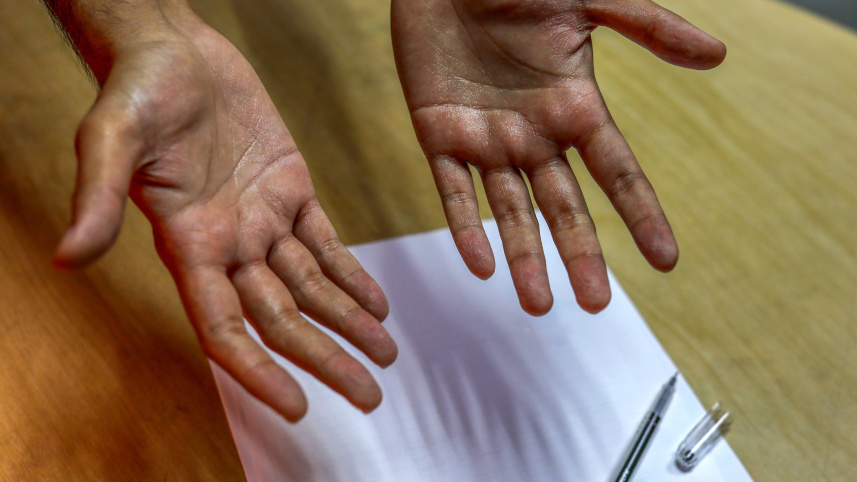
A few months ago, I was waiting at my school’s terrace for an exam to start. The weather was sweltering. Everyone was feeling uncomfortable. However, for me, the situation was significantly worse. My palms and soles were sweating uncontrollably. I was using a copious amount of tissue paper to wipe the sweat away, but to no avail. The sweating didn’t stop. At one point, the school staff took the tissue paper roll away, accusing me of “wasting” tissue paper.
The air conditioner in the exam hall wasn’t working properly either. However, my palms continued to sweat, making it almost impossible to write without constantly stopping to wipe them.

This problem I face is not exclusive to me. In fact, millions of people around the world face this debilitating problem of excessive sweating, which is clinically called “hyperhidrosis”. Although sweating is normal in our country where the climate is very hot and humid, people with hyperhidrosis sweat excessively to the point that their daily lives are severely hampered.
Prof. Dr Md Reza Bin Zaid, a dermatologist at Skin Square BD, explains, “This happens because the sweat glands receive too many signals from the nerves. Sweat glands are found all over the body, but they are mostly found in the armpits, palms of the hands, soles of the feet, and face. People with hyperhidrosis usually sweat a lot in these areas. Doctors diagnose, treat, and help people manage this condition.”
Amongst individuals with hyperhidrosis, students are a subgroup who must confront the issue on a near-daily basis. This is because students often have to engage in tasks like writing, reading, and interacting with their peers. Excessive sweating, however, can make these simple actions extremely frustrating.

“I feel hesitant to shake hands with my friends. I feel annoyed because my hands get sweaty repeatedly while writing in exams,” says Aminullah Syed Imran, a third-year undergraduate student at Chittagong University (CU).
Bayzid Biswas, an economics student at the National University, concurs, “When it starts, I feel very uncomfortable. I can't shake my hand with others, and I often cannot write on the paper. I also face difficulty using electronic devices.”
These conditions can affect both a student’s social and academic life gravely. In a research paper published in Health Qual Life Outcomes, it was found that 63 percent of participants experienced interference in the performance of tasks at school or work.
As such, students with hyperhidrosis perform poorly in some exams where their sweating may be triggered due to induced anxiety or sweltering weather. As a result, they often find themselves in difficult situations where they are unable to feel comfortable in their own skin. This is exacerbated because people with hyperhidrosis cannot control when or how much their palms sweat. They also don’t know when exactly it may be triggered. Such distress creates a perfect hotbed for anxiety to thrive and inundate the sweat glands with signals which, in turn, may cause more sweating.
Abrar*, a student of microbiology at Jahangirnagar University (JU), says, “The most severe issue I face in my daily life is social isolation. This condition makes it incredibly difficult to interact with people. When I try to shake hands with someone, my sweaty palms often make them feel uncomfortable, which puts me in an embarrassing situation. I encounter this challenge at every social gathering, whether it is a function, sports activity, or even during prayers. Due to this issue, it becomes nearly impossible to carry out most daily activities properly.”
Besides affecting his social life, his academics are also impeded. “My sweaty hands and feet have severely disrupted my academic life. It makes writing a massive struggle, and at times, the constant sweating completely dampens my desire to study. As a result, my academic productivity has significantly dropped. On multiple occasions during exams, my hands sweated so profusely that they soaked my exam scripts,” he adds.
This vicious cycle can undermine a student's confidence, increase stress in everyday situations, and ultimately affect both academic performance and social interactions. Everyday activities like reading a book, using a computer, or playing sports may become quite exasperating. A literature review published in the American Journal of Clinical Dermatology found that individuals with hyperhidrosis consistently report higher levels of anxiety and depression and a decreased sense of well-being.
Dr Reza adds, “Sometimes, excessive sweating can be a sign of one's own internal health problem, so a doctor should check if the sweating starts suddenly or is very severe.” This usually happens when the person has secondary hyperhidrosis, where the sweating occurs due to an underlying medical condition.
However, according to a 2011 study published in the Journal of the American Academy of Dermatology, the vast majority of people who sweat excessively have primary hyperhidrosis. Primary hyperhidrosis is idiopathic, meaning its origin is unknown. As a result, it is very difficult to cure this condition permanently. All of the interviewees have explained how they’ve taken various types of medicine, but it couldn’t cure their condition.
“The conventional medicines I have taken so far have not provided any noticeable relief. As part of my allopathic treatment, I have used various types of tablets, sprays, and lotions, but my condition did not improve much,” says Abrar. Similarly, Bayzid adds, “I have sought various types of treatment. I have gotten treatment from my local village as well as in Dhaka, but I couldn’t get a proper solution to this problem. I have even applied various types of homeopathic and allopathic medicine.”
Instead, people with primary hyperhidrosis are forced to take various steps to manage it throughout their lives. Dr Reza says, “A doctor may recommend 20 percent aluminium chloride hexahydrate, which is usually applied at night to control sweating. If this does not help, iontophoresis (a treatment that uses a mild electric current to reduce sweating) may be recommended, especially for sweaty hands and feet. In severe cases, a doctor may prescribe medicines or suggest treatments such as Botox injections.”
Hyperhidrosis treatments like Botox injections or iontophoresis (which many patients of hyperhidrosis are required to use regularly) are difficult for many, especially students, to access due to the cost of the treatments. Bayzid also highlights this cost factor, stating that he could not afford surgery to cure his condition because it was too costly.
 For all latest news, follow The Daily Star's Google News channel.
 As students with hyperhidrosis are genuinely disadvantaged due to their condition in both academic and social settings, perhaps their institutions can make some provisions for support.
Abrar says, “Since my hands and feet sweat excessively, most of my exam time is wasted just wiping them. This leaves me with far less time to write compared to other students.” Institutions can take measures like providing extra time in exams, ensuring comfortable conditions within exam halls, or simply letting them use tissue paper to control their sweating.
Besides institutional support, social support is also imperative for students with hyperhidrosis. Many of their peers, who often lack awareness of this condition, may not be empathetic of the problem. Therefore, they could develop negative preconceptions of their peers with the condition and hold the belief that it is merely a matter of a lack of hygiene. The fear of social rejection compounds on top of the stress felt from academic setbacks due to their condition. It is important for peers to be understanding of their condition because these students are already suffering. Support from friends can help significantly curb the psychological impact of the trials and tribulations of hyperhidrosis.
*Name has been changed upon request
References
- American Journal of Clinical Dermatology (2023). The Impact of Hyperhidrosis on Quality of Life: A Review of the Literature
- Journal of the American Academy of Dermatology (2011). Clinical differentiation of primary from secondary hyperhidrosis
- Health and Quality of Life Outcomes (2017). The impact of hyperhidrosis on patients' daily life and quality of life: a qualitative investigation
Ayaz is a contributing writer at Campus. Reach him at ayazkader710@gmail.com
Comments