


‘He instilled the belief’
It was the morning of July 23 last year.
National Professor Anisuzzaman was waiting in front of an elevator at the ground floor of Brac Centre Inn in the city to pay a courtesy call on Brac founder Sir Fazle Hasan Abed.
 For all latest news, follow The Daily Star's Google News channel.
 Suddenly, someone placed his hand on Prof Anisuzzaman’s shoulder from behind. It was Sir Fazle.
They got in the elevator and reached Sir Fazle’s office room together.
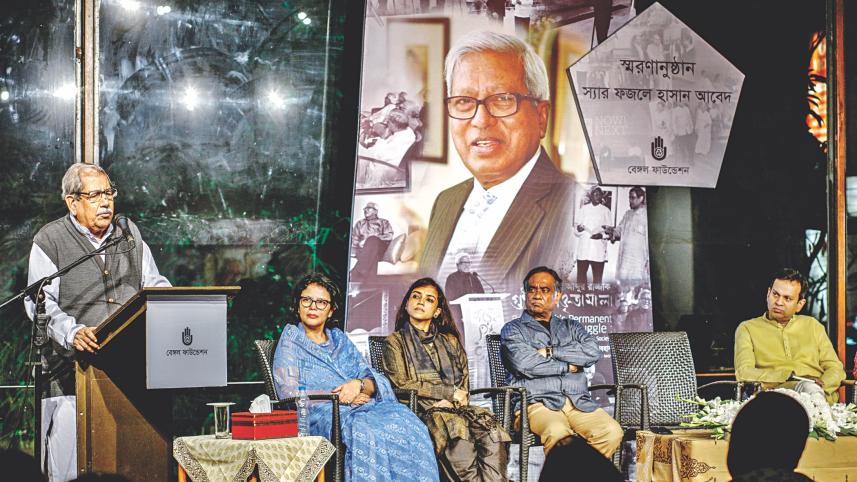
“There, he, without hesitation, said ‘I have been diagnosed with brain cancer; doctors have given me four months.’ I could say nothing but Oh! No,” said a bereaved Prof Anisuzzaman yesterday, speaking at a memorial programme arranged by Bengal Foundation at its premises in the city last evening.
At one point of the conversation, Sir Fazle told Prof Anisuzzaman that he had decided to not continue with medical treatment.
Two days later, Sir Fazle announced at a Brac trustee board meeting that he and Prof Anisuzzaman, who also had been with Brac since its early days, would no longer serve their posts in the trustee board.
At the event, eminent citizens recalled Sir Fazle’s illustrous life and his nearly five-decade visionary journey in the field of development, saying his initiatives were unmatched in Bangladesh and beyond, and those tremendously helped lift millions of people out of poverty.
Fazle Hasan Abed’s goal was to eradicate poverty and empower women, and for this he had chosen three different sectors -- education, health and employment, said Prof Anisuzzaman.
One of Sir Fazle’s greatest contributions is he made people believe in the notion that it is possible in Bangladesh to do something for the poor and destitute, and it can be done without government support, said Mahfuz Anam, editor and publisher of The Daily Star.
“This is tremendously important psychological shift to think that we can,” he said.
Now, the country has made significant progress in various social indicators and of course the government has its contribution behind this, Mahfuz Anam added.
However, non-government sector can also contribute in social development and it is actually capable of doing so -- such belief has been instilled in people’s minds by Sir Fazle, he said, terming Sir Fazle as a “constant visionary and relentless implementer”.
Sir Fazle was a unique personality in terms of setting vision and successfully implementing it, said Brac Executive Director Asif Saleh.
Bengal Foundation Chairman Abul Khair said one of lesser-known aspects of Sir Fazle’s personality is that he was an art connoisseur.
He had many rare and original pieces of artwork in his personal collection, said Khair.
Bangladesh Garment Manufacturers and Exporters Association President Rubana Huq proposed that her organisation together with Brac can arrange a memorial lecture series named after Sir Fazle.
The series can be held once in every three months and feature globally-acclaimed scholars to deliver lectures on various issues, she said.
Director of Brac’s Preventing Violence against Women Initiative Nobonita Chowdhury also addressed the event.
Comments