


Bangladesh needs to move up in global value chains through industrial upgrading

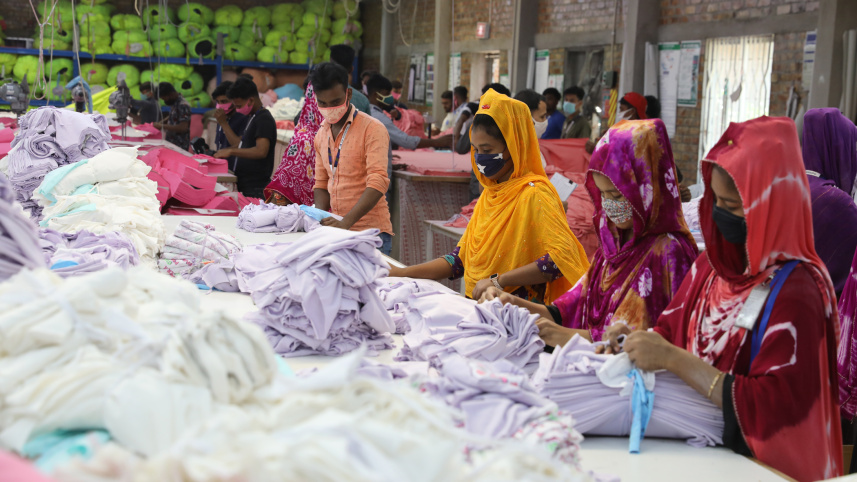
Bangladesh’s participation in global value chains remains narrow and concentrated in low-value segments. As the “Global Value Chains and Inclusive Development: Asian Development Policy Report,” published earlier this month, notes, the country’s garment-led model has delivered jobs, exports, and confidence. Yet the present form of participation may not be enough to sustain productivity growth, better jobs, technological learning, and export resilience. Bangladesh’s export story is still defined by millions of workers, mostly women, producing garments for global markets; a powerful achievement that now faces structural limits. The country is deeply embedded in the apparel chain but largely in its lowest-value stages; that is, cutting, making, trimming, and shipping. Much of the value is created elsewhere: in fibre development, design, branding, logistics, and retail intelligence. Bangladesh participates, but it does not yet exercise much influence over how the chain is organised.
The foundations of Bangladesh’s competitiveness, i.e., low wages, scale, and preferential access, are eroding. Wages have risen, preference margins will shrink after LDC graduation, while competitors such as Vietnam, India, Cambodia, and Indonesia are moving quickly. Buyers now demand shorter lead times, traceability, environmental compliance, smaller batches, and flexibility. The old formula of low-cost, high-volume production will not drive the next stage of transformation. This does not imply a push to move away from garments. RMG remains Bangladesh’s strongest industrial platform, with firms, workers, compliance systems, and global buyer relationships built over decades. The challenge is to use this base to move into higher-value activities while laying the foundations for a more diversified industrial economy.

Upgrading within garments must begin with textiles and inputs. Bangladesh still imports most woven fabrics, human-made fibres, chemicals, dyes, and machinery. Knitwear has stronger backward linkages, but woven garments remain dependent on imported fabric, which lengthens lead times, reduces flexibility, and weakens bargaining power. Competing in higher-value apparel requires capabilities in fabric development, synthetic and blended fibres, technical textiles, design services, and modern dyeing and finishing. Environmental management for cleaner energy, water efficiency, and effluent treatment must be integral to this upgrading. Product sophistication is another frontier. Bangladesh excels in producing basic T‑shirts, trousers, and sweaters, but there is a rising global demand for sportswear, outerwear, uniforms, medical textiles, recycled fibre-based clothing, and smaller fashion batches. These require skilled technicians, digital production planning, design capacity, quality assurance, and closer buyer communication. Firms must evolve from order-takers to problem-solvers.
The constraints are also institutional. Bangladesh lacks a dense ecosystem linking factories, engineers, designers, testing labs, logistics firms, universities, and regulators. Training is detached from industry needs, while research and development is still viewed as a luxury. Many factories operate efficiently inside their gates but face weak support outside: congested ports, uncertain customs, fragmented regulation, and high trade costs. Besides, diversification beyond garments is now essential. Bangladesh has long discussed it, but progress has been limited. The issue is not a lack of potential, as pharmaceuticals, agro-processing, leather goods, footwear, light engineering, ceramics, electronics assembly, shipbuilding niches, digital services, and renewable energy components all offer opportunities. The deeper problem is that the policy regime has not supported these sectors as consistently as it has RMG. While garments benefit from bonded warehouses, duty-free inputs, and predictable export procedures, other sectors face higher input costs, weaker logistics, limited testing capacity, and more complex regulations. This uneven landscape makes it difficult for non-RMG exporters to compete internationally.
Bangladesh, therefore, needs a broad-based industrial policy, not narrow incentives for a few sectors. A comprehensive strategy to build capabilities across the economy is essential. This includes tariff rationalisation, access to inputs at world prices, export finance, technology upgrading, industrial infrastructure, standards institutions, logistics reform, skills development, and support for small and medium enterprises (SMEs). Domestic market-oriented industries should be nurtured to create future exporters through gradual exposure to competition and integration into regional production systems. Meanwhile, industrial diversification will require wider ecosystem: reliable energy, serviced land, efficient customs, credible regulation, patient finance, and institutions that can solve coordination failures. Bangladesh must move beyond extending RMG-type facilities to a handful of “promising” sectors and instead build an industrial base that allows multiple sectors to learn and upgrade.
Regional production networks are another missing link. Unlike East and Southeast Asia, South Asia has not developed strong cross-border production sharing due to political mistrust, high tariffs, weak transport links, and cumbersome borders. Bangladesh could benefit from deeper ties with countries in South Asia, ASEAN, Japan, Korea, and China, not through uncritical openness but via strategic integration. Better regional links would allow firms to access specialised inputs, technologies, and markets, as well as enable SMEs to participate in supply chains they cannot reach alone.
Moving up value chains is also a labour challenge. The first generation of export success relied on low-skilled labour. The next phase requires skills in machine maintenance, quality control, digital inventory, industrial engineering, compliance documentation, merchandising, and production analytics. Supervisors and mid-level managers will be crucial. Policies must ensure that automation and upgrading do not displace workers without support. Technical and vocational education must be redesigned with industry input but not captured by narrow employer interests. Women workers must be supported to move into higher-skilled roles rather than being pushed out of the sector they helped build.
Sustainability pressures are rising. EU due diligence rules, carbon reporting, waste management, and circular fashion commitments will shape export prospects. While some factories have invested in green buildings, compliance must extend across dyeing, washing, packaging, transport, and recycling. Industrial policy must be linked to discipline: support tied to learning, productivity, environmental compliance, employment quality, and export performance, with incentives reviewed and withdrawn when ineffective. LDC graduation also adds urgency. Bangladesh must compete more on productivity, reliability, quality, and institutional credibility. The coming years should focus on trade negotiation capacity, customs and tariff reform, stronger standards institutions, expanded export finance, better industrial land management, and FDI that brings technology and market access rather than low-cost assembly.
Bangladesh has already proven that it can enter the world market. The harder task now is to move from assembly to capability, from preference dependence to competitiveness, and from one-sector dominance to a broader industrial base. The garment worker on the sewing line remains part of this future, but she should not remain at the same point in the chain, and neither should Bangladesh.
Dr Selim Raihan is professor of economics at Dhaka University and executive director at the South Asian Network on Economic Modeling (Sanem). He can be reached at selim.raihan@gmail.com.
Views expressed in this article are the author's own.
Follow The Daily Star Opinion on Facebook for the latest opinions, commentaries, and analyses by experts and professionals. To contribute your article or letter to The Daily Star Opinion, see our guidelines for submission.
 For all latest news, follow The Daily Star's Google News channel.
Comments