


Reclaim road width, footpaths to end perennial traffic choas
Reclamation of actual road width and pedestrian ways with enforcement of traffic management could bring about a significant improvement in the capital city's perennial traffic problem, said a leading civil engineer at a workshop in the capital yesterday.
 For all latest news, follow The Daily Star's Google News channel.
 The perennial traffic problem in the capital is mostly all about management failure, said Prof Jamilur Reza Choudhury, the noted civil engineer, while chairing the workshop on a revised strategic transport plan (STP).
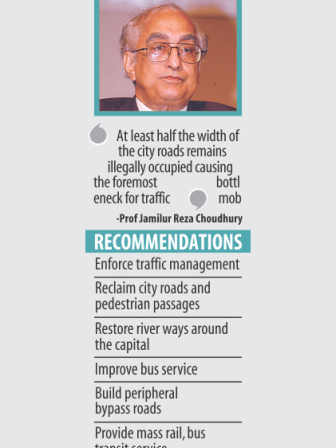
"At least half the width of the city roads remains illegally occupied causing the foremost bottleneck for traffic mobility in the capital," said Choudhury, who was an advisory committee convener on the existing STP for Dhaka city prepared in 2005.
Dhaka Transport Coordination Authority (DTCA) along with Japan International Cooperation Agency (Jica) organised the workshop at Cirdap auditorium on the final draft report of the revised 20-year STP for greater Dhaka city.
Small management interventions like reclamation of pedestrian passages and actual road width and route franchising instead of talking of only billion-dollar development schemes could bring about significant improvement, said Choudhury.
Restoration of the river ways all around Dhaka city and development of railway service are easy options for reducing Dhaka's traffic congestion significantly, he said, but none of those simple jobs capable of yielding high results could be done thanks to strong hindrance by powerful political quarters.
Besides, several transport schemes developed in the capital out of STP recommendations and without thorough analysis have been incompatible with various STP-proposed ones, he said.
Tamaoki Watanabe, team leader of the STP revision consultant, in his presentation, underscored the short term measures, including bus service improvement, building bypass roads, traffic management and enforcement, vehicle parking management and pedestrian way development, maintenance of traffic lanes and removal of obstruction from roads and sidewalks.
Satoko Tanaka, director for transportation, infrastructure and peace-building department of Jica, said the government should view Dhaka's eastern fringe as a preferential development area for diversion of population settlement with planned transportation development.
"And to do so, coordination with private developers is very vital for a planned urban development there," she said.
The revised STP has proposed five metro rails (mass rapid transit or MRT), two rapid bus service (bus rapid transit or BRT) systems, three ring roads around the city and six expressways. Construction of one MRT, one BRT and one expressway are underway.
While construction work of MRT-6 is set to begin in February, feasibility options of MRT-1 and MRT-5 are to soon follow with Jica assistance, said Road Transport and Bridges Minister Obaidul Quader.
Mega transport projects like MRT, BRT, expressways and the Padma bridge would hardly help change the traffic situation unless people change their behaviour, he said, if the lawmakers and ministers break the law by driving on the wrong side of the road, general people would not abide by it.
The route alignment of MRT-1 stretches from the Shahjalal international airport to Kamalapur through Kuril, Progoti Sarani and Rampura while that of MRT-5 stretches from Gabtoli to Bhatara across Mirpur, Kemal Ataturk Avenue and Madani Avenue.
The revised STP is to be finalised by December and is expected to have cabinet approval by March next, said the officials.
On another note, Obaidul said the government has taken "adequate security measures" to ensure safety of foreigners.
"I state this boldly and emphatically that full security is there and the foreigners have no reason to be anxious over security either at home or workplaces so that no development project is hampered," he said.
DTCA Executive Director Md Kaikobad Hossain and Jica Chief Representative Mikio Hataeda also spoke.
Comments