


Dinajpur craft export industry in decline
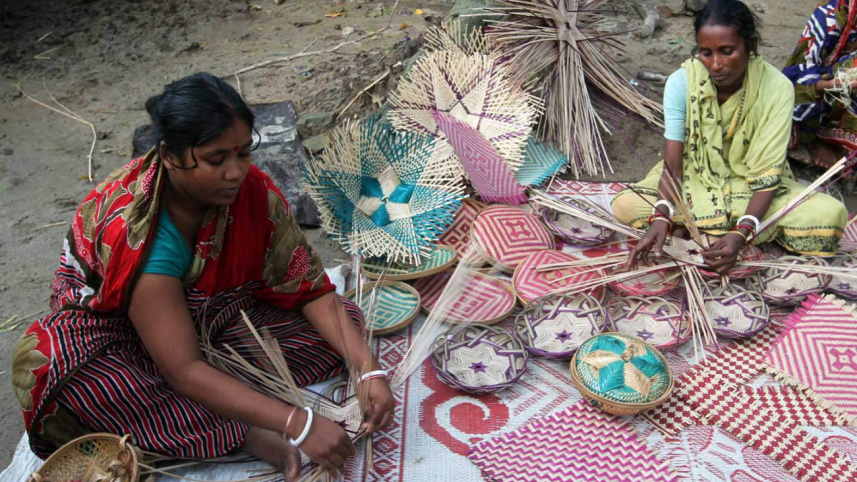
Dhirendranath Samanto, 64, of Purbo Basudebhpur village in Dinajpur's Phulbari, is proud of his business success. In 1977 after completing training with the Bangladesh Small and Cottage Industries Corporation he established a handicrafts concern. By 1982 he had achieved his first export, a bamboo tray to the United States. Subsequently Samanto exported traditional craft products to several countries including India, Pakistan, Japan and Germany.
Indeed he was not alone in his endeavours and rural villages in Phulbari became renowned for producing traditional baskets, rice winnowers, hand fans, tea trays, boxes and other items for domestic and decorative uses. Exporting traditional crafts became a mainstay of the area.

As is natural for many a small entrepreneur, Samanto believed he was building a future not only for himself but for future generations of his family and true to this goal, the business is now being run by his son Mohon. However, while overseas interest in traditional craft products is as robust as ever, the craft export industry is in decline.
"Recently my son cancelled an export order to Germany," says Samanto glumly, "The buyer wanted the goods as early as possible and we couldn't manage it." The problem facing Samanto and Mohon, a difficulty shared across the industry is a lack of skilled artisans.
"When I started the business," says Samanto, "it was easy to find artisans locally but in recent years there became fewer skilled people available. Nowadays the position is alarming."
Many workers have left traditional crafts in order to pursue more lucrative professions. While the German organisation in this instance hoped to receive the products within 3 months, with existing manpower the order would take 7 months to produce.
The Daily Star found that only 25 families in the village continue to work in craft manufacture, which many do as an expression of Bangladeshi culture and hobby, rather than as a chief income source.
Housewife Sarswati Rani who learnt artisan skills after her marriage is typical. "I work away at making something almost every day between household chores, so that at least I can help my husband a little."
Still others take to crafts only seasonally, to meet the increased local demand for traditional items that precedes Pohela Boishakh and other festivals. Without the logistics available to arrange export sales themselves, such household producers are paradoxically facing the problem of not finding enough buyers to warrant craft making outside festival times.
"We are trying to make new things, more creative designs that might better attract buyers," says artisan Milon Samanta, thinking of the local market.
Despite his son cancelling export orders that have become too large to handle, Direndhranath Samanto believes that across the country many do retain traditional craft manufacture skills. "If the government could help us to better access the international market with the smaller-scale production levels that are nowadays possible, then at the least our business could survive."
 For all latest news, follow The Daily Star's Google News channel.
Comments