


Rabindranath Tagore and the evolving spirit of Pohela Baishakh
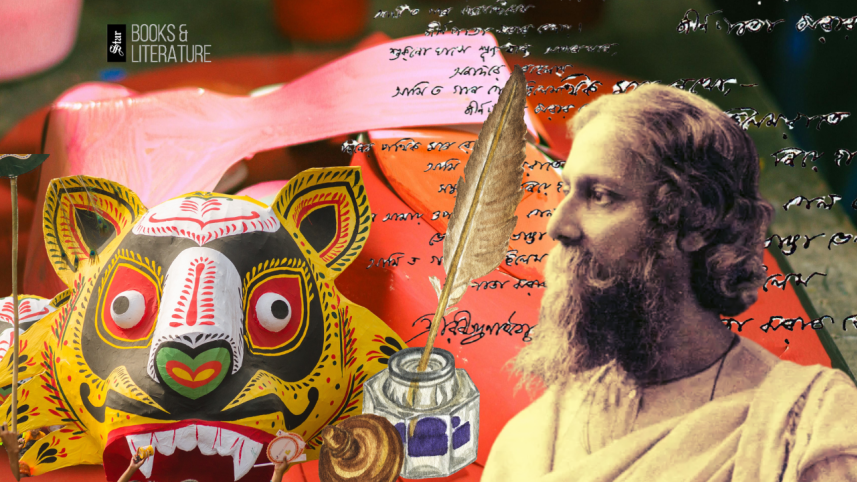
It is almost impossible to put Rabindranath Tagore aside and celebrate Pohela Baishakh. The most iconic song, “Esho He Baishakh”—the song every Pohela Baishakh programme starts with—was written by him. This attachment to Pohela Baishakh is not exclusive to Rabindranath, however. The whole Tagore family of Jorashanko Thakurbari had a wide reputation for their celebration of Baishakh, as writers such as Lila Majumdar and Chitra Deb inform us through their books, such as Kheror Khata (Ananda Publishers, 2000) and Thakurbarir Andarmohol (Ananda Publishers, 1952), respectively.
But it goes without saying that Rabindranath, as the most famous member of the Tagore family and one of the cornerstones of Bengali culture, is thoroughly intertwined with the most significant day of the Bengali calendar. His thoughts on Pohela Baishakh are complex and evolved over the years, alongside his own development as an artist and the changing societal circumstances, as can be seen through his three essays on this day.

Tagore associated Pohela Baishakh with his own views of spirituality, as evidenced by these essays. The essay “Noboborsho”, published in 1902 (1309 BY), can be found in his essay collection titled Dhormo (1908). In this essay, he celebrates God, exclaiming that the existence of the natural world and its beauty would not have been possible without divine intervention. The metaphor of the first sunshine of dawn as the blessing of God is written with brilliant eloquence. The optimism in his voice cannot be ignored—the reader is compelled to reignite the living part of their inner soul. In his still ongoing romantic phase, Rabindranath emphasised individuality, and this can be seen in his focus on the spiritual development of the individual.
In another essay, also titled “Noboborsho”, published around 1911 (1318 BY) and included in his essay collection known as Shantiniketan (Indian Publishing House, 1908), he echoes a similar sentiment. This essay was originally a prayer or sermon delivered at the ashram in Shantiniketan. Here, he is more cautious in his tone than in the earlier piece. He admits that he has failed to keep the pledges he made on Pohela Baishakh in previous years. Yet, it is the individual’s responsibility to make the year worthwhile and not retreat from the duty God has bestowed. In the final passage, he tells God, “God, I could not deliver you the message of victory. Yet, the war continues, and I will not withdraw.” This essay is more introspective, self-reflective, and sceptical, and as a result, less joyous and less optimistic. It reminds us of our fragile humanity. It is painful to accept that we were not able to fulfil every promise we made to ourselves, but it is only human, and we should allow ourselves the chance to begin again.
In these writings, perhaps what is noteworthy is the absence of the agrarian character of PohelaBaishakh. In its origins, PohelaBaishakh was an agrarian festival, held to facilitate tax collection and mark the beginning of the harvest season. The Tagore family in general, and Rabindranath in particular, were influential in giving PohelaBaishakh an urban character—akin to New Year celebrations in the West. Both of these essays emphasise his spiritual and mystic inclinations rather than political concerns. However, after events such as the Partition of Bengal, the First World War, the Swadeshi Andolon, and the Non-cooperation Movement led by Mahatma Gandhi, his writings became increasingly political. This shift is reflected in his third essay on PohelaBaishakh.
In his essay titled “Shobbhotar Shongkot”, published in 1941 (1348 BY), he adopts a sombre tone amid the unfolding Second World War. In this essay, he delivers one of his most succinct condemnations of imperialism and wars driven by imperial ambition. Yet, even within this grim tone, his optimism about a new and better world continues to shine.
He reminisces about being mesmerised by the fruits of British civilisation in his youth and his belief that India would be fully liberated through British education. He later regrets this belief. His youthful wonder was replaced by the harsh reality of British exploitation. He feels betrayed by the violence of the Second World War; the so-called European civilisation, once admired, reveals its brutality.
Interestingly, moving away from his earlier emphasis on individual development, he shifts his focus to power structures. In his earlier years, he would have placed responsibility primarily on the individual for social issues. Here, however, he writes, “The danger is that our society will be blamed for this crisis (communalism). Yet, this shameful, uncivilised situation of Indian history would not have occurred if this unfolding crisis had not been manufactured by a secret centre above the ruling state of India.” He also notes that British exploitation of the Indian subcontinent would result in fragile independent states and questions how India would survive. Despite everything, he expresses hope for a new dawn that would mark the beginning of an era of human dignity. The spirit of Pohela Baishakh, the Independence of India, and the end of the Second World War become intertwined in this essay through themes of renewal.
Almost 85 years later, this essay appears strikingly relevant. Only this time, the United Kingdom has been replaced by the United States. The image of American civilisation as a bastion of freedom has been challenged by its invasions of Iraq and Afghanistan, as well as its continued support for global conflicts. Divisions continue to be sown across humanity in the name of religion and ethnicity. International law and order seem increasingly ineffective in the face of such injustices, much like British law during colonial rule. When existing systems of justice fail, resistance begins to appear as a moral necessity.
In this Pohela Baishakh of 1433, Bangladesh finds itself in a similarly complex moment, facing both internal and external challenges. Yet, life continues. Celebration continues. This Pohela Baishakh, too, carries Tagore’s spirit—acknowledging harsh realities while continuing to stand firm. “It is a sin to lose faith in humanity,” said Tagore, and we must not commit that sin.
Shubho Noboborsho!
Sadman Ahmed Siam, as the name suggests, is indeed a sad man. Send him happy quotes at: siamahmed09944@gmail.com.
 For all latest news, follow The Daily Star's Google News channel.
Comments