The real gore is hunger

Certain childhood memories remain preserved not as narratives, but as sensory ambushes.
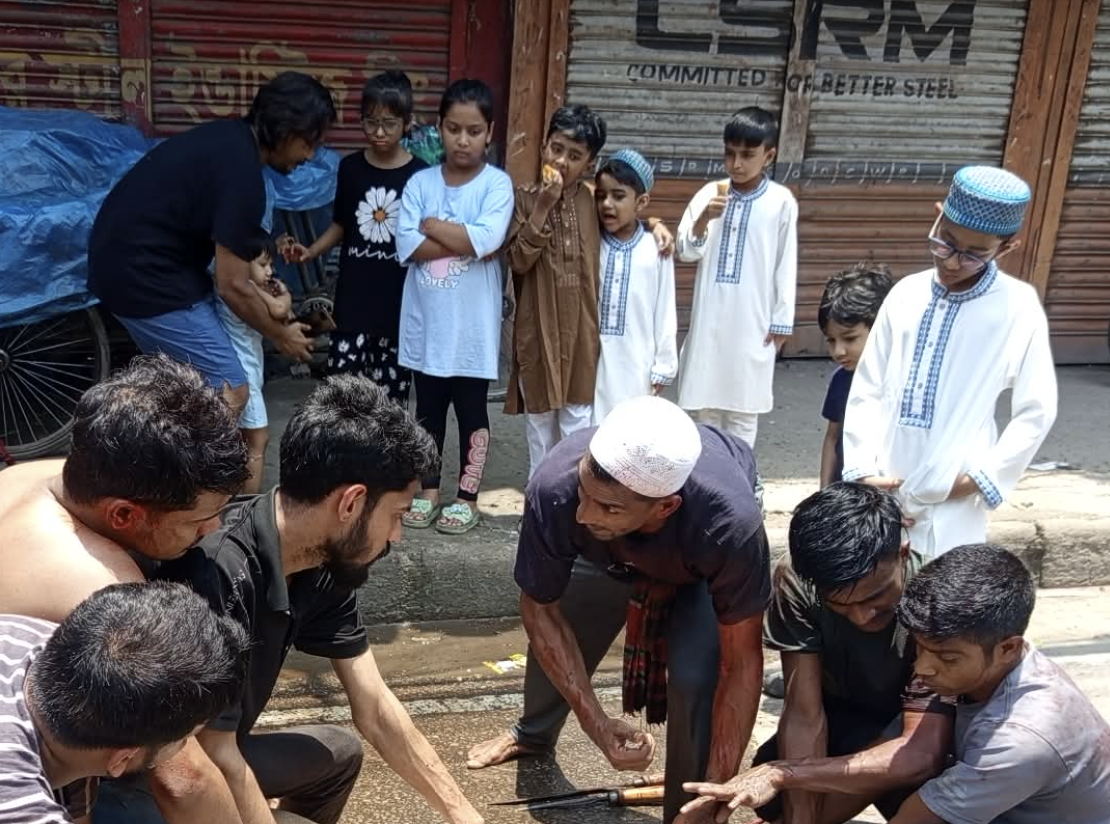
The metallic smell of fresh blood, the wet slap of water thrown onto crimson pavements, the guttural cries of cattle moments before silence overtook them. Men with rolled-up sleeves, tank tops and ceremonial bravado. Children gawking with the macabre curiosity only they possess, as if gore were some carnival of initiation into adulthood.

Eid-ul-Azha, for many, arrives swaddled in the vocabulary of festivity. For me, it first arrived as terror.
As a child, I would perform the rituals expected of me with mechanical obedience -- Eid prayers, embraces, perfunctory smiling. Then, almost immediately, I would flee -- to my now-late grandmother’s bungalow. Her home stood curiously insulated from the theatre of slaughter unfolding across the town. No cattle tied to gates. No drains running red.
Her own qurbani would be carried out at our house alongside the many animals sacrificed for the extended family, which meant her home remained untouched by the “crimson carnival” that so unsettled me.
And so I ran there every Eid-ul-Azha morning -- driven partly by refuge, partly by appetite. My Nanujaan was a great cook who put care into the craft, as well as inheritance that stretched across the subcontinent – Karachi, Kolkata and Dhaka.
But more than the dishes, hers was a sanctuary from the world.
I realise now that childhood often mistakes retreat for cowardice when, in truth, it is sometimes merely an instinct for self-preservation.
The irony, however, is that adulthood offers no such sanctuary.
My grandmother passed away nearly two decades ago. The bungalow survives only to serve as melancholy’s monolith. And the thing I hide from today is no longer just blood.
Human beings possess an alarming capacity to normalise almost anything through repetition. The gore no longer horrifies alone as it once did. What unsettles me now comes afterwards.
The crowds.
Their waiting.
And the wanting.
One sees people thronging outside homes, alleyways and makeshift slaughter points with an urgency that is difficult to describe without sounding cruel. Nothing performative. Nothing cinematic, just the computation of survival, and hopes of having something better.
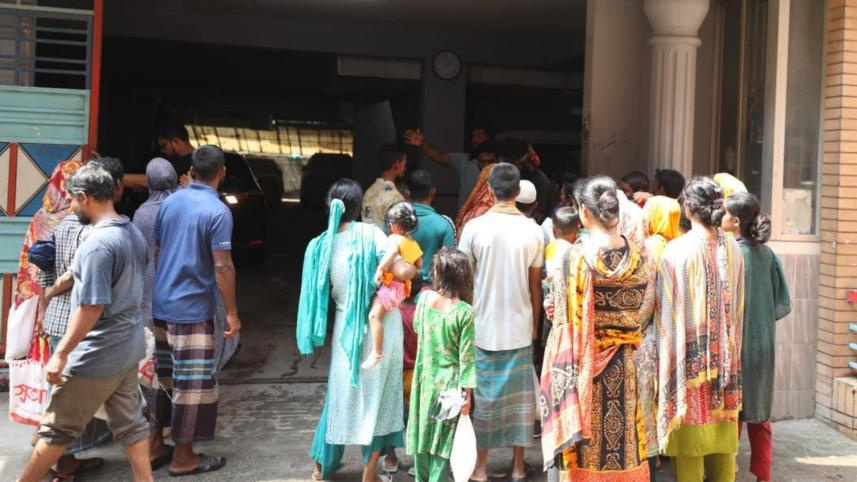
For many, this is the only time in the year they get to eat meat. Eid-ul-Azha does not only function as a religious occasion in Bangladesh and across much of South Asia, it becomes an annual redistribution mechanism in societies where protein itself has become stratified by class.
The grotesque contrast reveals more about the socioeconomic paradigm of our societies than any policy paper or poverty index ever could.
There are families who do not even consume the meat they collect. They sell it.
 For all latest news, follow The Daily Star's Google News channel.
 Desire becomes negotiable when survival enters the room. Nutrition gives way to rent. Taste bows before medicine costs. Celebration is pawned for continuity.
That is the true violence of poverty -- not merely deprivation, but the perpetual coercion of sacrifice. The poor are constantly sacrificing things the wealthy romanticise. Appetite. Dignity. Leisure. Preference. Choice.
Modern inequality has created another kind of sacrifice altogether -- the involuntary surrender extracted daily by economic precarity.
And nowhere does this become more visually conspicuous than on Eid-ul-Azha.

Bangladesh, like much of the developing world, has mastered the aesthetics of growth while failing to dismantle the infrastructure of deprivation. There are people discussing artisanal coffee notes in one neighbourhood while, a few kilometres away, others calculate whether selling their share of sacrificial meat can buy cooking oil for the week.
The annual spectacle around meat collection also exposes another uncomfortable truth -- charity, while necessary, can sometimes become theatre for the conscience of the privileged.
One does not doubt the sincerity of many who give. But sincerity alone does not absolve structural failure.
A society cannot perpetually survive on ceremonial compassion compensating for institutional inadequacy.
And perhaps that is why I still hide away during Eid – not just from slaughter anymore, but from confrontation. From the unbearable awareness that one occupies relative comfort in a country where millions perpetually negotiate scarcity. From the guilt that arrives uninvited while carrying plates heavy with food. From the recognition that while one debates seasoning, someone else negotiates with survival.
The child in me fled gore, the adult tries to flee helplessness. Except there is nowhere to run now.
And so, these days, I bury myself in work instead.
Busyness becomes camouflage. Anything to avoid lingering too long before the moral mirror Eid-ul-Azha now holds up before me.
Because the tragedy of growing older is realising that the real gore was never the blood on the streets.
It was the hunger beneath it all along.

Toronto film festival opens with 200-plus films and major stars

Stars take social media back to the ’80s and ’90s

Apurba-Niha pair reunite on screen after a break

Nirvana to receive Video Vanguard Award at 2026 MTV VMAs
‘Drishyam: The Conclusion’ trailer pits Ajay Devgn against Jaideep Ahlawat

Drishsho Madhyam Shilpi Shomaj condemns attack on Badhan, demands fair investigation
Hot take / If the 1980s and '90s were so great, who built the present?
Bangladeshi documentary ‘Pankauri’ selected for Delhi’s River Festival