


When fanfiction swapped out fans for publishing deals
It sounds flippant to put it that way but, the Aeneid, at its core, really is a continuation fic—picking up where Homer’s Trojan War ended and following Aeneas, a minor character in the canon, as he stumbles through an entirely new narrative along with original characters and incredibly expanded lore. Cut to a few centuries later, an earnest Virgil fan decides to take it one step further by adding himself into the story, and effectively writing what might be history’s first self-insert fic: Dante Alighieri’s Divine Comedy.
 For all latest news, follow The Daily Star's Google News channel.
 Part of what made fanfiction so special was that shared intimacy of being able to exist in a space so obsessively and still be met with a similar enthusiasm, and in my own selfish way, I’m glad some of its best versions never left that place.
But we don’t think of Virgil or Dante when we think of fanfiction. Instead, their works are “derivative” or “revisions”. Why?
Because for as long we have been alive, stories have been told and retold and passed along without much concern for originality because, copyright as we understand it today, was not how it always used to be. But once intellectual property became something that could be owned by a person or a corporation, that line between “derivative work” and “fanfiction” changed as well. If Virgil were to borrow from Homer today, it would not be without legal consequences.
So, how does fanfiction manage to operate within that grey area?
Fanfiction, as it exists today, mostly does so because of the unspoken argument that you cannot profit from it. You can write as many Harry Potter spinoffs as you please, pick up where Sherlock Holmes left off, fix-it-fic the ending of your favorite franchise—but it only exists in this online space where the reward is typically nothing more than adoration from other fans. Or at least, that used to be the rule.
Before it became a pipeline to publishing deals, fanfiction lived quietly within the margins of the internet—forum entries, Wattpad and fanfiction.net, tumblr blogs, AO3. It was not the industry it is today. What is currently often referred to as a genre, started out so many degrees outside these usual circuits of value that it felt more like a place we all went to together. You knew people only by their online handles. Feedback was hits, bookmarks and kudos, and recognition (if it came at all) was from quiet obsession; not royalties or six-digit Netflix deals.
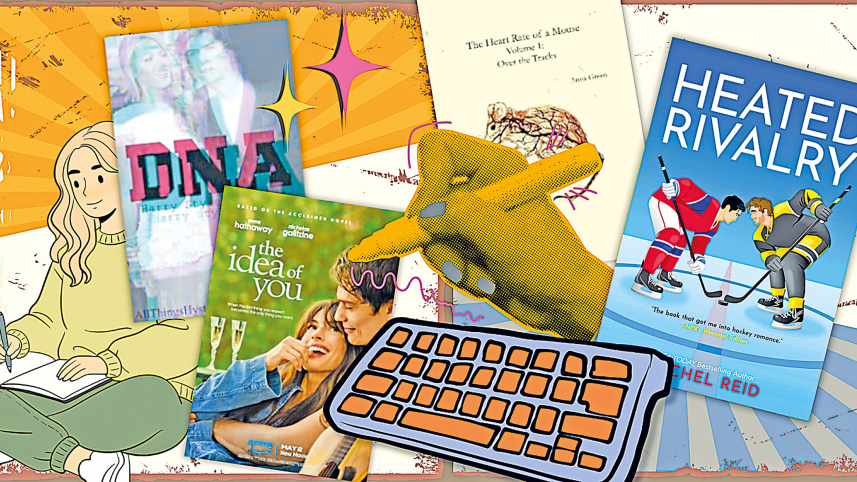
One of the most formative pieces of literature I’ve encountered came from an old, culturally defunct website, LiveJournal, titled—The Heart Rate of a Mouse, or colloquially THROAM (throw-am): a 1970s AU slashfic about Brendon Urie and Ryan Ross of Panic At The Disco, with a rotating cast of early-2000s emo heartthrobs—and even a brief, glittering cameo from a glittery-eyeshadowed David Bowie himself.
What I remember most is the sheer scale of it—just this endless scrolling that never seemed to stop. First published in 2009, the fic ran over half a million words across three volumes, written by someone who was probably as old as I was when I found it at 16. And it didn’t make sense to me. How could something this expansive, this good just exist on a website like this? For free? With no real expectation of anything beyond people reading it?
Between the fan-made art, merch, and a small stint in self-published copies for sale by the author, none of it translated into what we’d recognise as a career. The author stayed a username (beggarsnotes) and the fic to this day only exists archived on the internet. But over the past decade, many stories that begin on similar platforms have been reworked into traditionally published novels, some even snapped up by major houses for film and television deals. This trajectory is now consistent enough to be a formula that promises good output: a fanfic gains a cult following, the names and the plot gets filed off, and what once circulated (free of cost) among fans is repackaged as new IP. The success of Fifty Shades of Grey—originally a Twilight fanfiction—effectively opened the floodgates for this model, and the examples have only multiplied. In one decade, publishers and studios have switched to actively scouting this for their platforms.
After, which began as a One Direction fanfic, was spun into a full-fledged film franchise. The Love Hypothesis started life as a Star Wars sequel trilogy “Reylo” fic. The Mortal Instruments was originally a Draco Malfoy “Dramione” trilogy by Cassandra Clare. Heated Rivalry, the hockey romance on everyone’s roster this year reportedly began as a Steve Rogers/Bucky Barnes AU on AO3 before being pulled, reworked, and relaunched. The Idea of You is another book-to-movie adaptation in this sage that carries the unmistakable DNA of Harry Styles fanfics. Even Red, White & Royal Blue, the glossy Amazon Prime production has a lot of conjecture surrounding its supposed origins back to a Jesse Eisenberg/Andrew Garfield fic inspired by The Social Network.
But of course, the caricature of pre-teen girls writing self-indulgent romances about boy bands, or the more convenient exhibit of Fifty Shades of Grey as a kind of infallible proof that fanfiction is embarrassing, cringe, and not “real” literature is still a really popular idea, even though both parties know that it flattens the vast range of what fanfic really is. Because certain forms of excess, especially when it comes to young girls liking something, has always been easy to dismiss, even when history is full of works that adapt this similar act of borrowing.
In her 2018 essay, “The Bodies of the Girls Who Made Me”, Seanan McGuire points out this obvious double standard. Fanfiction has historically been a space far outnumbered by women and queer writers and part of it was to accommodate a specific lack of representation that was often left out in the original canon. The human desire to expand on narratives, to want to see themselves in a story has always existed. But when men engage in similar acts of transformation, it’s derivative, and a homage, but when women do it, it’s unoriginal and just fanfiction. And there’s a particular kind of dismissal that attaches itself to that because the argument regarding lack of originality is just categorically untrue (I once came across a James Bond AU in which everyone worked at a grocery store, which, if anything, is excessively original).
And that’s where I start to hesitate. Because there is something undeniably significant about good writers finding wider audiences and being taken seriously, being paid—it would be disingenuous to ignore that. But even as fanfiction is finally being taken seriously it still carries the weight of that same dismissal. It’s valuable, but only after it’s been reshaped and sanitised to be more palatable to a system that never quite respected it to begin with.
I would love for some of my favorite writers from that era to reach the visibility they deserve. But I’d be lying if I said I wasn’t also a little relieved that a million-dollar company hasn’t ultimately managed to get its grubby hands on something like THROAM. Part of what made fanfiction so special was that shared intimacy of being able to exist in a space so obsessively and still be met with a similar enthusiasm, and in my own selfish way, I’m glad some of its best versions never left that place. And I’m not sure a Netflix exec would ever take the time to learn how to package the thrill of that experience without tainting all the important parts.
Arshi Ibsan Radifah is a Literature major who loves unreliable narrators and Wes Anderson movie sets. If she had it her way she would have liked to play bass for a girl band in the 90s, but for now she’ll suffice by rewatching Empire Records.
Comments