


Cash aid for extreme poor


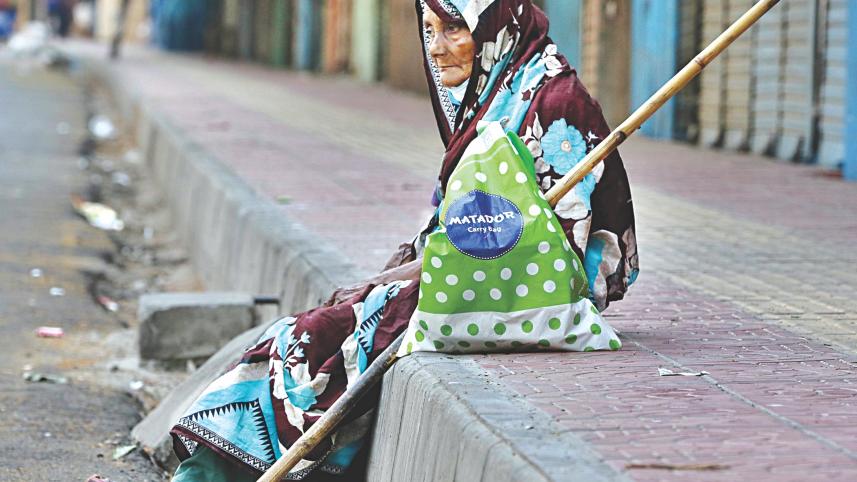
The government is set to unveil its third stimulus package soon, offering cash aid to poor families that have been hit hard by the ongoing shutdown amid coronavirus scare.
It plans to transfer between Tk 2,000 and Tk 3,000 a month to each of 34 lakh poor families across the country through mobile banking. The aid will continue for three months starting from April, said officials of the Prime Minister's Office and the finance ministry.

The stimulus package will also include a scheme -- between Tk 5,000 crore and Tk 10,000 crore -- to help farmers boost crop production, they said.
Finance ministry officials said they plan to provide growers with farm loans at 3 percent interest against the existing rate of 9 percent.
"Prime Minister Sheikh Hasina is likely to announce the third stimulus package later this week as part of measures to safeguard the most vulnerable segments of society," a top official at the PMO told The Daily Star.
Hasina on March 25 announced a Tk 5,000 crore package for paying wages and allowances of workers and employees of export-oriented industries.
Later on April 5, she unveiled a Tk 67,750 crore stimulus package to offset the impact of the coronavirus pandemic.
Under the third package, if Tk 2,000 is provided monthly to each of the poor families for three months, the government would need around Tk 2,040 crore. But if the amount is Tk 3,000 per month, it would need Tk 3,060 crore, said officials.
"We plan to send the money to vulnerable groups through mobile phones. We will select them through mobile phone tracking and send the money. We have already talked to three large mobile phone operators, and they gave positive feedback…," said a top official at the finance ministry.
Officials said the vulnerable segments include rickshaw and rickshaw-van pullers, transport workers, construction and hotel workers, street hawkers, agricultural and day labourers, porters and domestic helps.
They said the aid programme would be run taking into consideration the Census of Slum Areas and Floating Population 2014, conducted by Bangladesh Bureau of Statistics.
The survey shows there were around 5.95 lakh households in 13,935 slums across the country at that time.
The government plans to transfer cash to 34 lakh poor families as the number of such households in the slums may have increased in the last few years, and there are poor families outside the slum areas as well, mentioned the officials.
Of the slum dwellers, 16.80 percent were rickshaw or rickshaw-van pullers, 14.35 percent garment workers, 14.33 percent were in the service sector, 8.27 percent porters and day labourers, 8.38 percent construction workers, 6.94 percent transport workers, 2.82 percent hotel workers, 2.85 percent domestic helps, and 1.40 percent street hawkers and others, according to the census.
Low income people, especially rickshaw-pullers, domestic helps and day labourers, have already been hit hard by the ongoing shutdown as they have no work.
Yesterday, the ongoing nationwide shutdown was extended till April 25.
Earlier, the government announced closure of all public and private offices from March 26 to April 4, asking people to stay indoors and maintain social distancing. It was later extended till April 14.
Zahid Hussain, former lead economist at the World Bank's Dhaka office, said that without a minimum social assistance, the vulnerable and those who live a hand-to-mouth existence will have no choice but to defy orders.
The finance ministry needs to play a major role in providing cash assistance to the target groups, taking the help of other relevant ministries, parastatal organisations, NGOs and mobile financial services providers, he mentioned.
"While testing, testing and testing is the key to fighting Covid-19, governance, governance and governance is the key to delivering assistance to the poor and the vulnerable.
 For all latest news, follow The Daily Star's Google News channel.
 "Justifiably, one may worry about the impact on the prices of essentials after the cash transfers kick in. Inflation generally should not be a concern in the present context if the reliance on deficit monetisation is strictly restricted to the duration of the emergency measures linked to the health crisis," Zahid pointed out.
"What would be important is to ensure that the supply chains of essentials remain functional and the stocks of essentials available in the local markets are adequate. There is an overall contraction in domestic and export demand any way.
"The key priority to focus on now is the mitigation and containment of the virus spread, the consequent deepening of poverty and the specter of hunger," he added.
In an article published in an Indian newspaper recently, noted economists Abhijit Banerjee and Esther Duflo, who won the Nobel Prize last year, called for bolder direct benefit transfers to deal with the coronavirus crisis that has left India's poor in the lurch.
"Be much, much bolder with the social transfers schemes. Without that, the demand crisis will snowball into an economic avalanche, and people will have no choice but to defy orders," the duo said.
Their comments came days after the Indian government on March 26 announced a $22.6 billion economic package to ensure that no one goes hungry during the nationwide coronavirus lockdown.
Indian Finance Minister Nirmala Sitharaman said the government would provide food rations and cash transfers for three months to take care of "the welfare concerns of poor and suffering workers, and those who need immediate help".
Earlier on March 24, the Pakistan government announced a rescue and stimulus package involving Rs 1.13 trillion to support various segments of society.
Of the amount, Rs 200 billion were allocated for the labour force and Rs 150 billion for vulnerable families.
Comments