


Marriage age to remain 18
The government is mulling over ways to deal with the issue of marriage of girls aged between 16 and 18 in special cases such as elopement and unwanted pregnancy, State Minister for Women and Children Affairs Meher Afroze Chumki said yesterday.
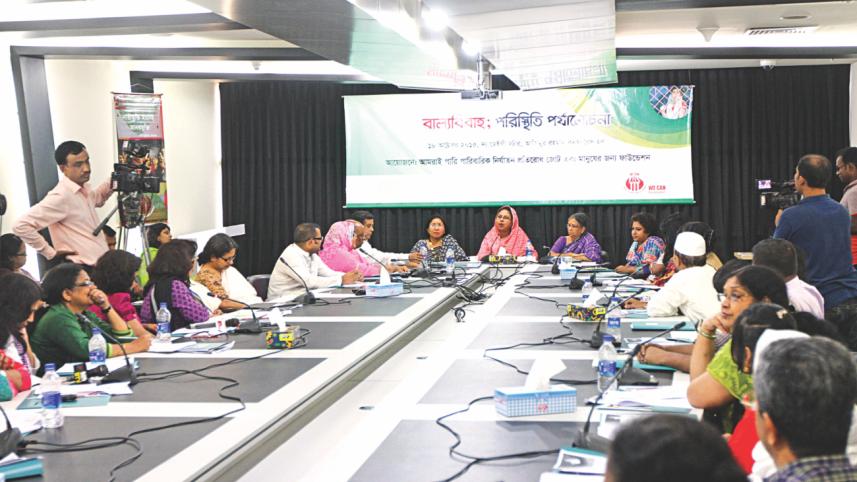
Not allowing registration of marriage under such special circumstances would make a girl's future uncertain, she said at a discussion, organised jointly by Manusher Jonno Foundation and We Can, an alliance of civil society and organisations to end domestic violence, at The Daily Star Centre in the capital.

The state minister, however, reassured that the minimum age of marriage for girls would remain 18 in the upcoming Child Marriage Restraint Act, and the government wouldn't enact any law that would have a negative impact on the lives of women.
Too much debate on the issue made general people think that the minimum age of marriage for girls would be 16 under the new law, she said at the discussion titled "Child Marriage: Review of the Situation".
"I request you not to say this even once. It [the minimum age] was 18 years and it will remain 18," she said.
Shaheen Anam, executive director of Manusher Jonno Foundation (MJF), observed that laws are not enacted to accommodate exceptions.
She pointed out that the Children Act 2013 defined all Bangladeshis aged below 18 as children. "Therefore, marriage of anyone below the age of 18 would be a child marriage."
Referring to Section 18(4) of the 2014 draft of the upcoming law, which states boys aged above 18 and girls above 16 can marry with the consent of parents and court, human rights activist Sultana Kamal said, "We humbly request the government not to keep any such sub-clause in this law."
Though law alone cannot stop a crime or practice, it provides a protection against such incidents, said Sultana Kamal, also chairperson of We Can.
"We expect the state to save us from a more dangerous situation by performing its duty of legal protection," she added.
Abul Hossain, project director of Multi-Sectoral Programme on Violence Against Women, said a government survey found that besides Imams and Kazis (marriage registrars), other people conduct marriages in the country.
"They are mostly Madrasa teachers." The government plans to run an awareness campaign for these groups of people for preventing child marriage, said the head of the project under the women and children affairs ministry.
In reply to a query from Argentina P Metavel, country representative of the United Nations Population Fund, on the status of National Action Plan to End Violence Against Women and Children, he said the plan would be finalised this year no matter whether the proposed law is passed or not.
Tariqul Islam, secretary to the social welfare ministry, said the draft of the law has been lying with the law ministry for the last two years.
The draft should be sent to the cabinet as quickly as possible for approval so that it can be placed before parliament, he said.
Once it is tabled in the House, civil society and rights organisations will have the opportunity to give their opinions on the law, said Tariqul, also former secretary to the women and children affairs ministry.
UNFPA Country Representative Metavel said child marriage cannot be a way to protect girls from sexual harassment, as many parents often reason.
"We don't want to see them abused on the streets, so we marry them off to be abused behind the walls!" she exclaimed.
An analysis of the 2014 draft of the proposed law by advocate Farida Yeasmin and a MJF study on perception of early marriage by Banasree Mitra Neogi were presented at the discussion.
A documentary by Shabnam Ferdousi on bad effects of child marriage was also screened.
 For all latest news, follow The Daily Star's Google News channel.
Comments