


Fund crunch squeezes free medicines for poor

Key points:
- Funding gap disrupts NCD services in many upazilas
- At least 26 upazilas are rationing medicine due to shortage
- Tk 100 crore sought for procuring medicine in mid-March
- Gains in hypertension, diabetes control at risk
Mihura Begum, a 35-year-old homemaker, recently visited Keraniganj Upazila Health Complex in Dhaka for a routine diabetes check-up, expecting to get her monthly supply of free medicines from the facility’s Non‑Communicable Disease (NCD) Corner.

After completing her tests, she was given just a single strip of medicine.
“They used to provide medicines for the entire month. This time, they gave me only one strip, saying there is a shortage,” said Mihura, a resident of Boalkhali village in the upazila.
“The strip will last only five days. I spent Tk 100 on rickshaw fare. It will be difficult for me to buy the rest of the medicine.”
Moslem Uddin, a hypertension patient from Bamansur village, faced a similar situation.
“I used to get medicines for a month. Now they give me medicines for only 10 days. I will have to buy the rest from a pharmacy. This facility gave me some relief, but the [medicine] shortage has put me in trouble,” said 70-year-old Moslem, who has been receiving services at the NCD Corner since February 2023.
Thousands of patients across Bangladesh are in a similar bind. NCD corners -- dedicated points at every upazila health complex where health workers check blood pressure and blood sugar and dispense five types of free medicines -- are running short of supplies due to a funding crunch.
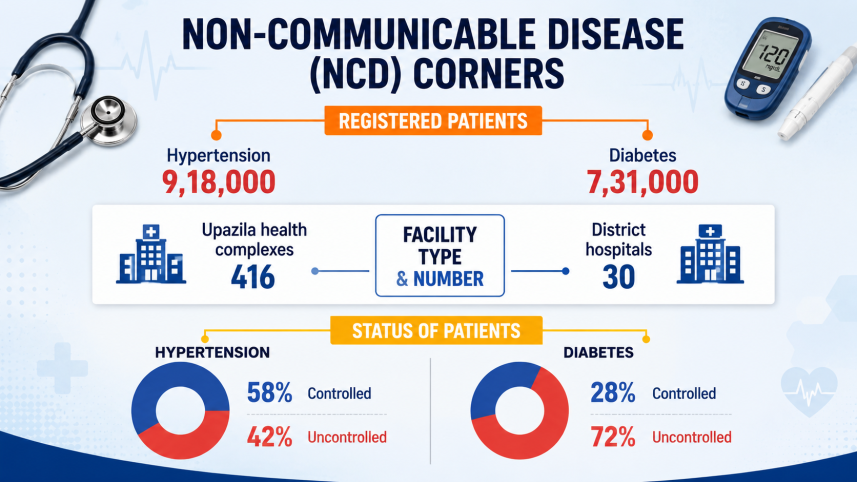
As of March, 9.18 lakh patients with hypertension and 7.31 lakh diabetic patients were registered at these corners. Of them, 58 percent of hypertension patients and 28 percent of diabetic patients have their conditions under control, according to the Directorate General of Health Services (DGHS).
The DGHS launched the NCD corner programme in 2018 and now runs the services at 416 upazila health complexes and 30 district hospitals.
Though the health directorate does not have exact figures on how many NCD corners are affected, information collected from eight upazila health complexes in different districts shows that most are struggling with shortages. This correspondent learnt from health officials that at least 26 such facilities are unable to provide a month’s supply of medicines to patients.
In a letter to the health ministry on March 16, the DGHS sought Tk 100 crore in emergency funding, mentioning that its stocks would be exhausted in 60 days. Since then, 50 days have passed but the request has yet to be fulfilled, said officials.
Health officials warn that the disruption may raise out-of-pocket costs for poor patients, forcing many to discontinue treatment. It may also undo years of progress by increasing the risk of life-threatening complications due to interrupted medication.
Talking to The Daily Star on April 23, Prof Halimur Rashid, director (disease control) of the DGHS, said the suspension of a sectoral programme is behind the current crisis at NCD corners.
“I cannot say exactly how many NCD corners are facing a shortage of medicines, but there is definitely a problem,” he said, adding that chances are low that the DGHS will receive the Tk 100 crore allocation as requested.
He further said the government is likely to increase funds for hospitals in the next budget, instead of providing block allocations, so that they can procure medicines on their own from July.
Asked if the situation might worsen, Halimur downplayed its gravity. He said around 70 percent of patients with hypertension and diabetes already buy medicines on their own, and the disruption in NCD corner services would push that figure up by at most 5 percent.
When contacted on April 22, Health Secretary Quamruzzaman Chowdhury said, “We will certainly take steps to mitigate the crisis if there is any.”
A PROGRAMME UNDER STRAIN
 For all latest news, follow The Daily Star's Google News channel.
 Hypertension and diabetes are among the most prevalent non-communicable diseases in Bangladesh, accounting for over 70 percent of all deaths.
In 2018, the DGHS launched a programme to establish NCD corners at upazila health complexes. Staffed by a three-member team, including a medical officer, each corner provides five types of medicines free of cost. Initially introduced in four upazilas in Sylhet, the programme has since expanded to 416 upazila health complexes and 30 district hospitals.
In a report published in September last year, the World Health Organisation (WHO) praised the programme for “demonstrating a strong and scalable impact in improving hypertension management and control”.
Between October 2018 and June 2024, 56 percent of 5.17 lakh treated patients achieved blood pressure control at the implementing facilities, said the Global Report on Hypertension 2025.
The programme was previously operated under the Non-Communicable Disease Control (NCDC) programme, a component of the Fourth Health, Population, and Nutrition Sector Programme (HPNSP), which expired in June 2024.
In March last year, the interim government scrapped the proposed Fifth HPNSP, deciding instead to take up projects to complete unfinished work under the previous programme.
In the absence of the programme and any new project, medicine shortages began emerging at the NCD corners in early 2025. An allocation of Tk 100 crore in August last year provided temporary relief, but the crisis resurfaced after the programme was excluded from projects approved in November last year, and no regular revenue budget was allocated for medicine procurement.
The shortage of diabetes testing strips is particularly acute, with no procurement in the past two years.
SITUATION ON THE GROUND
This correspondent contacted officials of eight upazila health complexes, six of which reported shortages.
Officials from Shailkupa (Jhenaidah), Zakiganj (Sylhet), Banaripara (Barishal), Boalkhali (Chattogram), and Lauhajang (Munshiganj) confirmed supply problems, while those from Akhaura (Brahmanbaria) and Badarganj (Rangpur) reported adequate stocks.
In Keraniganj, 2,781 hypertension and 2,724 diabetic patients are registered with the upazila health complex, and 130-190 patients visit it every day.
Upazila Health and Family Planning Officer Abdul Mokaddesh said they are currently providing medicines for only 10 days instead of a full month due to shortages.
He warned that if the supply disruption continues, there could be a fall in the blood pressure control rate of 56 percent among treated patients.
“We don’t know when we will receive fresh supplies,” he said on April 20.
A DGHS official involved in the programme said health complexes in Sylhet, Chattogram, and Barishal divisions are facing significant shortages of medicines. Patient numbers are higher in these divisions compared to others because NCD corners were launched there at an early stage of the programme.
Prof Sohel Reza Choudhury, the head of Epidemiology and Research at the National Heart Foundation Hospital and Research Institute, warned that supplies in most upazilas will run out within a month.
The National Heart Foundation provides technical support, drug forecasting, training for health workers and application-management assistance to 327 NCD corners across 47 districts under Bangladesh Hypertension Control Initiative.
“We have urged the health authorities to provide another block allocation immediately,” he told this newspaper on April 22, adding that the disruption will hit low-income patients the hardest and jeopardise Bangladesh’s target of achieving hypertension control in 65 percent of patients.
Comments