


United Healthcare performs Bangladesh's first robotic surgeries
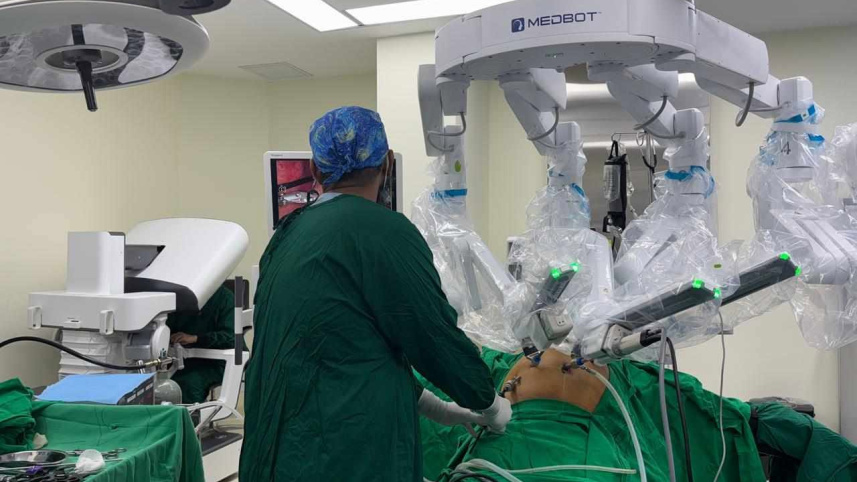
United Healthcare successfully performed what it described as the country’s first-ever robotic surgery today, marking a milestone in the use of advanced technology in Bangladesh’s health sector.
Two procedures were successfully performed using a state-of-the-art Medbot Toumai Endoscopic Surgical Robot at United Healthcare in United City on Madani Avenue, doctors involved in the procedures said.

“This is a milestone. We have become a part of the transformation,” said Prof Rafiques Salehin, chief consultant and head of the Department of Surgery at United Medical College Hospital.
He led a team that performed a robotic cholecystectomy, a procedure to remove gallstones from the gallbladder, on a 57-year-old man.
Later, Prof Samsad Jahan Shelly, senior consultant and head of the Department of Obstetrics and Gynaecology at the hospital, performed a robotic hysterectomy, a procedure to remove the uterus, on a 45-year-old woman suffering from abnormal uterine bleeding.
Speaking to reporters after the first procedure about its benefits, Prof Rafiques said the robotic arms can move through 360 degrees, overcoming the limitations of the human hand and enabling exceptional precision in confined spaces.
“This allows for greater protection of blood vessels, minimal invasiveness, significantly less bleeding and faster patient recovery,” he said, adding that the patient who underwent the surgery would be discharged in a day or two.
“Robotic surgery is particularly helpful for complex, major and cancer surgeries, where precise selection of the surgical area is crucial,” he said.
Asked about the cost, Prof Rafiques said robotic surgery is relatively expensive, costing around two to three times more than conventional surgery. However, the cost is expected to come down as its use increases in the coming days, he said.
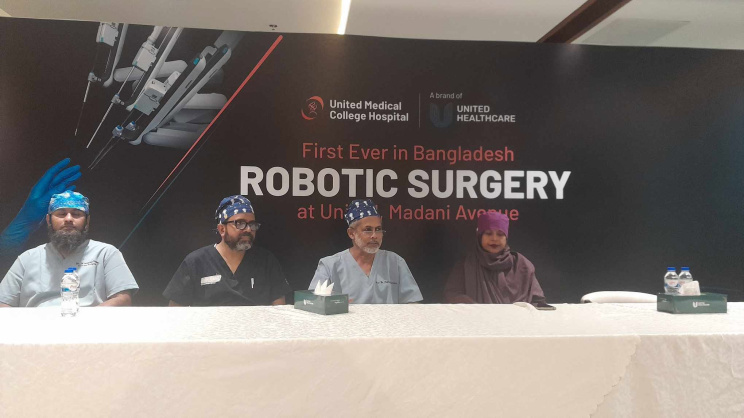
Many patients currently travel abroad for robotic surgery because of its precision and other benefits, he said, adding that they would now be able to receive the service in Bangladesh.
He said they had brought the robot long ago and several doctors had received training in its use from abroad. However, they received approval from the Directorate General of Drug Administration on Thursday, the letter of which reached them on Monday afternoon.
After receiving the approval, they carried out the procedures in the evening, he added.
Prof Samsad said Bangladesh had lagged behind neighbouring countries, including Nepal, which had already started performing robotic surgeries. “Now, the procedure has also started in the country,” she said.
The robotic surgery programme will soon expand into cardiac surgery, neurosurgery, urology, general surgery, gynaecology and thoracic surgery, she said.
A major long-term goal is to provide advanced procedures locally and reduce the need for patients to travel overseas, thereby helping retain valuable foreign currency within the country, she added.
The National Institute of Cardiovascular Diseases (NICVD) carried out a remote robotic stent placement surgery in January 2024.
Asked about the procedure, Prof Mofassel Uddin Ahmed, senior consultant at the Department of Cardiac Surgery of United Medical College Hospital, said the two procedures were completely different.
At NICVD, only part of the stenting procedure was robot-assisted, while the dedicated robot at United Healthcare independently performs surgery. Besides, NICVD brought the robot only for demonstration, and no second case was performed there continuously with the robot, he added.
“That’s why we are calling that the first robotic surgery performed here successfully,” he added.
NICVD Director Prof Abdul Wadud Chowdhury could not be reached for comment.
 For all latest news, follow The Daily Star's Google News channel.
 Contacted, DGDA Director Akter Hossain said they had given approval to two private hospitals, including United Healthcare, to use robotic surgery after formulating the necessary regulations.
“So, this [United Healthcare’ one] is officially the first robotic surgery,” he told The Daily Star tonight.
*Note: This report was updated at 11:20pm.
Comments