


Is a Title Suit Barred during pendency of RoR preparation?
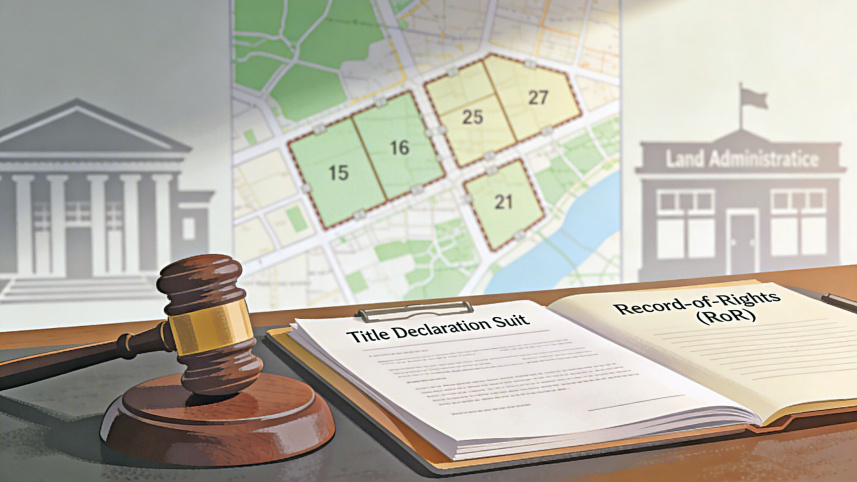
Whether a civil suit for declaration of title is barred or not during the pendency of the preparation of Records-of-Rights (RoR), is a matter of uncertainty in our jurisdiction, as no explicit statutory provision provides a clear answer thereto. Notably, ROR is a document maintained by the government that contains primary records of land ownership, relevant liabilities, and land classification. A comparative discussion on the two legal provisions, namely, section 144B of the State Acquisition and Tenancy Act 1950 (SAT Act), and section 42 of the Specific Relief Act 1877 (SR Act), may sufficiently resolve it.
Notably, under section 42 of the SR Act, any person entitled to any legal character or to any right as to any property may sue for a declaration against anyone denying, or interested to deny, such right. Conversely, section 144B of the SAT Act bars civil courts from entertaining any suit or application for the alteration of any rent or determination of the status of any tenant of the incidents of any tenancy in such area, upon an order under section 144(1) for preparation of revision of RoR in respect of any area. A clear understanding of both provisions is important for delving further into the discussion.

The very purpose of section 42 of the SR Act is to determine and declare title. In contrast, section 144B of the SAT Act is intended to provide protection in matters relating to the preparation and publication of RoR. The objectives of title establishment and administrative protection are distinct, and do not, by themselves, create any legal contradiction.
On the one hand, the bar to civil jurisdiction under section 144B of the SAT Act encompasses matters of a limited scope, where the executive (revenue) authority corrects errors relating to incidents of tenancy. On the other hand, a declaration of title conclusively determines proprietary rights such as inheritance, transfer, settlement, or other substantive questions of ownership. Such legal character or legal right does not, in any circumstance, include arithmetical or administrative matters like alteration of rent, or determination of the status of a tenant as contemplated under section 144B (1) and (2). Hence, the subject-matter transcends the statutory bar applicable to administrative corrections.
Section 144 relates to the preparation, revision, or correction of the RoR by the revenue authority. Such proceedings are summary in nature and primarily for fiscal purposes. They do not finally adjudicate complex questions of title. Besides, it is a settled principle that title only carries a rebuttable presumption of correctness. As such, complex questions of titles should be left for adjudication by civil courts.
Section 144B bars the jurisdiction of civil courts in respect of matters which the revenue authority is empowered to determine under Chapter XVII of the SAT Act (Maintenance and Revision of Record-of-Rights). However, the bar is limited to: correction, preparation, or publication of ROR---matters directly falling within the statutory competence of revenue officers. It does not expressly bar a suit for declaration of title where the plaintiff seeks a declaration of title beyond mere correction of the record.
Moreover, it is a well-established principle that jurisdiction of civil courts is generally inferred not to be barred. Unless the statute expressly or by necessary implication excludes the jurisdiction of civil courts, such jurisdiction remains intact. Furthermore, law demands that no aggrieved person be left without relief. From that perspective, an aggrieved person cannot be compelled to wait for an uncertain period merely because final publication under section 144 of the SAT Act is pending or has been made.
Hence, I take the view that a civil suit for declaration of title is not barred merely because an order for preparation of the RoR has been made under section 144 of the SAT Act. It will be barred under section 144B only if the suit essentially seeks the correction of the record-of-rights and nothing more.
The writer is judge, Bangladesh Judicial Service.
 For all latest news, follow The Daily Star's Google News channel.
Comments