


Meet the hawkers carrying Nakshi Kantha through Dhaka

Certain things carry their entire journey in their name, Nakshi Kantha, for instance. The name takes you somewhere before you have even decided to go — A village courtyard. A woman with a needle in hand, patiently pulling stories through coloured thread. An old saree being given one more life. Stories of lives that came before us, and of lives that still linger in the villages where these kanthas are made.
For others, the name carries Jasimuddin's literary world of Nakshi Kanthar Math — Rupai, Saju, the fields, the love, the grief, the memory of a whole rural world stitched by words.

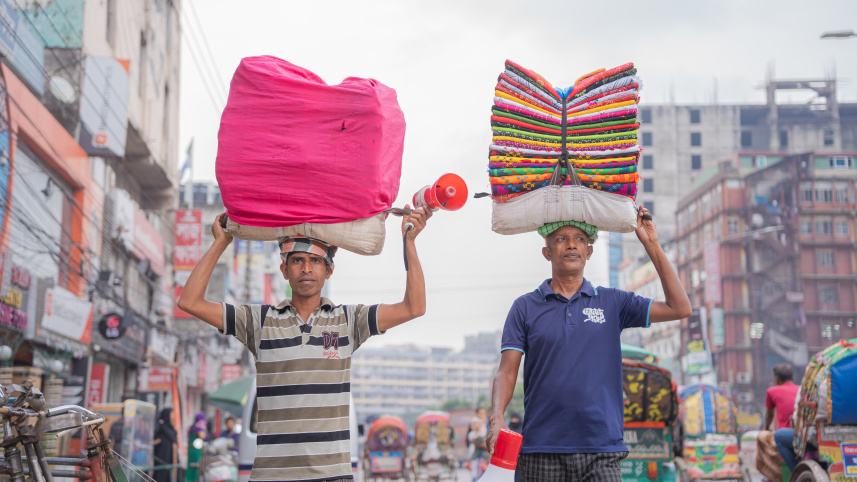
Which is why I was slightly confused the other day, sitting on my office terrace in Banani and waiting for lunch, when a soul-piercing hawker's voice rose from the street below: “Nakshi kantha!”
Dhaka's hawkers are an adaptable species. If something can be carried, worn, eaten, plugged in, hung on a wall, or even vaguely imagined as something you might need someday, chances are someone is already selling it from the pavement.
And it turns out a small informal network of sellers moves through the city with bundles of nakshi kanthas, chadors, and regular hand-stitched kanthas sourced from different parts of the country.
The sellers then fan out across Gulshan, Banani, Dhanmondi, Mirpur and the city's residential lanes, carrying bundles that are, depending on whom you ask, a piece of rural Bengal, a household item, or simply something worth shouting about at 1 PM.
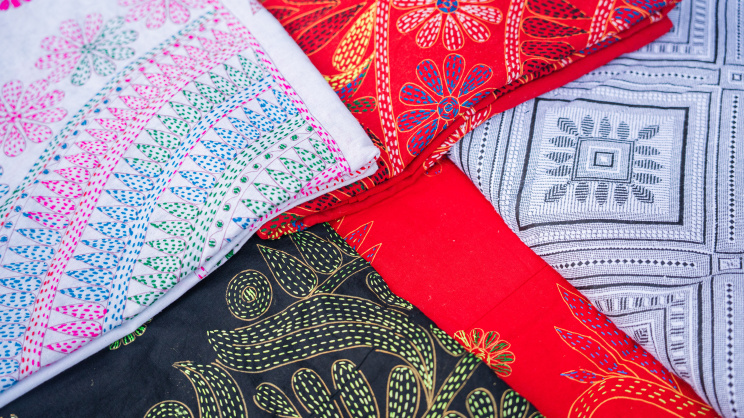
What made it all the more amusing was that we usually encounter Nokshi Kantha in rather more respectable surroundings — intricately embroidered, carefully displayed under boutique lights, hung against tasteful walls, and accompanied by a brand name and a price tag that might make you wonder whether you are buying a quilt or putting a down payment on land itself.
These were not quite those kanthas.
The designs are simpler, the embroidery less elaborate, and somehow more familiar — the sort of kantha that looks less like a heritage product and more like something your grandmother would quietly fold into a parcel and send you from home.
There is no carefully arranged display here. Just a seller, a colourful pile of kanthas, a microphone announcing the sale, and the usual Dhaka orchestra of horns, CNGs and parking disputes.
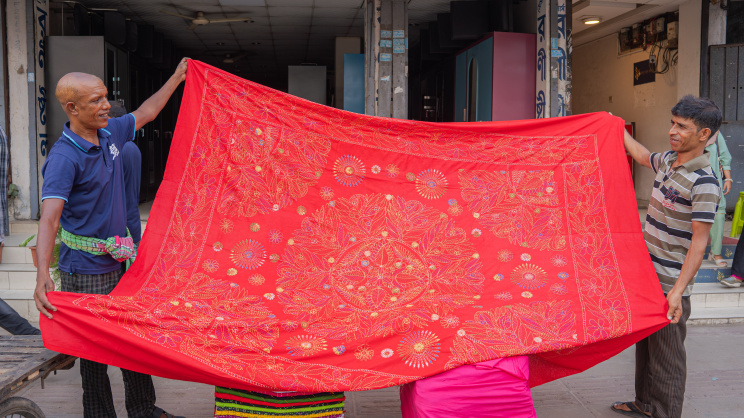
Amirul Islam Nokshi is one of the people making that announcement. His family lives in Kushtia, while he lives in Mirpur's South Bishil area. He says around 40 other men live in the same area and do similar work, travelling through different parts of Dhaka with their bundles.
“Our mornings are basically about deciding which part of Dhaka we are going to disturb today,” he tells me, laughing.
The actual routine is simple. They take their bundles in the morning, scatter across different neighbourhoods and begin calling out through microphones. Gulshan one day, Banani another, perhaps Dhanmondi or Mirpur the next.
And then they wait. “Sometimes women hear us and call us to stop,” Amirul says. “They take us inside their homes sometimes, we open the bundles, show them everything, and they choose what they like.”
And the prices are considerably less intimidating than those in some of Dhaka's malls.
“You can buy kanthas in the big malls too, but they will cost you a lot more,” Amirul says. “Our prices start from Tk 1,500 and go up to Tk 3,500, sometimes a little more, depending on how intricate the design is.”
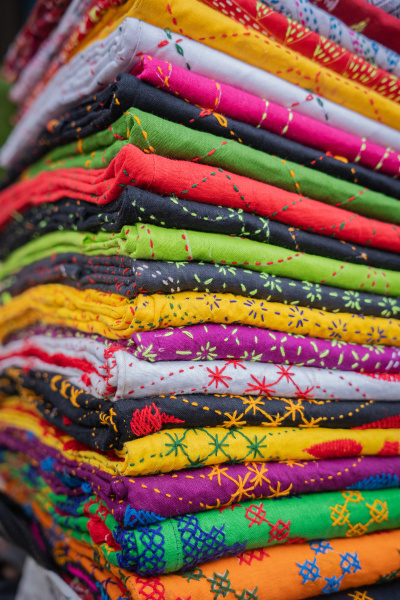
They also sell embroidered bedsheets, which they call Nakshi chador. “These are also made with thread and needle,” he says. “It is all work done by hand.”
 For all latest news, follow The Daily Star's Google News channel.
 But the most interesting part of Amirul's story is not what happens on Dhaka's streets. It is what happens before the kanthas ever reach them.
According to Amirul, many of the kanthas are made by rural women in Kushtia, Jessore, Jamalpur and elsewhere, including some women with disabilities.
“Every kantha comes from a different woman, and every woman has a different struggle,” he says.
And it is a sentence that makes you look at the bundle differently.
Because from a distance, it is easy to see only a colourful quilt. Up close, it is labour. It is time. It is someone sitting with a needle and thread, working patiently through whatever the body allows, turning worn fabric into an income.
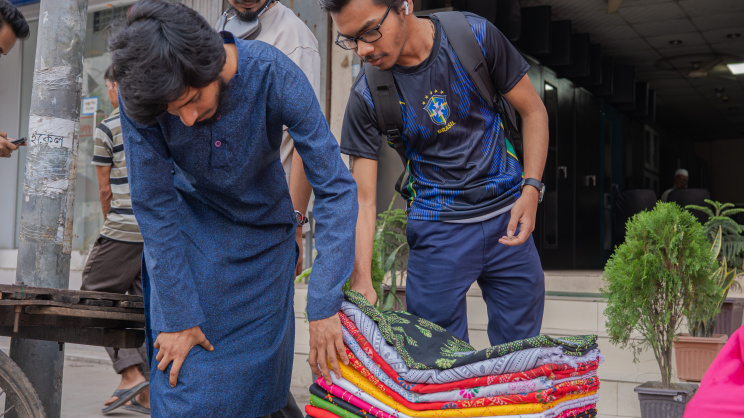
And eventually, it is someone else walking through Banani at midday, carrying all those hours on his shoulder and shouting about them through a microphone.
Rubel, another seller, reveals a rather democratic side to this little ecosystem.
“We get all kinds of customers,” he says. “Sometimes someone from the seventh floor calls us up and buys 10 or 20 pieces to send to relatives living abroad. And sometimes someone working in that same house buys just one for her own home.”
So, in a way, the kanthas move through the city with very little regard for the social geography we are so desperate to maintain.
One bundle can go upstairs to a home where someone is buying 20 pieces to send across oceans. Another piece from the same bundle can go to someone who has saved enough to take home just one.
Same thread. Same needlework. Same seller at the door.
When I asked Rubel why he chose this work over doing something else, he laughed.
“I don't really know how to do anything else,” he said. “I only know how to shout, and thankfully, Dhaka knows how to listen.”
A funny answer, certainly, but perhaps a little sad too; when the only work you know is the work you do, “choice” can become a rather generous word.
So, the next time if you hear “Nakshi Kantha!” from somewhere below, don't dismiss it as just another hawker's call. There may be a whole rural economy, generations of craft and countless hours of women's labour stitched together, much like the kantha itself, passing beneath your office window -- carrying the quiet stories of hands you may never see, but whose work has somehow found its way to you and me.
Comments