


Number of fire-prone structures triples in a year


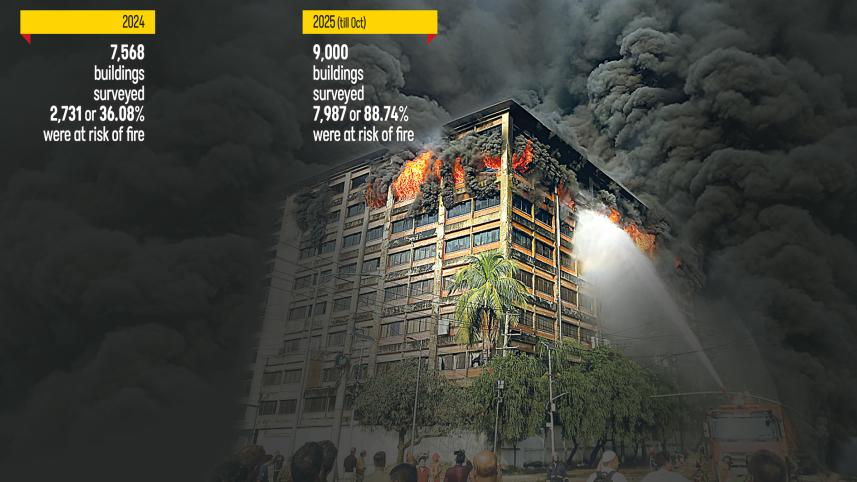
The number of fire-prone structures across the country has nearly tripled to 7,987 within a year, underscoring a worsening fire safety situation despite repeated warnings from the Fire Service and Civil Defence.
Experts have attributed this to negligence by building owners, inadequate monitoring, and weak enforcement of fire safety regulations.
 For all latest news, follow The Daily Star's Google News channel.
A nationwide inspection last year found that 2,731 out of 7,568 buildings were at risk of fire. The fire service then notified the owners and instructed them to improve safety measures at the buildings.
From January to October this year, the fire service inspected around 9,000 buildings, of which 1,435 were marked as extremely fire-prone and 6,552 as fire-prone.
The inspection covered a wide range of establishments, including factories, hospitals, clinics, shopping complexes, educational institutions, and government offices.
According to fire service officials, the number of risky buildings has risen sharply, partly due to an expanded scope of inspection and partly because most of the previously listed buildings remain non-compliant.
A building is classified as risky if it lacks essential fire safety measures such as fire extinguishers, emergency exit stairs, a dedicated water tank, or fire hydrants.
When contacted, Lt Col Tajul Islam Chowdhury, director (operations) of fire service, said, "Since most owners of the buildings, listed as risky in the past, have not taken steps to improve safety, the number continues to rise, with new ones added every year."
He further said they have scaled up inspections, which have made available more data on risky buildings.
Asked what steps the fire service takes after identifying a risky building, Tajul said, "We serve notices to the building owners. But since we don't have magistracy power, we cannot take immediate action if anyone doesn't comply."
Noting that the fire service prioritises awareness-building, Brig Gen Muhammad Jahed Kamal, director general of the fire service, said "Awareness needs to be raised at all levels. Progress can be achieved if building-specific safety and awareness at the individual level are ensured."
WEAK ENFORCEMENT OF LAW
According to section 18 of the Fire Prevention and Extinction Act, 2003, if anyone fails to comply with any condition of the licence granted under the act, the person may face imprisonment for a minimum of six months in addition to a fine.
The law empowers the fire service to carry out investigations and file cases with police stations over violations of fire safety regulations.
Tajul said that whenever they need to take action against non-compliant building owners, they inform Rajdhani Unnayan Kartripakkha (Rajuk), the local administration or city corporations, which then assign magistrates to run mobile courts.
"During such drives, we either impose penalties or seal off buildings, depending on their condition.
"We can conduct 30 to 40 mobile courts across the country a month against a requirement for around 400. But to achieve the target, we need magistracy power," he added.
When asked, Md Jahirul Islam, chief executive officer (CEO) of Dhaka South City Corporation, said, "Whenever the fire service asks for magistrates, we cooperate with them."
Muhammad Asaduzzaman, CEO of Dhaka North City Corporation, said they stand ready to provide the fire service with magistrates to run mobile courts.
He further said the DNCC periodically inspects the city corporation markets to assess fire safety measures. "Besides, our head office and regional offices regularly arrange fire drills."
Rajuk officials said they have the authority to conduct drives through mobile courts and cancel designs and approval of buildings if found risky.
When asked, Ashraful Islam, chief town planner of Rajuk, said multi-storey commercial buildings in Dhaka are jointly inspected by Rajuk, the fire service, city corporations and law enforcement agencies.
"Before approving the design of a building, we check whether it includes provisions for fire hydrants, fire-rated doors or other alternatives. These measures typically apply to multi-storey buildings."
In reply to a query, he said, "We are currently revising the building construction regulations. Stricter fire safety measures will be included in the rules to help mitigate risks."
WHAT EXPERTS SAY
Fire safety experts have stressed the need for effective safety measures and strict enforcement of regulations to reduce risks.
Brig Gen (retd) Abu Nayeem Mohammad Shahidullah, former director general of the fire service, said, "The biggest weakness lies in initial response systems, fire alarms, and water supply -- all of which are part of fire management.
"Fire drills must be conducted regularly in commercial buildings and government establishments. Besides, there should be regular inspections of residential buildings," he added.
Adil Mohammad Khan, president of Bangladesh Institute of Planners, said, "Most buildings in our cities lack effective fire safety systems. Fire risks are further compounded by the negligence of building owners and authorities, inadequate monitoring, and weak enforcement of regulations.
"After almost every major fire incident, it is found that the fire service had already raised an alarm over fire risks to the affected building. But its owner didn't heed the warning."
The urban planner noted that fire prevention systems should be incorporated into building designs, and relevant laws must be strictly enforced.
Comments