


Slum fires, inequality and Dhaka’s invisible residents

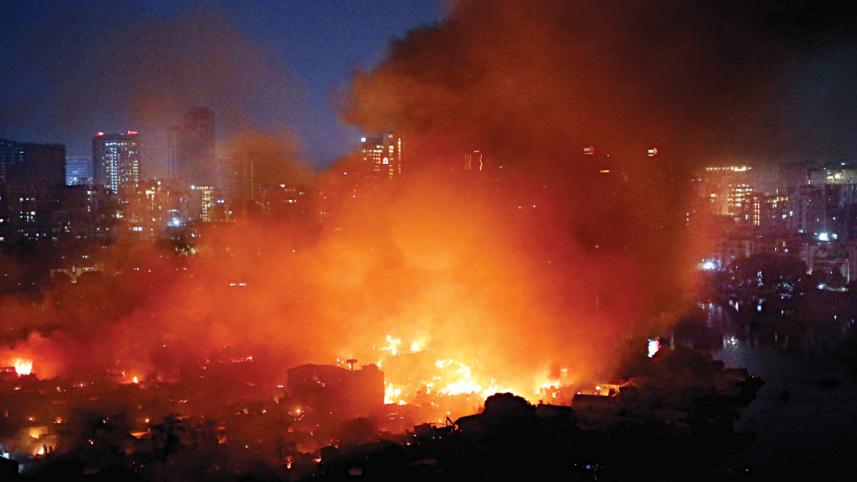
The night was torn by orange flames that rose to the sky after another massive fire—the fourth in two years—ripped through the Bou Bazar area of Dhaka's Korail Slum on November 25. Within hours, the slum was engulfed in flames, injuring many and displacing thousands who stood in the smoking ruins of their belongings, asking, "Where will we go now?"
The slum, jammed between the capital's two major affluent neighbourhoods—Gulshan and Banani—is home to nearly 60,000 families, many of whom live in single rooms that house up to eight people. Although many aid organisations and city agencies rushed in to provide food and immediate shelter to the residents, rebuilding dozens of houses remains a massive task. Yet, many residents reported to their daily work the next morning, even when they did not have a roof over their head anymore. It is because without their daily earnings, they would be lost in the thin line between survival and hunger. Perhaps they knew that short-term aid is no alternative to sustained government action and long-term rebuilding support.

People migrate to Dhaka mostly out of necessity. They come in search of work in factories, services, or construction, drawn by better economic opportunities. Natural disasters fuelled by climate change also push many towards the capital. However, unaffordable housing and a lack of coordinated land-use policy force many to settle and start living in any place they can. Consequently, this unplanned urbanisation and lack of safety protocols in slums create the grounds for fire disasters. Slum houses are closely packed with little or no space between them. As a result, a single short-circuit or an overturned gas cylinder can trigger a blaze that can sweep across blocks. Such disasters escalate due to the poor enforcement of safety regulations inside slums. Building codes and fire inspections rarely reach these informal settlements. Furthermore, narrow lanes and parked vehicles make it difficult for firefighters to reach all corners inside slums—a problem firefighters also faced in the recent Korail slum fire.

Inequality and uneven development are the main drivers behind the creation of informal settlements like the Korail slum in urban areas. According to the "White Paper on the State of Bangladesh Economy," the country's wealth distribution is extremely skewed, as the bottom 50 percent of the population owns only five percent of the country's assets. In other words, wealth, jobs and services remain centred among the urban elite. Not only do rural areas get far fewer investments, they often lack better schools, hospitals and, most importantly, jobs.
The informal economy compounds the problem. A 2018 report of the Bangladesh Bureau of Statistics (BBS) reveals that the informal economy accounts for 78.2 percent of Dhaka's employment. This adds to the importance of a vastly ignored reality: the need for incorporating a sustainable, comprehensive urban plan for the city where informal settlements must be treated as an integral part. Such a plan will also decrease social inequality, negative health consequences and the adverse impact on the environment.
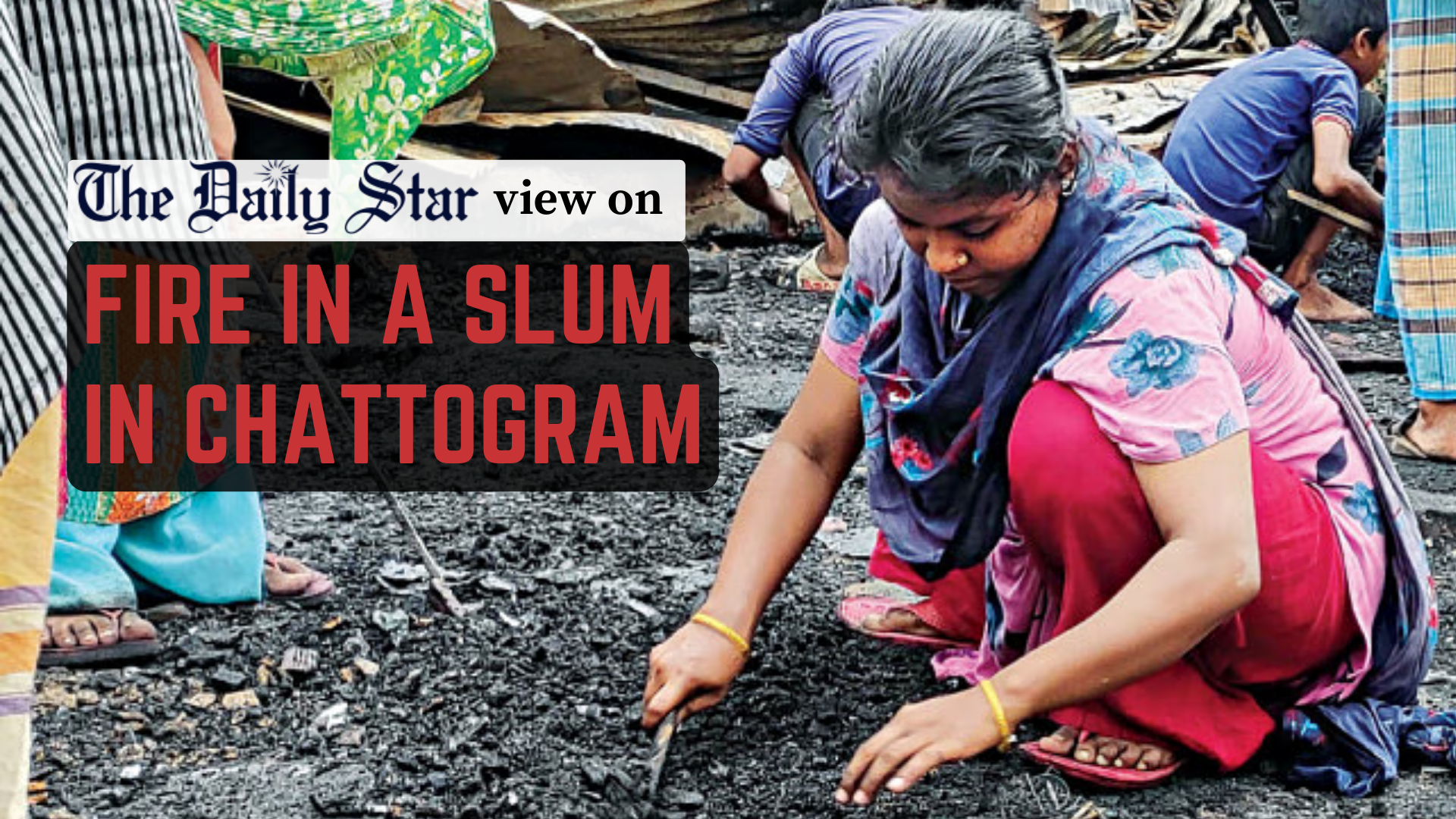
Slum fires are not accidents but a predictable by-product of inequality and policy failure. Each time a fire engulfs a slum, it spotlights deeper problems in Dhaka's growth. It pushes families to the margins, leaving households evicted and their livelihoods uncertain. While the promise to invest in better infrastructure and create more jobs in rural areas is left ignored, the political pressure to improve conditions for the urban poor remains also weak, as only a tiny elite holds most of the wealth. This leaves one wondering: when will the negligence towards these informal settlements stop? The victims of the Korail fire do not just need fire trucks to douse the flames; they require a system that protects livelihoods, secures housing and preserves their hopes for a better tomorrow.
Tagabun Taharim Titun is content executive at The Daily Star.
Views expressed in this article are the author's own.
Follow The Daily Star Opinion on Facebook for the latest opinions, commentaries, and analyses by experts and professionals. To contribute your article or letter to The Daily Star Opinion, see our guidelines for submission.
 For all latest news, follow The Daily Star's Google News channel.
Comments