


Only 44% make it to class 10 after primary


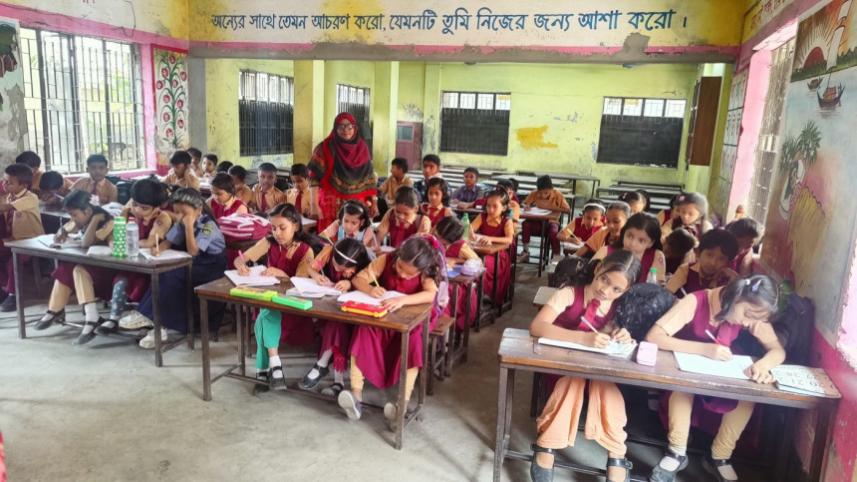
Although 84 percent of children in Bangladesh complete primary school, less than half go on to finish secondary education, a government survey has revealed, highlighting the large number who drop out long before higher studies.
The Multiple Indicator Cluster Survey-2025, launched on Sunday, found that children from low-income households, mostly girls, are more likely to leave before completing secondary school.
 For all latest news, follow The Daily Star's Google News channel.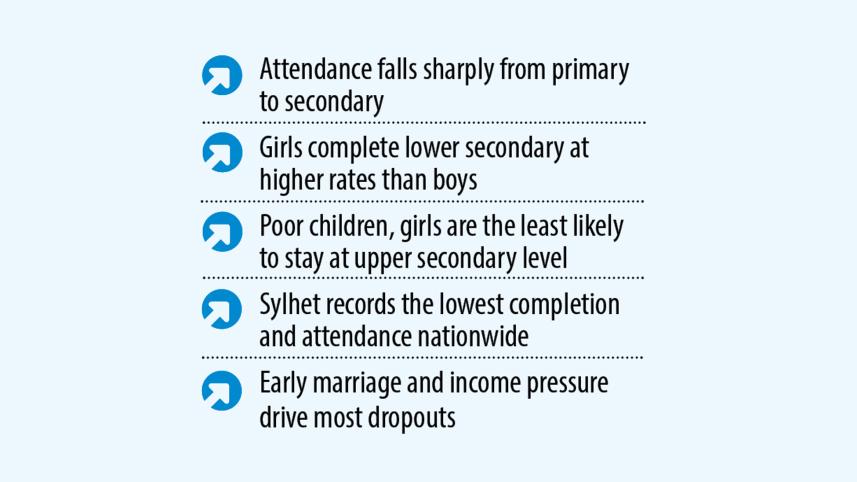
At the lower secondary stage (classes six to eight), however, boys lag behind girls in completion.
The survey, conducted by the Bangladesh Bureau of Statistics with technical and financial assistance from UNICEF, shows that 63 percent boys complete lower secondary, compared to 76 percent girls.
Conducted for over a year in nearly 63,000 households, it divides the secondary education into two levels, lower and upper (classes nine and ten).
According to data from the Bangladesh Bureau of Educational Information and Statistics, over 81 lakh children study at 18,968 general secondary schools across the country.
Education experts attribute socio-economic realities and structural weaknesses in education as key reasons behind students leaving school before completing secondary level.
Noted educationist Rashed K Choudhury said, "This is a worrying picture. Similar declining trends in completion rates have also been found in other independent studies."
She said early marriage remains a major factor in girls dropping out, as many families, particularly outside Dhaka, prefer to marry off their daughters rather than keep them in school.
"Affordability is another reason. A significant number of low-income families still prioritise boys for contributing to household income over continuing education and thereby push them into income-generating work by withdrawing them from school.
"Rather than seeing the value in learning, they consider it more logical to let the boys engage in alternative ways of earning," said Rasheda, also the executive director of the Campaign for Popular Education (CAMPE).
Another concern, she said, is the mundane learning process in post-primary schools. "The teaching-learning process in our mainstream schools is not interesting enough to keep students in class. Since these schools are privately managed, there's a question over their quality."
Prof Siddiqur Rahman, another noted educationist, cited similar reasons, early marriage for girls and early entry into the workforce for boys.
He added that many families also find schooling for girls more expensive, as they often need to be accompanied. "While a male student can walk, a female student often requires a rickshaw."
About the implications, Prof Siddiqur, a former director of the Institute of Education and Research at Dhaka University, said the nation is being affected in two ways due to the early dropout.
"A large number of students are deprived of education. Those who drop out do not get better work opportunities, as there are no adequate policies or programmes for their vocational training."
STEADY DECLINE
The survey reveals a steady decline in school completion as students move from primary to lower secondary and then to upper secondary across all divisions.
While 83.7 percent children complete primary school, the rate falls to 69.3 percent at the lower secondary level and drops further to 43.9 percent at upper secondary.
"The current policy in Bangladesh that focuses on universal primary education, alongside the need to prioritise attendance in higher grades, is reflected in these data," the report said.
It added that only 21 percent children from poor families complete upper secondary schooling, 23 percentage points below the national average. In contrast, around 66 percent children from well-off households reach this stage.
The survey highlighted disparities between urban and rural areas: 49 percent students in urban areas complete upper secondary education compared to 42 percent in rural areas.
The decline is more pronounced in some divisions. Sylhet records the lowest completion rates at both lower and upper secondary levels.
In Dhaka, the drop is also steep: while 81.6 percent of students finish primary school, only 42.7 percent complete class 10.
The attendance rates mirror this downward trajectory. Net attendance stands at 84.3 percent at primary level but drops to 59.6 percent at lower secondary and 50.5 at upper secondary.
"Children from the poorest households and boys are less likely to attend school than those from the wealthiest households and girls. These data may reflect economic imperatives," the study said.
Sylhet stands at the bottom also in terms of attendance, with just 44 percent of students staying through upper secondary, it added.
WAY FORWARD
To retain students, Rasheda K Choudhury suggested making the teaching-learning process more engaging. "School has to be interesting, otherwise the students won't feel encouraged to stay back and learn."
She stressed the need for improving the standard of education, saying public spending on education is continuously decreasing despite repeated calls from educationists.
"If we need quality education, we will require quality teachers who will make lessons interesting. And for that, more investment in education is a must."
Comments