


Family Card to cost Tk 1,34,000cr over four years

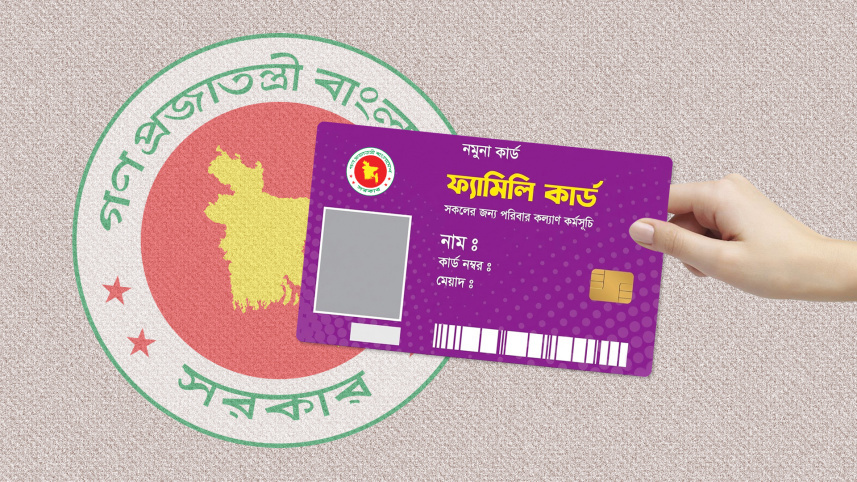
The social welfare ministry has drawn up an ambitious plan to implement the Family Card programme, a major electoral pledge of the new government, involving an outlay of Tk 1,34,000 crore over four years.
As per the plan, 2 crore families would be brought under the Family Card scheme within four years by surveying 4.1 crore households. To run the programme, the ministry has proposed recruiting 4,061 additional staff and appointing two social workers in each union.

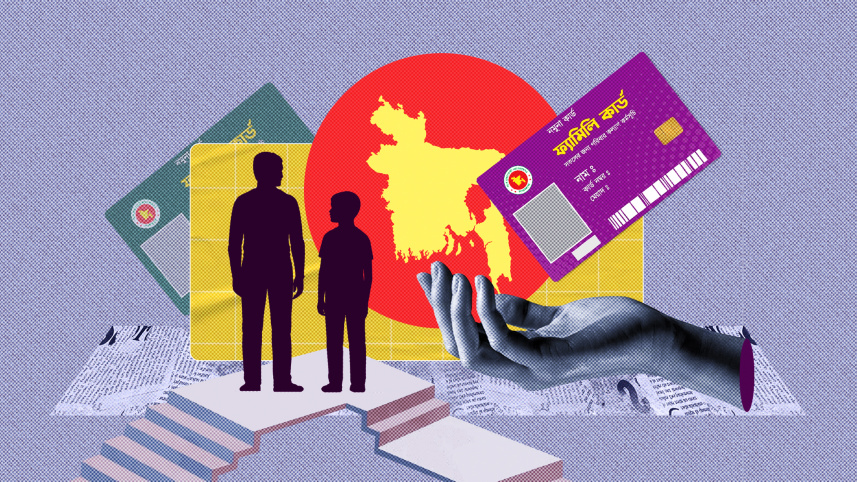
For fiscal 2026–27, the ministry plans to distribute 41 lakh Family Cards and has sought Tk 13,740 crore.
At a meeting chaired by the finance minister on April 28, concerns were raised about distributing 41 lakh Family Cards in the upcoming fiscal year before preparations are complete.
Pilot testing of 35,000 cardholders revealed anomalies of up to 18.1 percent. Beneficiaries of TCB smart cards, the Food-Friendly programme, or the Vulnerable Women Benefit scheme are not eligible for Family Cards, yet some were found among pilot beneficiaries.
Feedback on the social welfare ministry’s plan is expected in today’s meeting of the cabinet committee on social safety net.
The committee will also decide whether to include five other electoral pledges -- monthly honorariums for families of martyrs and the injured in the July uprising, Farmers’ Card, allowances for mosque and other religious institution workers, canal excavation, and tree plantation programmes -- in social safety net programmes.
However, questions have been raised about whether canal excavation and tree plantation, both development projects, should fall under social security.
Currently, the social security budget covers 95 programmes, of which 39 are identified as pro-poor, benefiting nearly 8 crore people.
About Tk 117,000 crore has been allocated for social net programmes this fiscal year.
Questions remain over whether certain programmes should be included in the safety net budget, with issues such as non-poor beneficiaries and mistargeting persisting.
Development partners, including the World Bank and the International Monetary Fund, have advised preparing the safety net budget in a more structured manner.
The main objective of the Family Card programme will be to ensure that assistance reaches genuine beneficiaries and that the same person does not receive benefits from multiple programmes, said Zahid Hussain, a former lead economist of the WB’s Dhaka office.
For this, an effective database will be required, containing the names, addresses and contact information of beneficiaries.
“Running different social safety net programmes separately is costly and complex. Therefore, the government may gradually move towards integrating these programmes. The proposed Family Card scheme could serve as an alternative to existing cash assistance and food-based transfer programmes.”
However, the biggest challenge will be coordination among ministries, he said.
At present, social protection programmes are run under multiple ministries, including Social Welfare, Labour, Health, Education, and Women and Children Affairs.
While the Family Card programme logically falls under the social welfare ministry, the other ministries may be reluctant to give up their programmes, arguing that existing beneficiaries could be deprived.
 For all latest news, follow The Daily Star's Google News channel.
 To make such reforms effective, clear directives will be needed from the highest levels of government.
The Family Card programme must be integrated with the existing social safety net system, said Sayema Haque Bidisha, a professor at the University of Dhaka’s economics department.
Before launching any new programme, both the existing safety net schemes and the Family Card system should be considered together, she said, citing the holistic approach used for the rollout of the National Social Security Strategy.
But one of the biggest problems in the current social safety net sector is inclusion and exclusion errors: genuine beneficiaries are often left out, while some individuals receive multiple benefits, she said.
When new programmes are introduced, it is often seen that the intended target groups do not receive support. Instead, those already covered by various programmes end up receiving additional benefits.
She stressed the need for a comprehensive mapping based on national ID (NID) to identify who is covered under which social safety net programme.
The current criteria for selecting beneficiaries need to be reconsidered as much of the data and indicators used in social safety net programmes still rely on outdated information.
As a result, many people are being excluded, even though their actual poverty situation is worse than the previously defined criteria.
“Those we consider to be below the poverty line and plan to support are, in reality, often in an even worse condition. But those calculations have not yet been updated. This is a fundamental problem.”
Comments