


Fuel crisis cripples motorcycle transport in southwest; riders’ incomes plunge

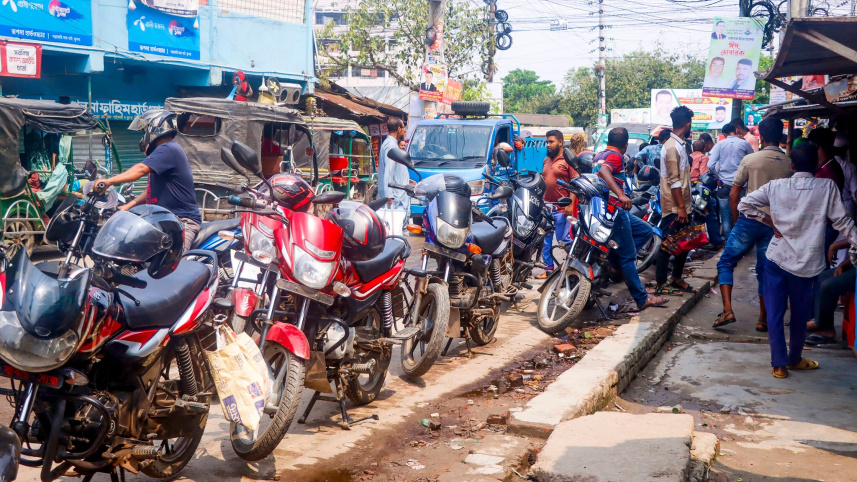
In the coastal districts of Khulna, Satkhira and Bagerhat, rented motorcycles remain a vital mode of transport, linking district towns with remote upazilas and unions where roads are poor and public transport scarce.
In areas such as Dakop, Koyra and Paikgachha in Khulna; Sarankhola, Morrelganj, Mongla and Rampal in Bagerhat; and Assasuni, Tala, Kalaroa, Shyamnagar and Munshiganj in Satkhira, thousands rely on motorcycles for daily travel.
 For all latest news, follow The Daily Star's Google News channel.
 An ongoing fuel crisis, however, is pushing more than 20,000 riders into severe hardship and disrupting the movement of rural residents, according to motorcycle riders’ association in these districts.
For Alokesh Goldar of Batiaghata, Khulna, the situation has worsened sharply. With over 15 years’ experience, he operates from Gollamari in Khulna city, carrying passengers to southern upazilas including Dakop and Koyra.
“Earlier, I used to earn between Tk 700 and Tk 1,000 a day. Now my income has dropped to around Tk 150 to Tk 200,” he said.
A round trip to Kalabogi requires at least five litres of fuel, he said, which has become “nearly impossible” to secure.
“I now avoid long-distance trips," he said adding that he is forced to spend two to three hours daily queuing at filling stations.
“Even after waiting for hours, I often fail to get fuel. Sometimes I visit multiple stations but return empty-handed.”
The picture is similar across the region. In Gollamari alone, more than 450 riders operate daily, providing essential transport to rural communities.
Most now face the same constraints due to the shortage.
Abdul Karim, 38, from Sutarkhali in Dakop, said the fuel crisis has slashed his earnings and disrupted basic services.
“People here have very few alternatives. Students, patients and daily commuters depend on motorcycles. Without fuel, we simply cannot operate,” he said.
Karim added that much of his day is now spent searching for fuel. “Sometimes the whole day passes just trying to collect fuel. This reduces our earnings and creates mental stress.”
Joy Prakash Roy, president of the Chalna Dakbangla Motorcycle Drivers’ Cooperative Association, told The Daily Star that around 70 motorcycle drivers’ associations operate across various upazilas and unions in the Khulna district, representing at least 9,500 riders.
According to him, nearly 70 percent of these drivers have now become unemployed due to the ongoing fuel shortage.
The number of motorcycles in Bagerhat also exceeds 6,000, said Al Amin Hossain, president of the Katakhali Motorcycle Riders of Bagerhat.
While motorcycle drivers bear the brunt of the fuel crisis, passengers are also struggling with transport shortage, long waits, and soaring fares.
Salma Begum, a development worker from North Bedkashi in Koyra, said transport has become unreliable. “Earlier, motorcycles were easily available. Now we have to wait for hours, and even then we may not get a ride,” she said, adding that fares have increased.
Local sources said infrastructure in coastal areas remains underdeveloped, with many roads narrow, damaged or unpaved, making them unsuitable for buses. Motorcycles therefore remain the most practical, and often the only, means of transport.
Shahinur Rahman, president of the district Motorcycle Riders’ Association, said around 80 percent of riders are now idle.
“More than 5,000 riders in the district depend solely on this work, many having taken loans to buy their motorcycles. They are now in serious distress,” he said, adding that the situation is worst in remote areas.
Ayub Hossain from Dhulihar in Satkhira’s Sadar upazila said he has been unable to operate since a few days before Eid.
“After waiting in line for two to three hours, announcements are made that fuel has run out before I even reach the pump,” he said.
“They are not selling fuel worth more than Tk 200 at a time, making long-distance trips impossible.”
Professor Anwarul Kadir, an economist and member of Khulna civil society, said many unemployed youths rely on ride-sharing services and are becoming more vulnerable amid the crisis.
“The government should extend support to those engaged in this profession,” he said.
“If their income continues to fall, it will affect not only their families but also access to essential services in remote areas.”
Comments