


Long walks, long wait for Rangamati voters
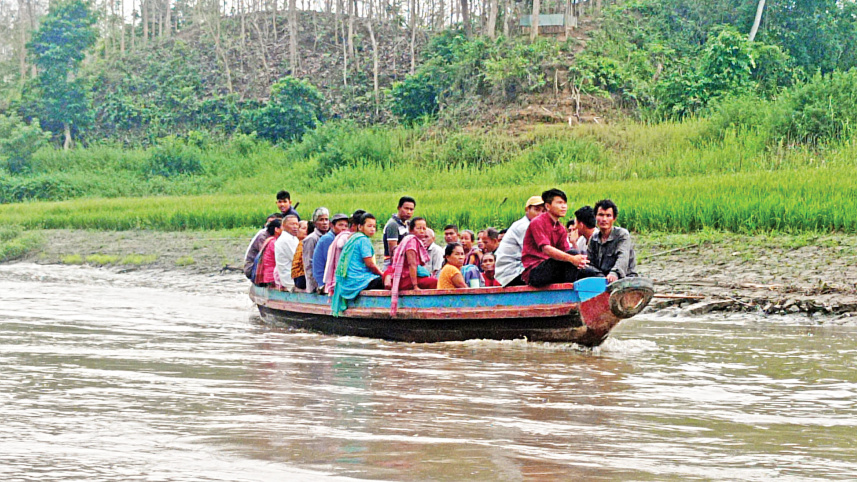
Voters in remote areas of Rangamati face daunting journeys to cast their ballots, with many forced to walk for hours or even stay overnight near polling centres, in some cases a day before voting, due to long distances and a lack of transport.
The problem is most acute in Baghaichhari, Barkal, Belaichhari and Juraichhari upazilas, where polling stations are located far from scattered hill villages, according to locals and election officials.

In several areas, voters must walk four to five hours to reach a polling centre, discouraging turnout and adding to the hardship of participating in the election.
According to the district election office, Rangamati has 20 polling stations classified as remote—six in Baghaichhari, two in Barkal, seven in Juraichhari and five in Belaichhari.
Election materials and officials are transported to and from these centres by helicopter.
More than 30,000 voters are registered at these polling stations.
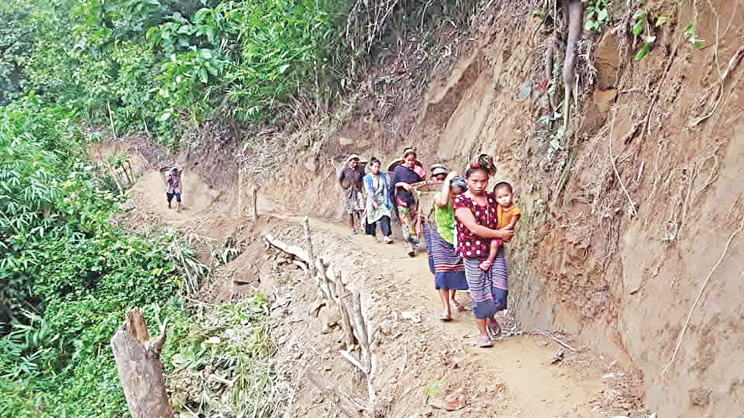
Jaupui Thang Tripura, headman of Sealdai Mouza in Sajek union of Baghaichhari, the district’s largest upazila, told The Daily Star that walking is the only option for most voters in remote areas.
“It takes a full day to reach the polling station and another day to vote and return,” he said. “People have to go a day before the election and spend the night nearby.”
Pratimani Chakma of the Hagra Kijing area in Sajek described the journey as exhausting and demoralising.
“We leave around 6:00am and reach the polling station around 10:00am or 11:00am,” she said. “Even after all that effort to vote, no one checks on us afterwards. Sometimes I wonder whether it is worth going through such hardship.”
Shanti Kumar Chakma, a resident of Moidong union in Juraichhari, said voters often return home late at night after voting.
“If someone is delayed, they may have to spend the night on the way and return home the next day,” he said.
Transporting election logistics also remains a major challenge in the district.
According to the returning officer’s office, 161 of Rangamati’s 213 polling stations have no mobile network or internet access, while 36 centres have no electricity.
Rangamati Returning Officer and Deputy Commissioner Nazma Ashrafi said the lack of connectivity makes communication with election officials and the transmission of results difficult.
“To address this, we have decided to transmit results using the wireless systems of the security forces stationed at those centres,” she said. “For the 36 centres without electricity, upazila nirbahi officers have been instructed to arrange temporary alternative power supplies.”
 For all latest news, follow The Daily Star's Google News channel.
Comments