


Waterlogging in Dhaka: Fresh rain lays bare gaps in drainage system


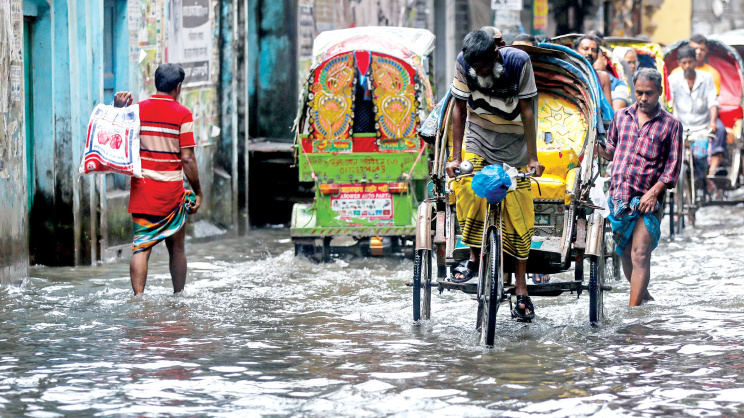
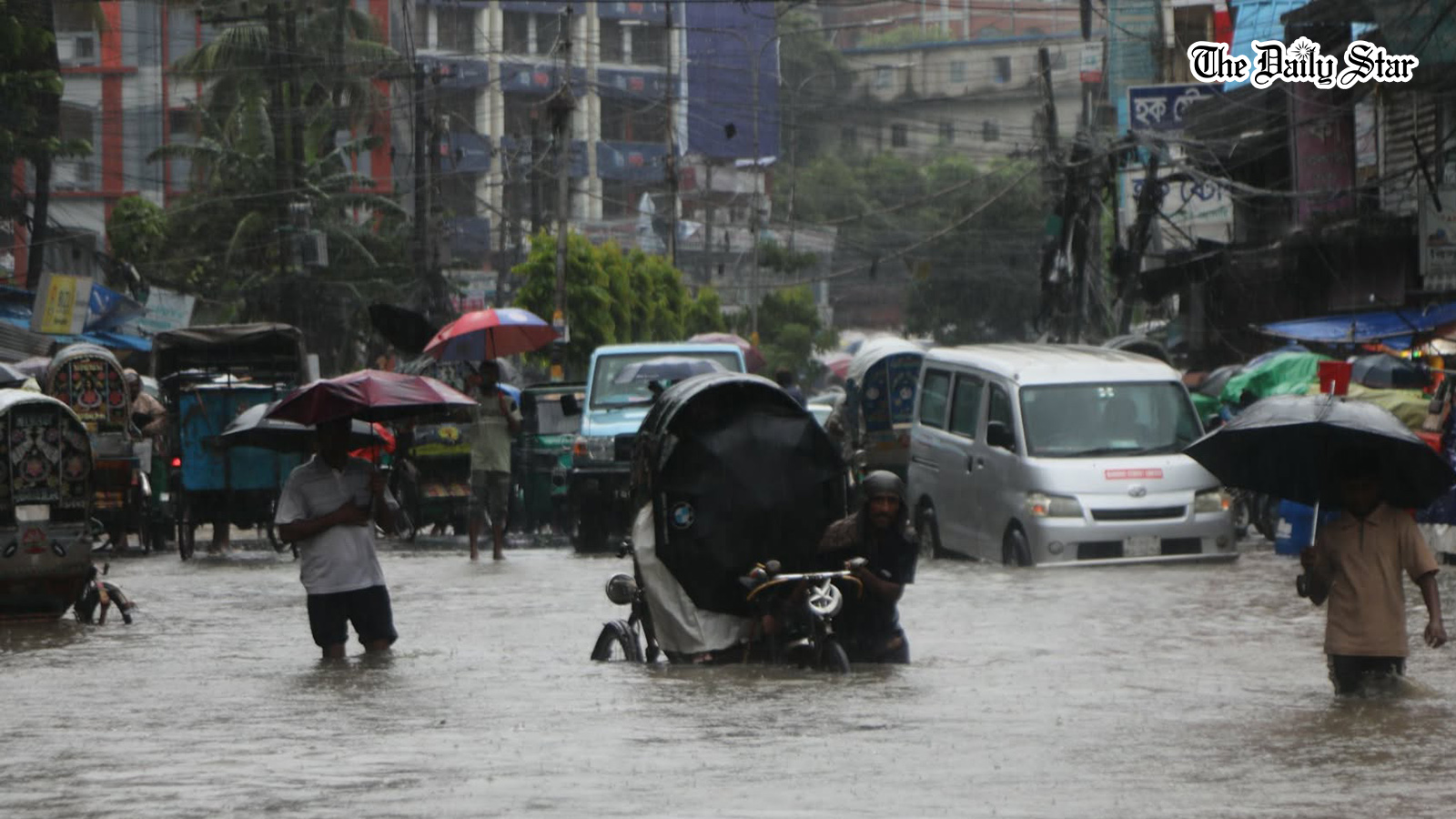
Intermittent rains over the last few days once again left parts of Dhaka submerged, exposing the chronic weaknesses of the city’s drainage system.
As roads and neighbourhoods went under water, bringing traffic to a halt and disrupting daily life, urban planners and engineers pointed to deeper structural problems -- unplanned urbanisation, shrinking canals and wetlands, inadequate drainage capacity and poor maintenance -- which continue to fuel the city’s recurring waterlogging crisis.

Over the past 16 years, the government has spent hundreds of crores of taka on canal recovery, drain renovation, box culverts, pumping stations and sluice gates. The responsibility for Dhaka’s drainage system was also transferred from Dhaka Water Supply and Sewerage Authority (WASA) to the two city corporations to improve coordination among government agencies.
According to officials, the two Dhaka city corporations invested more than Tk 262 crore over four years till 2024 in constructing 334.19km of drainage infrastructure, including box culverts and drains. Yet, waterlogging recurs in many parts of the capital.
In April this year, the two city corporations identified 141 waterlogging hotspots --108 under Dhaka North City Corporation (DNCC) and 33 under Dhaka South City Corporation (DSCC).
The recent spell of rain triggered waterlogging in several DNCC hotspots, notably Shewrapara, Kazipara, Kalshi and Badda.
Of the DSCC’s high-risk locations, New Market, Dhanmondi 27, Azimpur, Nazirabazar, and Bakshibazar experienced waterlogging over the last couple of days.
DSCC engineers said only three pumping stations are operational while at least 10 are needed to drain water in the southern part of the city.
One of the key pumping stations in Hatirjheel is currently out of service, making it difficult to remove water quickly after heavy rains in the area.
When asked, DNCC Chief Waste Management Officer Commodore Mohammad Humayun Kabir said they do not have any pumps for water drainage.
Instead, the DNCC uses six vehicles with high-pressure jetting units that blast high-velocity streams of water into blocked drain pipes to break up debris, silt, or plastic waste choking the drainage system.
“We have a quick response team to ensure rapid water drainage. They continue to work on clearing drainage systems and removing rainwater.”
Residents, however, said the measures taken by the two city corporations did little to ease their suffering, as roads in many neighbourhoods remained submerged for hours after the recent rains.
Putul Rani Bala, a resident of Shewrapara, said, “My daughter is sitting for her school examinations. Over the past few days, I had to take her to school through waterlogged roads in the area.”
Similar frustration was vented out by 25-year-old Meherin Azad, a resident of Bangshal area under DSCC.
“I have been witnessing waterlogging in Nazirabazar and Bakshibazar all my life. Over the years, several mayors have come and gone. Roads in these areas have been dug up and left that way for months in the name of repairs, adding to residents’ misery during the monsoon.”
WHAT EXPERTS SAY
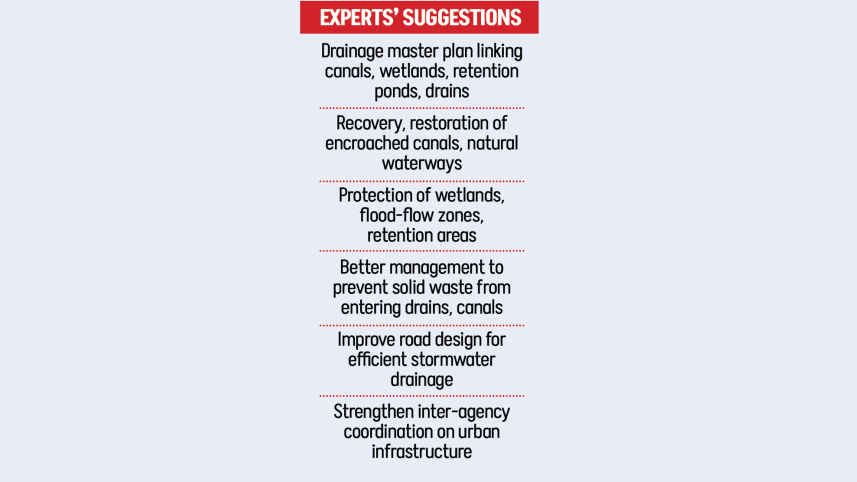
Adil Mohammed Khan, an urban planner and executive director of the Institute for Planning and Development, said Dhaka lacks an integrated drainage master plan that links natural waterways with the artificial drainage network.
“Drainage projects are now being implemented independently, with little coordination between agencies. Meanwhile, unchecked urban expansion and the continued filling of canals, wetlands and retention areas have severely weakened the city’s natural drainage capacity,” said Adil, a former president of Bangladesh Institute of Planners (BIP).
 For all latest news, follow The Daily Star's Google News channel.
 He pointed out that many drains are clogged with solid waste and operate at less than half of their intended capacity.
Every day, the city generates around 7,000 tonnes of waste, 15 percent of which is plastic. Much of this waste eventually ends up in drains and canals, according to officials from the two city corporations.
Adil said that regular maintenance of drains, together with greater public awareness to prevent indiscriminate dumping of waste, is key to improving the drainage system.
Iqbal Habib, vice president of Bangladesh Paribesh Andolon, said Dhaka’s drainage problems are rooted in flawed planning.
He explained that the Drainage Master Plan, prepared by WASA in 2015, assumed that 40 percent of rainwater would naturally seep into the ground.
However, rapid urbanisation has covered much of the city with concrete over the last couple of decades, drastically reducing groundwater recharge and increasing surface runoff beyond the capacity of the drainage network.
He stressed the need to revise the 2015 plan, which according to him, was not designed to cope with the changing rain patterns caused by climate change.
Habib further said that unplanned urban expansion has steadily wiped out wetlands and designated retention areas, while the city’s pumping stations remain capable of handling only around 40 percent of the existing drainage load.
Pointing to the absence of a proper sewerage network, he said sewage flows into stormwater drains and canals, blocking the drainage channels. Poor road design also traps rainwater in many low-lying neighbourhoods.
Asked about how to tackle the problem, he said only an integrated citywide water-management strategy can provide a lasting solution.
He suggested restoring wetlands, protecting canals from encroachment, improving road designs and implementing a drainage master plan.
Shaikh Muhammad Mehedi Ahsan, vice president of BIP, said that unplanned urban expansion has disrupted natural drainage channels and reduced water retention areas, making seasonal flooding an annual certainty.
WHAT AUTHORITIES SAY
Officials of the two city corporations said they are implementing immediate-, medium- and long-term measures to rid the city of perennial waterlogging.
Immediate steps include removing silt and waste from drains, canals and box culverts, deploying portable pumps during heavy rains, and forming ward-based emergency response teams.
Medium-term initiatives focus on restoring the city’s four major canals, constructing new outlets to channel water from Demra area and Shyampur canals into the Buriganga river, and expanding drainage infrastructure.
Long-term plans include the recovery of around 50km of canals in the two city corporations.
Officials said decades of mismanagement cannot be reversed overnight, acknowledging the need for stronger coordination and regular maintenance of drainage system.
When contacted, DSCC Administrator Md Abdus Salam said poor drainage and indiscriminate waste dumping into manholes remain a major cause of waterlogging.
“Drain cleaning and field monitoring are underway in the southern part of the city,” he said.
DNCC Administrator Shafiqul Islam Khan said city corporation staff have been instructed to ensure quick drainage of rainwater in several waterlogging-prone areas, including Airport Road and Mirpur.
Comments