


Family Card pilot to cover 40,000 households

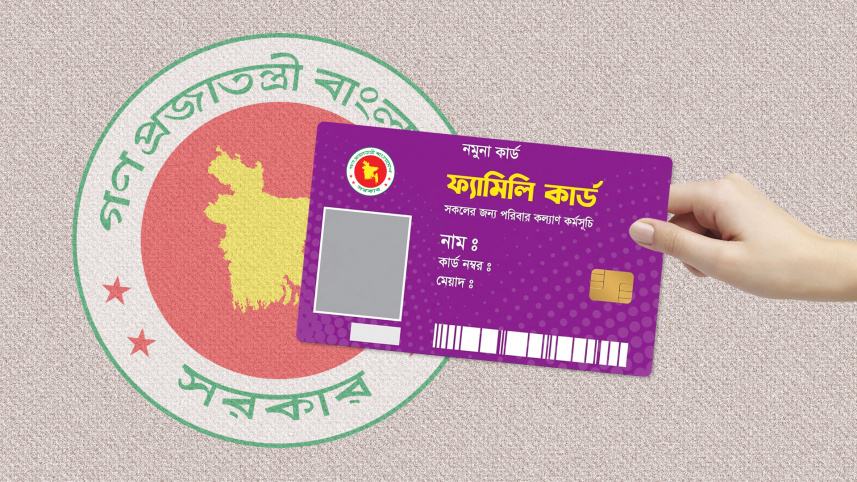
At least 40,000 families will receive Family Cards in the pilot phase over the next four months, which will cost about Tk 39 crore.
Starting from March 10, 10,000 families will be provided the cards each month, according to the Family Card Piloting Implementation Guideline, 2026. Each family with the card will receive Tk 2,500 every month.
 For all latest news, follow The Daily Star's Google News channel.
 Some Tk 39 crore has been set aside from the block allocation from this fiscal year’s revised budget, a finance ministry official told The Daily Star.
Of this, Tk 25.15 crore will be required for the allowance, while the remaining fund will be used for the beneficiary selection process, he added.
According to the guideline, Tk 4.8 crore will be used for field survey, Tk 5.08 crore for smart card and other related purchases.
In the first phase, 50 types of information on 320,000 families of 14 wards will be collected to assess their eligibility. For this task, 560 supervisors will be appointed, each receiving Tk 5,000.
By June, data collection will be completed and 40,000 beneficiaries will be selected.
The 14 upazilas selected for the pilot phase are Banani (Korail, Sattala and Bhashantek slums) and Mirpur/Shah Ali (Oli Miar Tek and Baganbari slums) in Dhaka; Pangsha in Rajbari; Patenga in Chattogram; Banchharampur in Brahmanbaria; Lama in Bandarban; Khalishpur in Khulna; Charfesson in Bhola; Derai in Sunamganj; Bhairab in Kishoreganj; Bogura Sadar in Bogura; Lalpur in Natore; Thakurgaon Sadar in Thakurgaon; and Nawabganj in Dinajpur.
The government’s ultimate objective is to gradually bring two crore families under monthly cash support, as per the guideline.
When fully implemented, the programme, a key election pledge of the BNP, would cost about Tk 5,000 crore a month and roughly Tk 60,000 crore a year.
The projected annual allocation would amount to nearly 12 percent of this fiscal year’s revenue target, making it potentially the largest social spending commitment in Bangladesh’s history.
The Family Card Piloting Implementation Guideline, 2026 prepared by the social welfare ministry envisions transforming the family card into a “Universal Social ID Card” for every citizen by 2030 and raising the social security budget to 3 percent of GDP by 2028.
At present, 95 social safety net programmes are run by 23 ministries. The allocation for the programmes is Tk 1.26 lakh crore this fiscal year, which is 1.87 percent of GDP.
Under the new scheme, cards will be issued in the name of the female head of household. Beneficiaries will be selected using Proxy Means Test (PMT) scoring, a scientific poverty assessment method.
Rural families owning 0.50 acres or less of homestead and cultivable land will be considered eligible, with income and assets also assessed to identify poor and ultra-poor households.
Families will be excluded if any member is a regular government employee or pensioner, owns a commercial licence or large business or possesses a car or air conditioner.
Priority will be given to the landless, homeless, persons with disabilities and marginalised communities, including hijra, Bede and small ethnic groups.
Selection will be carried out by committees formed at the city, upazila, union, municipality and ward levels.
The programme will be overseen by government officials under a two-tier checking system to minimise errors.
Existing TCB cards will be integrated into the family card’s Dynamic Social Registry, as per the guideline.
Using the same smart card with OTP verification, beneficiaries will be able to buy essential food items at subsidised prices and, in future, access services such as education stipends and agricultural subsidies.
The main philosophy of this programme is ‘family is the core unit of development, not the individual’, the guideline said.
Fragmentation and weak coordination among the 95 existing programmes have led to duplication, while 22–25 percent of the actual poor are left out.
The aim of this programme is to build a human welfare state by eliminating discrimination, the guideline said.
The programme’s pilot will inaugurated by Prime Minister Tarique Rahman on March 10.
Comments