


Citizen’s Platform pushes Tk 4,540 a month for families in need
Universal minimum income, school meals, youth loans and a national health card headline in a reform package put forward by the Citizen Platform for SDGs as part of its 10 national action programmes and 12 selected policy recommendations for the next government.
The universal minimum income programme is aimed at reducing inequality and provide financial security. Under the plan, each eligible family would receive Tk 4,540 per month in cash assistance, said the proposals presented by Toufiqul Islam Khan, additional director (research) at Centre for Policy Dialogue (CPD), and CPD Distinguished Fellow Prof Mustafizur Rahman during a media briefing at a city hotel yesterday.
 For all latest news, follow The Daily Star's Google News channel.
 The rollout is proposed in three phases.
Initially, 28 lakh families in 11 districts would be covered, followed by 80 lakh families in 36 districts in the second phase, and 1.47 crore families across all 64 districts in the final phase.
Beneficiaries would be selected and reassessed every two years using a poverty scorecard.
The platform said the scheme would protect vulnerable populations from job insecurity, disasters and limited access to credit. The estimated annual cost is Tk 40,600 crore, equivalent to 0.73 percent of the GDP for the first 36 districts.
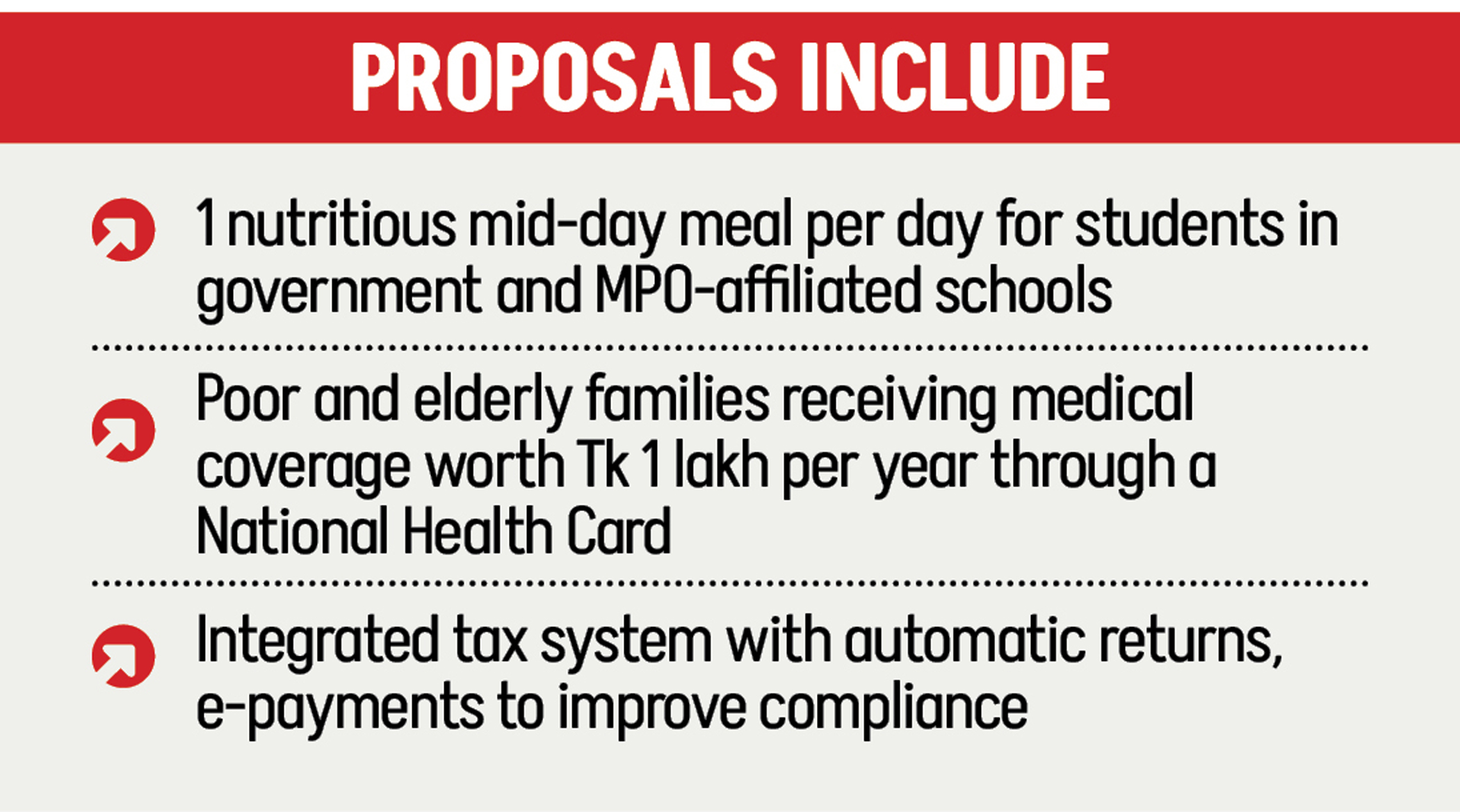
The platform also proposed midday meal scheme for government and MPO-affiliated schools, providing one nutritious meal per day to students. The programme would cover 1.18 crore primary and secondary school students.
The proposal aims to improve enrolment, attendance and learning outcomes, and reduce dropout rates, child labour and child marriage, particularly among girls. Annual implementation is estimated to cost Tk 8,288 crore, or 0.13 percent of the GDP.
For youth, the platform suggested a youth credit card programme offering interest- and collateral-free loans of up to Tk 1 lakh per person. About 1 lakh young people aged 18–24 would benefit annually, enabling them to pursue education, skills training and job applications without financial barriers.
Implementation would require Tk 1,000 crore annually as a revolving fund, along with Tk 134 crore for service costs, amounting to 0.01 percent of the GDP.
A National Health Card programme was also proposed to provide families with medical coverage worth Tk 1 lakh per year. The programme would initially cover 61 lakh elderly families, ensuring access to emergency treatment for poor and vulnerable groups.
The estimated annual budget is Tk 61,000 crore, or 1 percent of the GDP, depending on usage.
For the agriculture and labour sectors, the platform proposed a Farmer Smart Card for 1.65 crore farming families, linking incentives to farmers’ needs and reducing costs. The annual allocation is estimated at Tk 159 crore, or 0.002 percent of the GDP.
A National Labour Market Platform was also suggested to connect jobseekers, mainly youth, with employers in Bangladesh and abroad, with initial government funding of Tk 10 crore, or 0.0001 percent of the GDP.
Social and urban reform proposals include community-based childcare centres for working mothers, covering 24,000 children, and an integrated urban transport system to reduce congestion and unfair competition, benefiting low- and middle-income residents.
The platform also proposed digital and governance reforms, including an integrated tax system with automatic returns, e-payments and verification, as well as a national data platform linking citizen information to improve service delivery and programme monitoring.
The organisation emphasised that successful implementation would require structural reforms, digital transformation, anti-corruption measures, political commitment and interlinked data systems.
It estimated the overall funding need at about 2 percent of the GDP over one to two years, to be met through government-private partnerships, national budget allocations and foreign financing.
Addressing the event, CPD Distinguished Fellow Debapriya Bhattacharya said the interim government talked about bringing in new settlements, but in many cases, these efforts became hostage to a small and aggressive group.
“Because of this, they [the government] could not act properly and could not ensure citizens’ safety. Now the question is, will they be able to hold the election impartially?”
He added that reform efforts in Bangladesh have repeatedly failed because they focused on surface-level institutional changes while ignoring the need to organise social and economic forces capable of defending democracy.
“Changing the superstructure alone cannot bring a new political settlement. Unless the forces that support democracy are organised and empowered, reforms will always be captured by vested interests and traditional politics.”
Referring to past initiatives, Debapriya said political actors often prioritised constitutional and administrative changes without addressing deeper socioeconomic power relations.
“We have had caretaker governments before. Those arrangements were also dismantled. The question is not whether reforms are necessary, but whether there is a social force capable of protecting them.”
He added that reforms failed because citizens and stakeholders beyond politicians were not mobilised. “There was dialogue, but it was largely among political leaders. There was no national awakening, no broad-based participation of stakeholders.”
Rights activist Sultana Kamal, a member of the CPD board, highlighted the growing distance between citizens and those in power. “This country is not owned only by those in government. It belongs to ordinary citizens,” she said, adding that dignity must accompany rights.
“Every person should be able to live a peaceful and dignified life.”
On the media’s role, she stressed that journalists are the fourth pillar of democracy. “Without you, how will people’s voices reach society?”
She called for freedom of expression and safety for journalists, saying the struggle would continue until the ideals of the Liberation War are fulfilled.
Former caretaker government adviser Rasheda K Chowdhury said structural reforms, transparency and accountability are essential for meaningful change.
“If corruption is reduced by half, GDP could increase by four percent,” she said, highlighting economic losses from corruption and violence against women.
She added that digital systems alone cannot ensure reform. “Digital systems lose meaning when middlemen control them.”
Rasheda urged media engagement to track reforms and called for changes in political culture, bureaucracy and civil society.
Shaheen Anam, executive director of Manusher Jonno Foundation, voiced concern over attacks on minority communities. “For months, we have seen attacks, killings and vandalism of homes, businesses and religious institutions of minority communities, but no justice was served to the victims.”
She criticised the government’s limited response and called on journalists to follow up. “Ensuring citizens’ security is a state responsibility, and the media has a key role in holding authorities accountable.”
Prof Mustafizur emphasised the importance of planned development and parliamentary accountability. “Our resources are limited, and we must set priorities and implement them scientifically. Five-year plans are created, but they are often not implemented. Parliamentary accountability should ensure that every ministry reports regularly on what has been achieved and what gaps remain.”
He added that strong administration and institutional capacity are key to effective implementation.
Asif Ibrahim, vice chairman of Newage Group of Industries, and Anisatul Fatema Yousuf, coordinator of Citizens’ Platform for SDGs Bangladesh, also spoke at the event among others.
Comments