


Grievance, dialogue, and the search for political closure

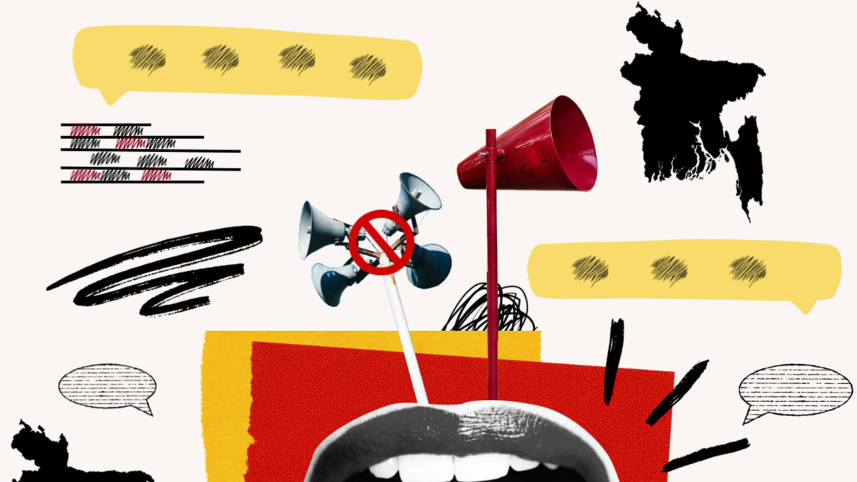
Grievance is often spoken of as excess these days—too emotional, too resistant to pragmatism. In political life, it is frequently treated as something to be managed or simply waited out. Yet, grievance rarely persists because it is irrational. It persists because it has not found closure, because it has not been answered in a way that feels adequate. Grievance is not noise. It is unfinished political speech.
In moments of transition, this unfinished quality becomes especially visible. In Bangladesh, political change has a way of drawing unresolved grievances to the surface. Memory sharpens. Old injuries re-emerge. What was once muted becomes loud. This is neither accidental nor inherently destructive. Grievance, after all, is not merely complaint; it is lingering memory seeking relevance.

July 2024 marked such a moment for Bangladesh. What unfolded that month was not only a confrontation over power, but a rupture in how political voice was expressed and received. The streets did not merely register dissent; they revealed a deeper exhaustion with being unheard. Grievances that had long circulated in fragments—across campuses, institutions, in hushed conversations—suddenly acquired a collective register. For many, July became less an event than a reference point: a reminder that when dialogue is deferred too long, it does not disappear. It changes form.
What followed in the months after July was equally telling, and by then, the cost of waiting had already begun to show. Episodes of mob violence—directed at institutions, at symbols, and at times at one another—started to occur. These did not emerge in a political vacuum, nor were they simply moments of unthinking rage. They reflected something more unsettled: the thinning of mediated political conversation. Where dialogue receded, action rushed in.
Political theory offers an uncomfortable lens here. The philosopher Mikhail Bakhtin warned against monologic discourse—a mode of speech that allows no reply, that assumes moral finality and treats disagreement not as difference but as bad faith. Monologue, in his formulation, does not merely silence other voices; it reorganises the world so that only one voice feels legitimate.
Unanswered grievance is particularly vulnerable to this narrowing. It begins as a call to be heard. Over time, if met only with deferral or dismissal, it hardens into certainty. The language of injury contracts into a single register. Nuance begins to sound evasive. Alternatives feel suspect. Politics ceases to resemble conversation and begins to resemble performance, often theatrical and increasingly hollow.
Mob violence is one of the clearest symptoms of this shift. It emerges not when grievance is loud, but when it is trapped—when there are no institutions that can be trusted, no processes believed to respond, and no language that feels consequential. In such times, violence becomes not only destructive but also declarative, a way of being seen when other forms of visibility have ostensibly failed.
At this point, it is important to clarify that grievance does not curdle into coercion on its own. It does so when state or political actors repeatedly fail to answer it; when deferral is mistaken for stability, and silence is treated as resolution. This is not always malicious. But there are consequences nonetheless.
Politics, like language, cannot survive monologue for long.
Bakhtin’s insistence on dialogism—the idea that meaning is produced between voices rather than imposed by one—offers a perspective that is both theoretical and practical. Dialogue does not require agreement. It requires the possibility of reply without dismissal. It requires institutions that absorb conflict rather than expel it, and a political culture that recognises disagreement as a condition of legitimacy rather than a threat to it.
For the next government in Bangladesh, this distinction will matter deeply. The task will not be to suppress grievance or replace it with manufactured optimism. That rarely works. And even when it does, it does not last long. The task will be more nuanced and political: to create conditions in which grievance can be articulated without spilling into coercive action.
This is where restraint must be recognised not as weakness, but as political maturity.
Restraint does not mean silence. It means calibration. It means recognising that escalation may feel responsive—sometimes even necessary—when patience has already been stretched thin, but when rhetoric becomes the primary currency of politics, strategy thins. Negotiation loses legitimacy. Institutions begin to forfeit their authority. And it is here that closure becomes most elusive.
Closure cannot be declared. It has to be worked towards, collectively.
Political closure does not mean forgetting. It means answering. It is not achieved by settling the past once and for all, but by changing how the past is allowed to speak in the present—by widening the range of possible responses without erasing the original injury. Closure is not the disappearance of grievance, but its translation: from the language of injury into the language of outcome.
This translation depends on institutions that function as mediators rather than enforcers: courts that are trusted, administrative systems that respond, political channels that absorb dissent without immediately criminalising it. It depends on communication that is protected from spectacle. Back-channel dialogue matters here as a form of insulation. Quiet conversation allows positions to evolve without public spectacle. It creates space for movement rather than defence.
Equally important is the shaping of public expectations. Governments often underestimate how much reform fails not at the policy stage, but in the gap between what people are encouraged to expect and what politics can realistically deliver. Take the upcoming February election, for instance. So much expectation is being built around it, but practically speaking, how much can the outcomes deliver? When grievance is amplified without limits, outcomes have nowhere to land, except back on the streets.
Unresolved grievances demand attention precisely because they continue to shape present behaviour. There is also a need to recognise that attention does not require perpetual escalation. Sometimes it requires patience. Sometimes, it requires accepting that not every answer will arrive quickly or clearly as expected.
As Bangladesh approaches another political transition, the question is not whether grievance will be present. It will be. The question is whether the next government or power structure can sustain a genuinely dialogic political culture, one in which grievance does not have to shout, or strike, in order to be acknowledged, and dialogue does not have to apologise for existing.
That is what political maturity looks like: not the absence of grievance, but the restoration of meaningful dialogue.
 For all latest news, follow The Daily Star's Google News channel.
 Tasneem Tayeb
is a columnist for The Daily Star. Her X handle is @tasneem_tayeb.
Views expressed in this article are the author's own.
Follow The Daily Star Opinion on Facebook for the latest opinions, commentaries, and analyses by experts and professionals. To contribute your article or letter to The Daily Star Opinion, see our guidelines for submission.
Comments