


Un-erasable: This open-access digital archive is preserving evidence of war from Gaza

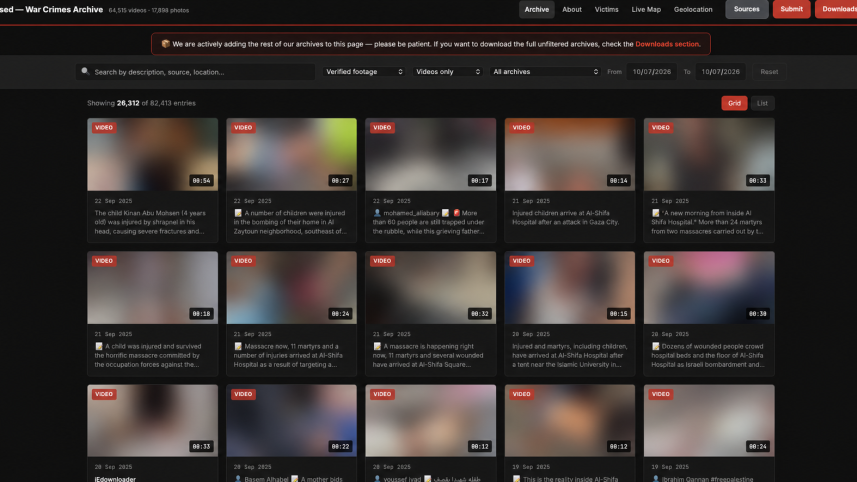
A new open-access digital archive has been launched to collect, catalogue and preserve visual documentation from Gaza and the occupied West Bank, bringing together material recorded by hundreds of journalists, photographers and other field sources.
The platform, ArchiveGenocide.com, allows journalists, researchers and human rights investigators to search for and download individual photographs and videos without obtaining the entire collection.

At the time of its launch, the archive was reported to contain more than 64,500 video clips and nearly 18,000 images gathered from more than 300 sources, according to the European Palestinian Council for Political Relations.
The project’s live download page now lists a substantially larger collection: 167,114 files occupying about 864GB, alongside metadata for more than 94,000 online entries. Organisers also claim to hold about 2.4TB of raw source material distributed across five downloadable volumes. These figures have not been independently audited and may reflect different methods of counting raw, duplicated and catalogued files.
The archive was developed by Israel Exposed, a self-described group of researchers collecting material that could be relevant to journalistic reporting, historical research and investigations into alleged violations of international law.
The website includes filters for dates, sources and media types, as well as original-source links where available. It also offers geolocation material, an interactive map of reported events and a memorial database listing identified Palestinians killed in Gaza.
The victim records are drawn from Gaza’s health ministry and compiled by the data project Tech for Palestine. The memorial section currently lists more than 60,000 identified names, although the archive warns that its wider collection remains incomplete and that cataloguing and verification are continuing.
Preserving evidence beyond one server
A central objective of the project is to prevent the collection from becoming dependent on a single website, company or storage provider.
Complete copies are being distributed through BitTorrent, allowing users to download, preserve and share the material without relying on one central server. The archive’s website and source code have also been released so that independent groups can establish mirrors if the principal site is blocked or removed.
Official releases are accompanied by cryptographic signatures and checksums. These allow users to establish whether downloaded files have been altered since publication. The project also maintains separate web domains and a version accessible through the Tor network.
These technical protections can help preserve the integrity of published copies. They do not, however, prove that the original footage is authentic, that its date and location are correct or that accompanying descriptions meet the evidentiary standards required by a court.
The archive says its sources have been vetted by its community and include Palestinian journalists, photographers, Telegram documentation channels and social-media accounts. Its public source directory identifies figures including Motaz Azaiza, Plestia Alaqad, Wael al-Dahdouh, Bisan Owda and Hind Khoudary.
However, the platform has not published a comprehensive account of how every item is authenticated, how conflicting descriptions are resolved or how consent and privacy are handled. Such questions will be important if material from the archive is used in legal proceedings or investigations.
A race against digital disappearance
Much of the war’s visual record has first appeared on Instagram, Telegram, TikTok and X, often uploaded directly by people inside Gaza. Social-media posts can disappear when accounts are suspended, users are killed, devices are destroyed or platforms remove graphic material under their moderation policies.
The loss of an account can consequently eliminate not only individual images but an entire chronological record of a journalist’s work.
ArchiveGenocide’s organisers claim the repository is intended to preserve that material before it vanishes. They claim to submit evidence to the International Criminal Court, the Hind Rajab Foundation and lawyers working with South Africa in its case against Israel at the International Court of Justice. Those submissions have not been independently confirmed by the institutions concerned.
 For all latest news, follow The Daily Star's Google News channel.
Comments