


‘No oil thru Hormuz if attacks continue’
Iran vowed yesterday that not a single litre of oil would leave the Gulf while US and Israeli bombardments continue, declaring it will decide the war’s end, as the United Arab Emirates shut its largest refinery following a drone strike.
Oil prices have surged since Iranian attacks on shipping closed the Strait of Hormuz in the wake of US-Israeli strikes but fell back somewhat on Monday when US President Donald Trump suggested the war would soon end.

Prices sank further and equities pushed higher yesterday following a wild day of swings that came after President Donald Trump signalled that the US-Israeli war on Iran could end sooner than thought.
International oil benchmark, Brent North Sea crude, plunged 9.6 percent to $89.44 a barrel, a day after it neared $120.
The region’s biggest single-site oil refinery, at Ruwais in the UAE, was closed yesterday as a precaution after a drone attack on the industrial complex which houses it caused a fire, a source familiar with the situation told AFP.
“The Strait of Hormuz will either be a strait of peace and prosperity for all or will be a strait of defeat and suffering for warmongers,” Iran’s security chief Ali Larijani declared.
The price increase also followed strikes on oil depots in Iran and attacks on oil infrastructure in Saudi Arabia, Bahrain and around the Gulf, which continued yesterday, with explosions heard in Doha.
Qatar, where a suspension of LNG exports has sent European energy prices sky-high, said Iranian attacks on its civilian infrastructure were continuing.
Explosions thundered out in Tehran yesterday after the Pentagon chief warned US strikes on Iran would reach their highest intensity since the start of the war in the Middle East.
“Today will be yet again our most intense day of strikes inside Iran,” Defense Secretary Pete Hegseth told a news conference at the Pentagon.
The war has shown no sign of relenting, with AFP journalists reporting three explosions in Tehran last evening, with no immediate information available about the intended targets.
Meanwhile, Israeli Foreign Minister Gideon Saar said last night that Israel is not seeking an endless war with Iran and will coordinate with the US on when to end the fighting, declining to publicly state a timeline for when the conflict could end.
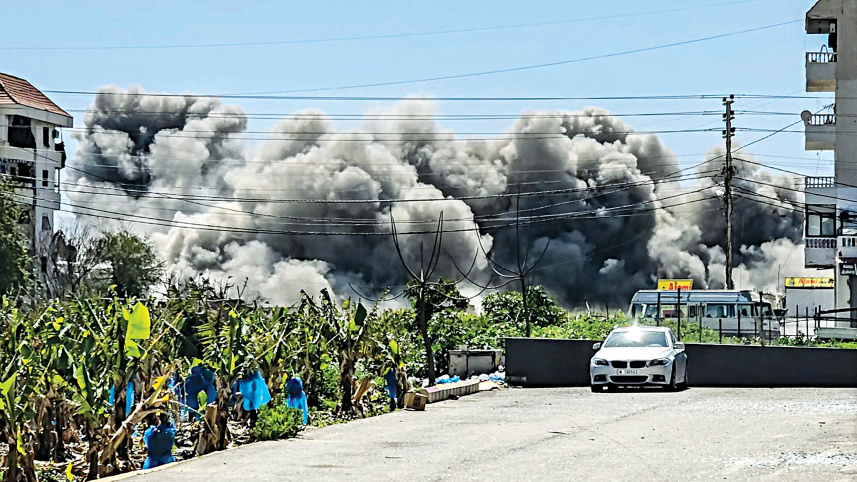
Israel’s military pounded the Lebanese capital’s southern suburbs with air strikes yesterday, and its troops pushed deeper into the country’s south.
Lebanese authorities say more than 759,000 have been displaced by the war.
‘CATASTROPHIC CONSEQUENCES’
The exchanges of fire will increase fears of economic instability, with traders and energy policy makers nervously following events in the Gulf, the source of around a fifth of world oil and gas supplies.
“There would be catastrophic consequences for the world’s oil markets the longer the disruption goes on and the more drastic the consequences for the global economy,” Saudi oil giant Aramco’s president and CEO Amin H Nasser told journalists.
“It’s absolutely critical that shipping resumes in the Strait of Hormuz.”
Egypt increased the cost of fuels by up to 30 percent and Pakistan said it would provide naval escorts to commercial shipping. France has dispatched warships to the region.
Iran’s Revolutionary Guards Corps (IRGC) mocked Trump’s bid to lessen the economic impact of the war, warning, “The Iranian armed forces... will not allow the export of a single litre of oil from the region to the hostile side and its partners until further notice.”
 For all latest news, follow The Daily Star's Google News channel.
 “It is we who will determine the end of the war,” the IRGC, seen as close to Iran’s new supreme leader Mojtaba Khamenei, said in a statement carried by Iranian media.
Larijani issued a thinly veiled threat to Trump himself, warning him to be careful “not to be eliminated”.
“Iran is not afraid of your empty threats. Even those greater than you could not eliminate the Iranian nation,” Larijani wrote in a social media post.
‘DEATH, FIRE AND FURY’
Iran’s warnings came as a response to Trump, who gave a news conference in a Florida ballroom to declare of the war, “It’s going to be ended soon, and if it starts up again, they’ll be hit even harder.”
“We’ve already won in many ways, but we haven’t won enough,” Trump said Monday.
But, in a later post on his social media platform, Trump warned that if Tehran interferes with oil exports, the US military will bomb the country in such a way to “make it virtually impossible for Iran to ever be built back, as a nation, again.”
“Death, fire, and fury will reign upon them — But I hope, and pray, that it does not happen!” he wrote.
Israel’s Prime Minister Benjamin Netanyahu also predicted that the conflict would continue, expressing hope that the Iranian people would seize the opportunity to “cast off the yoke of tyranny”.
“Ultimately, it depends on them. But there is no doubt that, with the actions taken so far, we are breaking their bones, and we are not done yet,” he said.
TRUMP, PUTIN TALK
US President Donald Trump and Russian counterpart Vladimir Putin spoke Monday about the war in Iran and prospects for peace in Ukraine, hours after Putin warned of a global energy crisis.
The Kremlin said Trump called Putin, in the leaders’ first telephone call this year, and they discussed Russian ideas for a speedy end to the conflict in Iran, the military situation in Ukraine and the impact of Venezuela on the global oil market.
Trump later told reporters he pressed Putin to resolve the Ukraine war.
Putin cautioned that US‑Israeli strikes on Iran had triggered turmoil in energy markets, threatening oil flows through the Strait of Hormuz. He said Russia was ready to resume long‑term cooperation with Europe.
Washington is weighing easing oil sanctions on Russia to boost global supply. Officials said options include targeted relief for countries such as India.
The Kremlin described the call as “substantial,” noting Trump’s interest in a rapid ceasefire and settlement in Ukraine.
RARE VOLATILITY
On Monday, world oil prices swept past the symbolic level of $100 a barrel and were briefly up 30 percent on the day before falling back after Trump’s intervention. But they rose again more slowly yesterday, and experts warned that the economic outlook remains extremely volatile.
“Rare are days in the markets when you get this much volatility,” said Ipek Ozkardeskaya, an analyst for Swissquote Bank, warning that investors are overreacting to every bit of news even when officials’ statements contradict each other.
“Part of yesterday’s optimism came after Trump said the war would end ‘soon’ and that the US was ahead of schedule,” she said.
“Concretely, however, the conflict in the Middle East continues at full speed, political developments are not pointing to a near-term resolution, and there is little clarity about the US plans.”
Comments