


Don't repeat old mistakes in labour migration to Malaysia
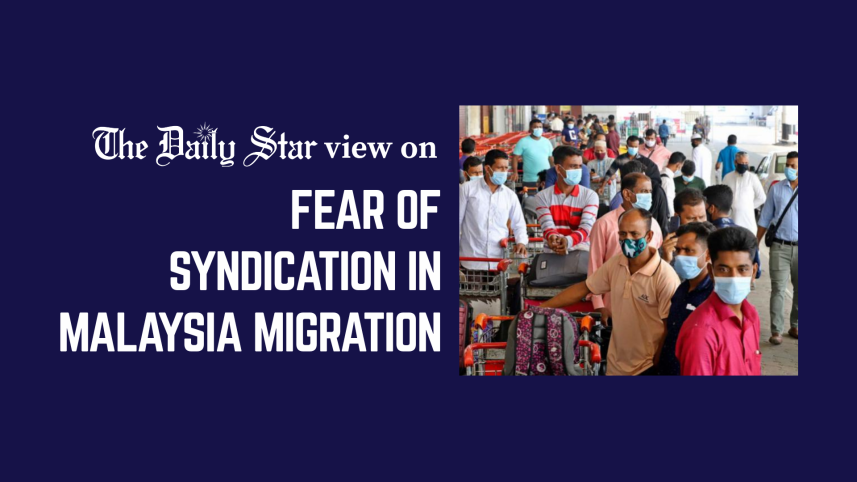
Some policy failures are so well documented that their recurrence seems inexplicable. The likely reopening of Malaysia's labour market to Bangladeshi workers is shaping up to be one such case, if early indications are correct. Malaysia has reportedly published a list of just 25 agencies authorised to handle the resumption of recruitment, which was suspended in May 2024. This appears to be a near-exact replay of what economists and labour rights groups on both sides have long called a textbook syndicate. We know very well how the agencies tied to that narrow circle charged steep fees for migration at the cost of aspirant workers.


So when the number of intermediaries permitted to supply labour to a market as large as Malaysia—which has absorbed close to 13 lakh Bangladeshi workers since 2009—is restricted, the system again runs the risk of exploitation. Whoever controls the list controls the rents. Recruiting-agency representatives have alleged that the cost of securing a place in the syndicate has jumped to around Tk 17.5 crore, more than triple the previous round, according to reporting by New Age. That means a select group of agencies will pass this cost straight on to workers, pushing migration costs as high as Tk 10 lakh per head.

Dhaka, therefore, must insist on a transparent, criteria-based system that opens the market to more agencies, not fewer. Tellingly, according to New Age, the expatriates' welfare ministry says it had little hand in drawing up the final list—Malaysia selected the names—and the state minister professes not to know how the selection was made. Meanwhile, Samakal, in its own coverage, flagged that some of the newly listed firms are functioning as fronts for influential figures who now dominate the political landscape. This is precisely the dynamic that made the 2022 list notorious. Samakal, for instance, named an agency newly added to the list, which is apparently run by the wife of a Jubo Dal vice-president and shares an office address with another firm linked to the same family.
For his part, Expatriates' Welfare and Overseas Employment Minister Ariful Haque Choudhury argued that Malaysia's labour market is equally open to India, Nepal and Pakistan, and that Bangladesh risks losing ground if it delays the process. That is not an unreasonable argument, but it is also the same argument that has historically been used to wave through opaque arrangements without scrutiny.

These controversies surface repeatedly because the underlying system keeps producing them—a 2018 shortlist scandal, a 2022 syndicate, and now fears of a repeat in this year's narrow list. The authorities on both sides must break this pattern. None of this is unique to Bangladesh-Malaysia labour flows; closed-list recruitment systems produce similar rent-seeking wherever they are tried, from Gulf kafala arrangements to seasonal-worker schemes in Europe. It is, therefore, crucial to publish the selection criteria and open the list to any agency that meets them. The Malaysian market has been suspended four times since 2009 for reasons of corruption and irregularity; a fifth reopening must not repeat the same mistakes.
 For all latest news, follow The Daily Star's Google News channel.
Comments