


End the criminality within our crime fighters
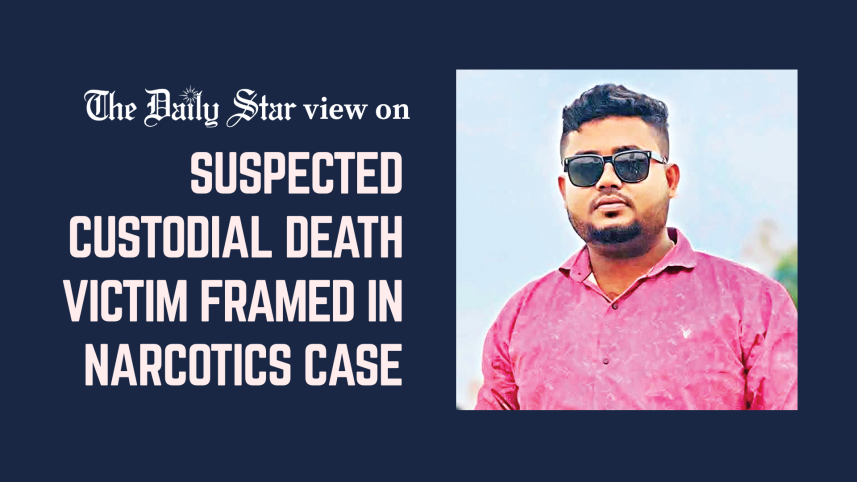
It comes as little surprise that a police investigation has confirmed what the family of Mirza Ishtiaq Ahmed Pranto, a law student who died in June while in custody of the Detective Branch (DB) of police in Faridpur, had been desperately trying to establish: that the narcotics charges brought against him were fabricated. The inquiry has found that there was no evidence that Pranto had drugs in his possession when arrested, and that “financial negotiations with Pranto’s family” had taken place while he was in custody. All these factors, the report concluded, could have caused mental stress that may have contributed to his death.
It is encouraging that the investigating team has established the truth of Pranto’s innocence. But it does not change the fact that a young man is dead after being framed by corrupt law enforcers. The allegations of torture made by his family now seem more plausible. This is a pattern that we have seen repeatedly in the past—law enforcers arrest an individual, bring made-up charges against them, take them into custody, and soon after, declare them dead with no credible explanation. Pranto’s case could have ended the same way if it had not received such public attention. A The Daily Star investigation last month also revealed several contradictions in the police version of events. All this may have played a role in bringing the truth to light.

But what happens when there is no public pressure or media attention? When deals are made quietly and victims are released if they are fortunate, and dead if they are not? According to the Human Rights Support Society (HRSS), at least 39 inmates died in prisons in the first three months of the year alone. Among them, 16 were convicts and 23 were awaiting trial. Twelve were leaders and activists of Awami League (Pranto was reportedly a Chhatra League activist). Evidently, despite the ouster of a regime that wielded power through torture, abduction, and killings, these practices have not been eliminated from the system. This is especially unacceptable for a government formed in the spirit of the uprising, which gave people hope that the days of arbitrary arrests, fabricated cases, custodial torture, and deaths in custody were over.
In the Faridpur case, the inquiry committee has recommended departmental action against 11 DB members over their conduct in the incident. This cannot be an end in itself. The government must acknowledge the gravity of the alleged crimes of filing a false case, torture, extortion, and causing the death of a detainee, and take necessary punitive and preventive measures. The amended Torture and Custodial Death (Prevention) Act, 2013 must be enforced rigorously and uniformly across the country. The government must ensure impartial investigations into every custodial death case reported, including alleged suicides of inmates, and punish those responsible. It must demonstrate that it will not tolerate corruption and criminality within the law enforcement and security agencies.
 For all latest news, follow The Daily Star's Google News channel.
Comments