Tigers and the empire: A history of hunting, power and resistance

“When a man wants to murder a tiger, he calls it sport; when a tiger wants to murder him, he calls it ferocity.”
-George Bernard Shaw, Man and Superman (1902)
Every year on 29 July, World Tiger Day celebrates the tiger as a conservation icon. Yet, this celebrity image obfuscates a forgotten but violent history for tigers. Long before the tiger became a conservation species with state protection in many parts of the globe, it was systematically hunted and killed as a display of human power. To observe this special day, it is worth remembering that the tiger’s current status as a conservation icon is inseparable from the history of empire. Understanding this past reminds us that the key challenge of tiger conservation is not only ecological and scientific but also deeply historical and political.

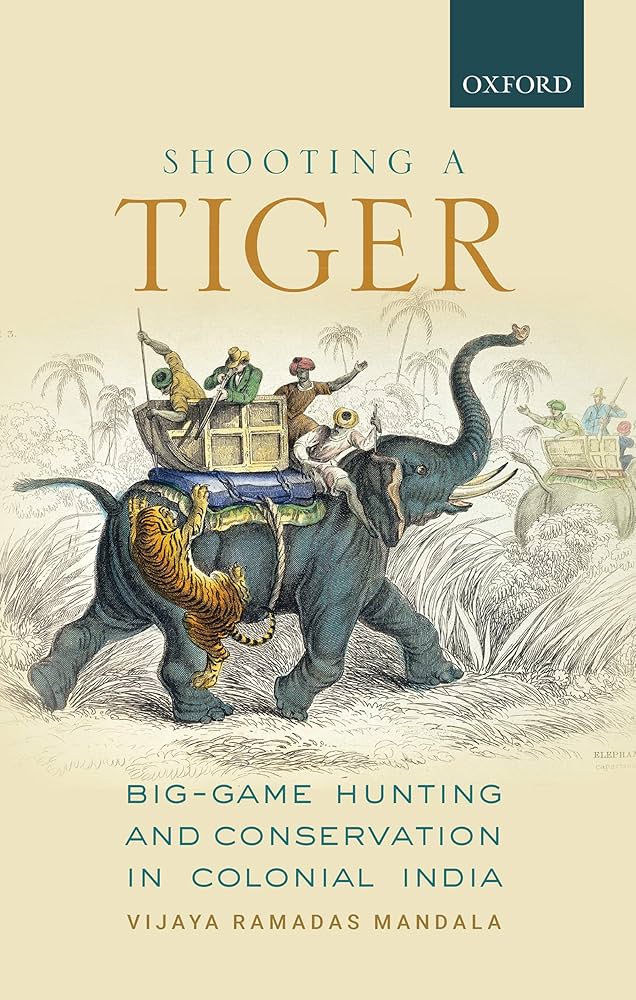
Let’s not think that it all started with the British colonisation of South Asia. It was primarily the Mughals who proliferated royal hunting before the British came to South Asia. During that time, hunting was associated with testing valour, a matter of royal display, and the confirmation of power. The Mughals also used hunting as a ruse for managing political affairs and for the acquisition of new territories. Killing feral, harmful, vermin animals such as ‘man-eating’ tigers, or deer and elephants that destroyed farmers’ crops, was a ruler’s obligation to his subjects. The Ain-i-Akbari reports that Akbar himself killed many man-eating tigers to save the common people. The Mughals had an entire department at court dedicated to the royal hunt, its organisation, and the tallying of the number of various animals killed, the tiger being one of them. So, it is clear that the hunting-governance nexus was not exclusively a product of British colonisation, but it became a political practice in the hands of the British. The British took this nexus to the next level, making it more meticulous. In Shooting a Tiger: Big-Game Hunting and Conservation in Colonial India (2018), Vijaya Ramadas Mandala argues that there was nothing glamorous about big-game hunting. Rather, “Shikar was ultimately a means to achieve an exploitative end that was neither scientific nor altruistic, but was aimed at realizing British colonial vested interests” (Mandala, 2018).
In The Empire of Nature: Hunting, Conservation and British Imperialism (1988), noted British historian John M. MacKenzie suggests that colonial hunting took place in several stages, slowly. Because of the presence of antelope, the nilgai, and a rich avifauna population in large numbers, they were quickly enlisted into the imperial diet. At first, the British took the services of the native shikaris but soon appropriated both the name and the activity themselves. Increasingly, they started big-game shooting in forests and mountains for sport and adopted the spectacular elephant-borne hunts of the Mughals. Hunting of foxes, jackals, and pigsticking increased too. Finally, the British targeted tigers, panthers, and elephants to display their symbolic power. By doing this, they also claimed the protective function for native life formerly offered by specialist Indian shikaris (MacKenzie, 1988).
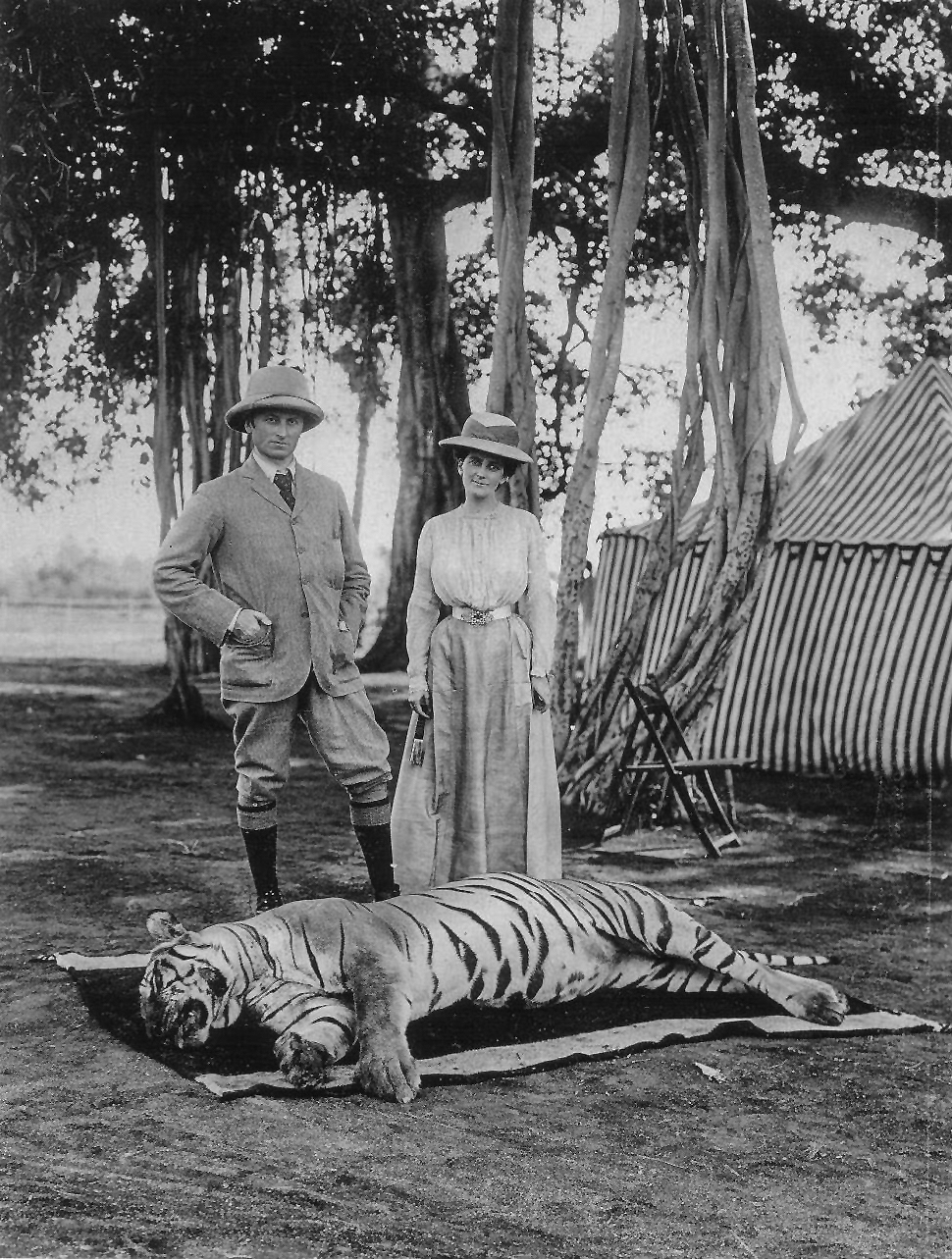
It is important to understand the British colonial interaction with the Indian forest before we understand colonial hunting, especially the pre-Forest Act regime between 1793 and 1882. In this phase, the entire enterprise of the British was the commercialisation of the Indian forest through every possible means, such as timber extraction, sandalwood extraction, coffee and tea plantations, railway construction, and revenue from agrarian expansion. How the British treated Indian wildlife, including large carnivores, went hand in hand with the way they colonised the Indian forest. During Company rule, the establishment of the Bombay Forest Conservancy in 1847 encouraged the British Indian government to develop the Imperial Forest Department in 1864 (Grove, 1995). The Forest Act of 1878 practically closed the forest by bringing more than one-fifth of the region’s topography completely under the control of the Forest Department. To hunt game in state forests, one now had to obtain a hunting licence. Licences were seldom issued to Indians, except to a few local elites (Rangarajan, 1996). Throughout this entire process of forest encroachment through the Forest Act, the Forest Department, game laws, hunting bans, licensing, and tribal pacification in many parts of India went hand in hand.
War against tigers
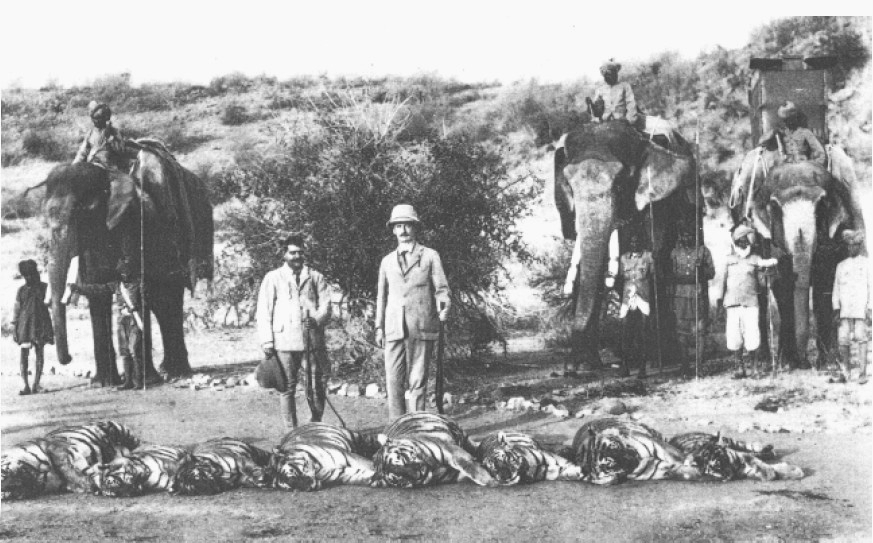
By one popular estimation, 80,000 tigers were killed between 1875 and 1925 (Rangarajan, 2001). One of the main reasons for killing tigers in British India was the mythical aura surrounding this species. The big-game hunters contributed to creating this pervasive myth that turned the tiger into both ‘vermin’ and a glorious trophy (Mitra, 2019). The massacre of big cats like tigers and lions throughout the late nineteenth and early twentieth centuries represented for the British “the triumph of culture over nature and of the colonizer over the colonized” (Storey, 1991). Besides, experts find structural similarities between the European policy of wolf extermination and the colonial efforts at eradicating tigers in India (Rangarajan, 1996).
Two additional factors accelerated tiger hunting during the colonial era: rewards and the advancement of war technologies, such as firearms. Since the tigers became the empire's enemies, the British aggressively promoted the extermination of tigers, along with other carnivores, by luring both White and Indian hunters, who annihilated them for cash rewards. Whenever a notorious ‘man-eater’ was gunned down, a significant reward was usually offered (MacKenzie, 1988). As early as 1822, the Company offered incentives of 38,483 rupees in the Bengal Presidency for the killing of 5,573 tigers (Skaria, 1999). In order to reduce their numbers in the Sundarbans, the British Government paid a reward of Rs. 50 for each tiger killed east of the Passur River and Rs. 100 for each tiger shot west of it (O’Malley, 1910). By the 1920s, given the pastoral nature of the Indian economy, hunting generated employment opportunities for some villagers, who could be engaged as beaters, trackers, servants, gun carriers, and cooks in the expedition. Protected game in reserved forests also became a source of income. In Diary of a Sportsman Naturalist, Stebbing claims that the Indian Forest Department started considering forest animals as resources and continued to protect them suitably for the lucrative big-game hunting trade by 1920 (Stebbing, 1920). Regarding firearms, the British used different weapons such as the single-barrelled rifle, the double-barrelled rifle, guns, pistols, improved bullets, and shotguns to kill different large, medium, and small animals throughout the centuries. A British Indian newspaper promoted high-velocity cordite rifles as the ideal tools for killing tigers in 1904. Since its conquest of Bengal, the British had been eager to display the superiority of their firearms and gunpowder over Indian-manufactured weapons (Mandala, 2018).
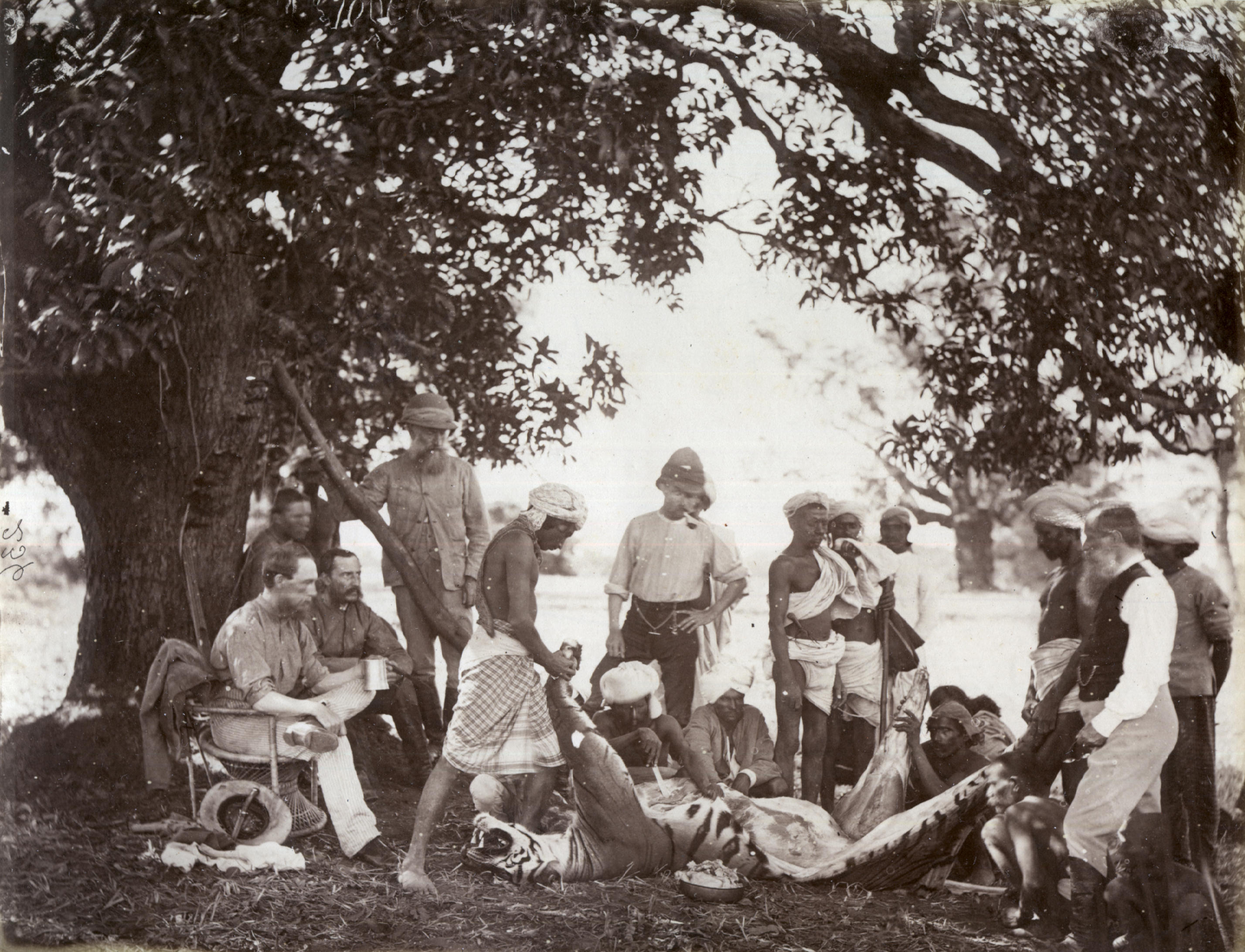
When the British found a wild plant species of tea, the fate of the Assam Forest and its tigers changed forever during the 1830s. A botanist, William Griffith, was quickly sent to Assam on a scientific expedition to examine the area as well as the indigenous tea plant. During the reclamation process for tea plantations, wild animals, including tigers, were hunted on an unprecedented scale during the 1860s and 1870s in Assam. In 1870, the Assam administration was offering five rupees for killing a tiger, with one army officer even recommending that spring guns be placed strategically along tiger trails in the forest (Ray, 2023). This colonial plantation economy transformed forests into tea gardens, natives into disciplined wage workers, and tigers into man-eaters.
Resistance of the ‘man-eaters’
It was found that big cats like tigers and lions practically resisted British expansion in the colonies, if we are ready to acknowledge animal agency in human history and power. In colonial documents such as the Statistical Accounts of Bengal and several Bengal District Gazetteers, it was repeatedly found that, during the land reclamation project in the Sundarbans, an initiative to clear the jungle to accelerate agrarian revenue by the British and local zamindars, tigers attacked defenceless forest clearers on numerous occasions. Sometimes, a tiger took possession of a tract of land and committed such fearful havoc that it was left in peace in its domain. The depredations of some unusually fierce tiger(s) often caused the retreat of an advanced colony of clearers, who, through fear, were compelled to abandon land that only the labour of years had reclaimed from the jungle (Hunter, 1875). Alongside Asian tigers, African lions were also tagged as ‘man-eaters’ in the nineteenth century when the British expanded their railway networks connecting Uganda and Kenya for transporting goods, soldiers, and slaves. Remarkably, 135 people were killed (according to the hunter Patterson, who killed the lions), or 28–31 (according to research conducted in 2001), by the two lions in less than a year.
It is obvious that tigers, as active agents, would respond to this structural violence. Tigers’ response was an effort to navigate shrinking habitats and resource scarcity imposed by colonial policies over the centuries. The construction of ‘man-eaters’ was a successful attempt at making tigers appear ‘dangerous’, ‘a threat’, and hence ‘killable’. Even if tigers killed 828 people in 1877 and a similar number annually throughout the late 1800s and early 1900s in British India (Hughes, 2013), and no fewer than 101 men were killed by tigers in the Sundarbans forests in 1905–06, and 83 in 1906–07 (O’Malley, 1910), we first need to raise the question of why this happened before pointing to the ‘man-eating’ instinct of tigers. Colonial historiography is hardly interested in answering the causes.
Rather than considering the broader structural factors behind tiger attacks on humans and livestock, many British officials were eager to blame the natives. Sir Henry Farrington, Deputy Conservator of Forests, who was in charge of the Sundarbans Division, wrote that native shikaris used small slugs to fire at tigers, but these did not kill them; instead, the wounded and irritated tigers killed humans. They also falsely blamed the native shikaris for the wholesale slaughter of the deer population, resulting in the shortage of the tiger’s natural prey in the forest. However, anthropologist Nayanika Mathur, in Crooked Cats: Beastly Encounters in the Anthropocene (2021), reconceptualises the ‘man-eaters’ as ‘crooked’ cats. She argues that we should see big cats as ‘crooked’ because the normal lives of these cats have been disrupted by human actions and their political structures more broadly, causing them to behave differently. It is important to ask what makes tigers ‘man-eaters’.
Natives’ resistance
All colonial hunting memoirs reveal something about the natives too, in multifaceted ways. Natives were always important as companions and guides during hunting expeditions because of their incredible knowledge of wildlife and the local ecosystem. The majority of British hunters shared one very common experience with a seemingly trivial matter: the coughing of the natives just before the right moment to shoot the tigers. The native guides, sitting patiently with the White hunters in a safe place in the jungle, would suddenly ‘cough’ at the perfect moment, that is, when the tiger, after a long wait, appeared and was about to be shot. But, upon hearing the natives’ coughing, the tiger would escape in the blink of an eye. British hunters like Henry Shakespear, George Sanderson, and J. C. Fife-Cookson wrote about this. While Shakespear and Sanderson explained it as a by-product of the nervousness and anxiety experienced by the natives upon seeing a tiger from such a close distance, Fife-Cookson, in his book Tiger-Shooting in the Doon and Ulwar: With Life in India (1887), elaborated on it. Fife-Cookson tried to provide answers about why the natives coughed in a more meticulous way. He writes:
‘Of course, they will say that they could not help it. Although nervousness may have something to do with it, they are probably influenced by the wish to warn the tiger off. They may fear that they will have to incur danger while following up the animal if it is wounded, or they may wish to protect it, owing to the superstitious belief that the spirit of a tiger pursues those who have assisted in its hunting’ (Cookson, 1887, pp. 208–209).
However, the native shikari communities did not support the indiscriminate killing of wild animals in large numbers for reasons such as the fear of wildlife depletion, the loss of hunting as a livelihood, and wiping out competition with White hunters because of their technological superiority (Mandala, 2018). So, it is easy to prove that not all natives thanked the White hunters as ‘saviours’ from tiger attacks, whether or not they were ‘man-eaters’. Obviously, the natives’ cough saved the lives of many innocent tigers, a much stronger and more effective ‘weapon of the weak’ compared with other means of resistance, such as a peasant’s fart (‘When the great lord passes, the wise peasant bows deeply and silently farts’), an Ethiopian proverb that anthropologist James Scott used in the prologue of Domination and the Arts of Resistance: Hidden Transcripts (1990).
It would be a mistake to view tiger hunting in South Asia as a sport or mere wildlife decline; rather, it is a story linked with empire, power, and resistance in the colonial world. Animal worlds are fundamentally entangled with human worlds. The history of the Silk Road was not only about silk and its trade but also about the horses that made this trade and human mobility possible. So, situating animals within a multispecies world, where human-animal relationships have evolved historically and politically, reveals animals as actors whose interactions with humans have profoundly shaped history, economy, culture, politics, and the natural world.
References:
Fife-Cookson, J. C. (1887). Tiger-shooting in the Doon and Ulwar: With life in India. Chapman and Hall.
Grove, R. H. (1995). Green imperialism: Colonial expansion, tropical island Edens and the origins of environmentalism, 1600–1860. Cambridge University Press.
Hughes, J. E. (2013). Animal kingdoms: Hunting, the environment, and power in the Indian princely states. Harvard University Press.
Hunter, W. W. (1875). A statistical account of Bengal (Vol. 1, Districts of the 24 Parganas and Sundarbans). Trübner & Co.
MacKenzie, J. M. (1988). The empire of nature: Hunting, conservation and British imperialism. Manchester University Press.
Mandala, V. R. (2019). Shooting a tiger: Big-game hunting and conservation in colonial India. Oxford University Press.
Mitra, R. (2019). To hunt or not to hunt: Tiger hunting, conservation and collaboration in colonial India. International Journal for History, Culture and Modernity, 7(1), 815–839.
O'Malley, L. S. S. (1908). Bengal District Gazetteers: Khulna. Bengal Secretariat Book Depot.
Rangarajan, M. (1996). Fencing the forest: Conservation and ecological change in India's Central Provinces, 1860–1914. Oxford University Press.
Rangarajan, M. (2012). The Raj and the natural world: The campaign against "dangerous beasts" in colonial India, 1875–1925. In M. Rangarajan & K. Sivaramakrishnan (Eds.), India's environmental history: Colonialism, modernity, and the nation: A reader (Vol. 1, pp. 95–142). Permanent Black.
Ray, R. (2022). On the prowl: Tigers and the tea planter in British India. In V.-Y. Tee (Ed.), Romantic environmental sensibility: Nature, class and empire (pp. 113–138). Edinburgh University Press.
Skaria, A. (1999). Hybrid histories: Forests, frontiers and wildness in western India. Oxford University Press.
Stebbing, E. P. (1920). Diary of a sportsman naturalist in India. John Lane, The Bodley Head.
Storey, K. W. (1991). Big cats and imperialism: Lion and tiger hunting in Kenya and northern India, 1898–1930. Journal of World History, 2(2), 135–173.
Fahmid Al Zaid is associate professor in the Department of Anthropology, University of Dhaka, and a PhD candidate at Durham University, UK. He can be reached at fahmidshaon@du.ac.bd.
Send your articles for Slow Reads to slowreads@thedailystar.net. Check out our submission guidelines for details.

25th Death Anniversary / A life so full: Remembering Ahmed Sofa

Bengal's forgotten slave trade: Portuguese, Arakanese and Dutch trafficking networks

Mufazzal Haider Chaudhury and the idea of Bangladesh

The Tagore paradox: Why critique strengthens his legacy

What Sufism can teach us about the modern world
The journey of Qawwali across South Asia: Music, mysticism, and cultural exchange

Thinking with Partha Chatterjee

Why secularism is losing ground in South Asia

Interview / Modern Islam has always been a 'secular' entity