


When crime becomes an economic risk
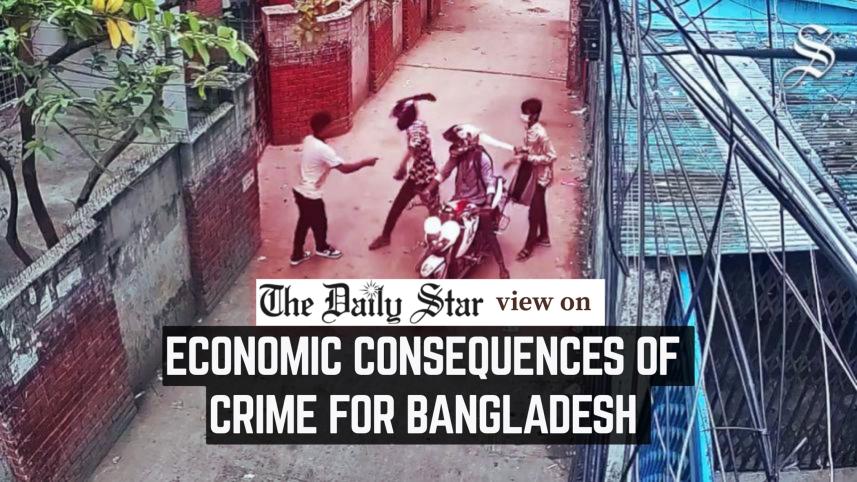
As the World Economic Forum (WEF) warns of a coming “stormy” period for the global economy, Bangladesh is already living through a phase of turbulence. The country’s most serious business threats are now identified as “crime and illicit economic activity.” This is only logical. For when businesses fear lawlessness more than other challenges, it reflects a breakdown in the stability and predictability essential for investment, job creation, and economic recovery.
The WEF’s Global Risks Report 2026, based on responses from more than 1,300 experts and over 11,000 business leaders across 116 economies, paints a dismal global picture. Half of all respondents said they expect the world to enter a stormy phase, while only one percent foresee calm conditions. For countries like Bangladesh, many of these global risks are not distant possibilities; they are already unfolding on the ground.

One of the most serious global threats identified is geoeconomic confrontation, driven by the growing use of tariffs, sanctions, and trade restrictions as political weapons. As major powers escalate economic rivalry, smaller, trade-dependent countries like Bangladesh are increasingly caught in the crossfire. In line with previous forecasts, inflation also remains a severe risk for Bangladesh. Despite recent efforts by the central bank, high prices continue to squeeze households and businesses. Rising debt vulnerability adds another layer of concern. High levels of debt are reducing the country’s ability to absorb shocks.
Bangladesh’s challenges mirror those of its neighbours to some extent. Sri Lanka, for instance, is still recovering from its 2022 sovereign debt crisis, with inflation and public debt remaining its top risks. Nepal faces chronic instability, driven by weak public services and high unemployment. Across all three countries, the WEF report identifies a shared problem: citizens feel excluded from political decision-making and are losing hope for better livelihoods.
South Asia is particularly vulnerable to the rivalry between the United States and China. For countries seeking to remain non-aligned, the pressure is intensifying. The weakening of the World Trade Organization further leaves smaller economies with fewer safeguards in trade disputes. For Bangladesh, this poses a direct threat to the garment sector—the backbone of its economy. Any disruption to global trade flows could have severe consequences for exports, employment, and growth.
As the world moves towards what the WEF describes as a “multipolar or fragmented order,” the message for Bangladesh is stark. The era of easy growth driven by globalisation seems to be over. What lies ahead is a test of resilience: rebuilding trust in institutions, restoring law and order, and creating inclusive economic opportunities.
To weather the current spell of turbulence, Bangladesh’s next elected government must prioritise the restoration of domestic stability by treating law and order not just as a security issue, but also as an economic imperative. At the same time, the authorities must address the deep-seated inequality and lack of economic opportunity that drive societal polarisation, ensuring that economic reforms are inclusive enough to mitigate the grievances of excluded citizens.
 For all latest news, follow The Daily Star's Google News channel.
Comments