


‘Unequal rural load-shedding is a symptom of a deeper structural crisis’

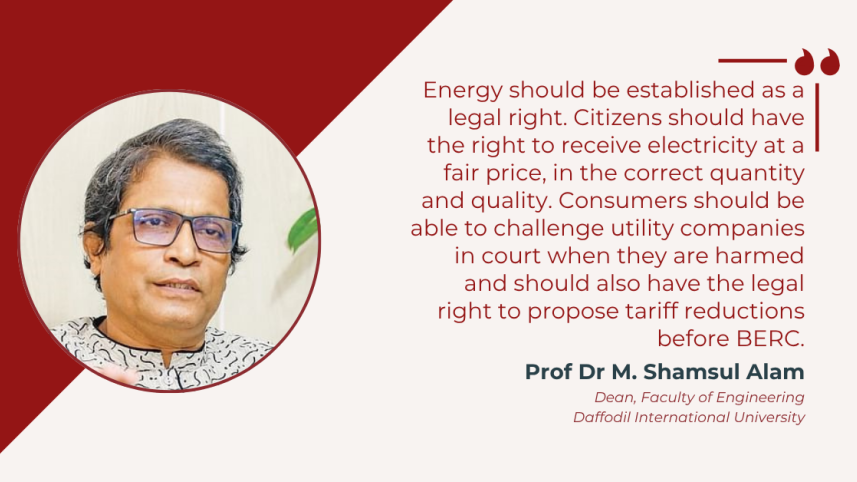
Prof Dr M. Shamsul Alam, dean at the faculty of engineering at Daffodil International University and energy adviser at Consumers Association of Bangladesh (CAB), speaks with Monorom Polok of The Daily Star about the ongoing power crisis, persistent rural-urban disparities in electricity distribution, financial challenges facing the power sector, and the reforms needed to ensure a more reliable and equitable energy system in the country.
As always, rural areas have been facing far more power cuts than the cities this summer. Why has the gap become so severe? Is this a technical problem or a policy failure?

This is neither simply a technical problem nor merely a policy failure. It reflects a lacking in our collective understanding of equality.
Load-shedding is one of the clearest examples of discrimination. Rural areas experience far more outages than cities even though their electricity demand is lower and often concentrated during the evening. If rural consumers are subjected to load-shedding while urban consumers continue receiving electricity, then public services are being distributed unequally.
There is also a policy dimension. Consumers connected above the 33kV level are generally exempt from load-shedding. Most large commercial, industrial and institutional consumers in urban areas receive electricity through 132kV or 230kV networks. As a result, policy itself shields them from outages.
Our constitution says citizens should not face discrimination in receiving state services. If load-shedding becomes unavoidable because the state cannot meet demand, then that burden should be shared equally.
The impact of this burden goes far beyond households, of course. Rural economy also suffers heavily. Without electricity, irrigation is disrupted, fish die in the ponds during the dry season, poultry production declines, and small industries cannot operate as expected. When these and other rural sectors lose electricity, production falls, incomes decline, and government tax revenues also suffer.
Many experts say Bangladesh generates electricity based on fuel availability rather than actual demand. What does that mean, and how has it contributed to the current crisis?
The real issue is not whether electricity is generated according to fuel availability or demand. The real issue is how Bangladesh designed its generation capacity and fuel mix. Power systems should operate according to the principle of least-cost dispatch. The cheapest available fuel should always be used first. If sufficient domestic gas were available, gas-fired plants could operate first because they generate electricity at the cheapest cost. But domestic gas production has declined while imported LNG is expensive. As a result, only a fraction of existing gas-based capacity is being utilised.
Coal-fired electricity is also cheaper than oil-fired generation. Bangladesh has substantial coal-fired capacity, but it is not fully utilised apparently because importing coal also requires foreign currency that the government struggles to afford. Despite that, expensive oil-fired plants continue operating even though electricity from them can cost Tk 25 to Tk 26 per unit. Meanwhile, the cheaper coal-based capacity remains underutilised.
Bangladesh’s fuel mix also reflects policy choices made over many years. The country significantly expanded oil-based electricity generation capacity even though oil is among the most expensive fuels. At one stage, around a quarter of the country’s electricity came from oil-fired plants, and even today oil still accounts for more than one-fifth of generation. Maintaining this system places a huge financial burden on the government because imported fuel must be purchased with scarce foreign currency.
This creates the impression that electricity generation depends on fuel availability. In reality, generation is constrained by the government’s financial capacity. The government purchases only as much fuel as it can afford, and electricity production is limited accordingly.
As generation costs have risen, the government has struggled to pay fuel suppliers, repay infrastructure loans, and meet other financial obligations. The result is that electricity generation is increasingly determined not by consumer demand or installed capacity, but by how much fuel the government can actually afford to buy. That constraint has become one of the main drivers of recurring load-shedding.
Hence, the current crisis is less about technical shortages than about financial constraints. Bangladesh’s dependency on imported fuels has made electricity generation increasingly expensive. As fuel imports are rationed because of dollar shortages, electricity production is falling below demand, making load-shedding unavoidable.
How much of the power crisis is linked to the country’s dependency on expensive private power plants and the financial problems in the power sector?
The crisis has several dimensions. First, as I said before, heavy dependency on imported fuels has sharply increased generation costs. Had there been a least-cost fuel strategy, electricity could have been produced much more cheaply. Second, the issue is not simply that the private sector has been encouraged; private investment can work if it is properly regulated. The real problem is that regulation has failed.
The Bangladesh Energy Regulatory Commission (BERC) was created to regulate the sector, but a regulatory culture has never developed properly. Independent power producers, merchant plants, and other private generation models were introduced, but effective oversight remained weak. The state weakened many of the safeguards. Competitive procurement was relaxed under emergency legislation, reducing transparency and accountability. Once competition disappears, it becomes much easier for excessive costs and inflated profits to become embedded in the system. When private investment expands without strong regulation, the sector becomes vulnerable to exploitation. In Bangladesh, private investors have gained enormous influence over state decision-making, creating what I would describe as an oligarchic structure.
It should also be remembered that private generation has not necessarily been cheaper. Government data shows that in 2022, electricity generated with gas cost around Tk 5 per unit in the private sector but only around Tk 3 in the public sector. Hence, the current crisis is not simply about expensive private power plants; it is about the state’s declining ability to regulate the sector effectively. When regulatory institutions become weak while private interests become stronger, the balance shifts away from public interest.
Today’s crisis should not simply be described as an electricity shortage. The deeper problem is that the power sector itself has become financially distressed. Its liabilities exceed its financial capacity, it cannot repay its debts, and it faces an acute liquidity crisis. This crisis ultimately affects electricity generation itself and spreads into the wider economy. As electricity shortages reduce industrial production, government revenues decline. The state then borrows more, crowds out private investment, and eventually faces even greater fiscal pressure.
What are the most important reforms that Bangladesh should make to reduce recurring summer power cuts and ensure a more reliable electricity supply?
 For all latest news, follow The Daily Star's Google News channel.
 First, the government must recognise that this is not primarily a technical problem but a structural governance issue. Simply building more infrastructure without changing the institutions that manage the sector will only create further opportunities for waste and corruption. The existing administrative structure has lost public confidence and is not capable of delivering meaningful reform in its current form.
Second, Bangladesh should rapidly expand distributed renewable energy. Renewable electricity currently contributes only a small share of the national grid despite much larger potential. Instead of relying solely on centralised generation, the country should encourage thousands of small entrepreneurs to develop decentralised solar and other renewable projects. This would expand generation capacity while creating employment and gradually reducing dependency on imported fuels.
The original “electricity for all” policy has lost public credibility because many people believe inflated demand projections were used to justify unnecessary infrastructure projects that created opportunities for rent-seeking. The government must acknowledge that loss of confidence if it wants to rebuild trust.
Moreover, government-owned energy companies should operate on a cost-recovery basis rather than seeking profits. Their purpose should be to provide public services, not to maximise commercial returns. Electricity tariffs should reflect only the actual cost of providing the service. At the same time, the government must rebuild confidence in regulatory institutions. Public trust has declined because many people no longer believe regulators are acting independently or effectively. Regulation should protect consumers, not merely approve tariff increases or accommodate commercial interests.
Finally, energy should be established as a legal right. Citizens should have the right to receive electricity at a fair price, in the correct quantity and quality. Consumers should be able to challenge utility companies in court when they are harmed and should also have the legal right to propose tariff reductions before BERC. Without stronger public accountability, reforms in infrastructure or generation alone will not solve the underlying problems. Genuine energy justice requires enforceable rights, transparent regulation, and accountability throughout the sector.
Follow The Daily Star Opinion on Facebook for the latest opinions, commentaries, and analyses by experts and professionals. To contribute your article or letter to The Daily Star Opinion, see our guidelines for submission.
Comments