


How Bangladesh can make the most of its South Korea CEPA

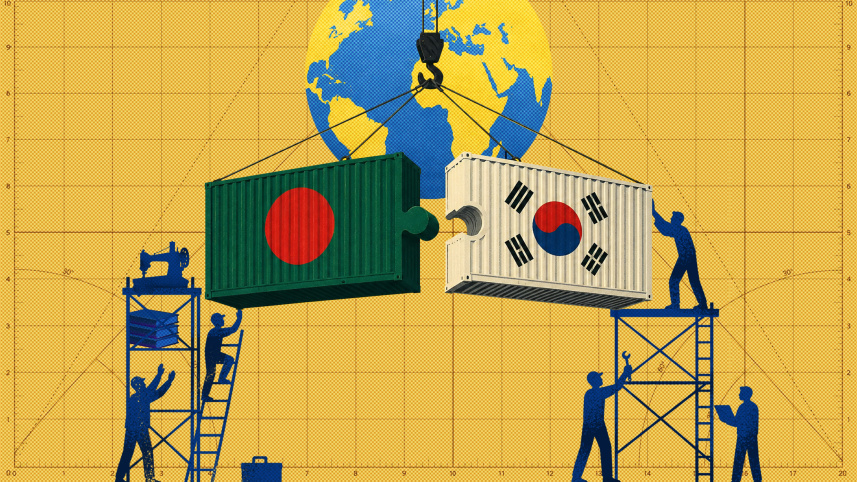
Following an intensive negotiating process spanning about a year, Bangladesh and South Korea signed a Comprehensive Economic Partnership Agreement (CEPA) on August 4, 2026. The CEPA was determined after five formal rounds of negotiations between August 2025 and July 2026, along with several meetings. This agreement has been signed as Bangladesh’s scheduled November 2026 graduation from the Least Developed Country (LDC) status approaches fast. Hence, this CEPA should be considered a turning point for Bangladesh’s trade policy, as it is a major shift from prevailing unilateral trade preferences towards negotiated and reciprocal economic partnerships.
As an LDC, Bangladesh has benefited from preferential access to markets in various developed and developing countries. With graduation in mind, some of these unilateral concessions will have to be replaced with bilateral and regional partnerships. The CEPA with South Korea can therefore be considered as part of a broader trade, investment, and economic strategy during Bangladesh’s post-LDC phase.

However, since a modern CEPA is not merely a tariff agreement, Bangladesh could materialise this preferential market access into actual exports, attract technologically advanced South Korean investment, integrate homegrown companies into South Korean supply chains, enhance services exports, and upgrade domestic industries overall. This all rests upon Bangladesh’s ability to enhance its capacity and undertake adequate preparation.
The CEPA creates a wide framework, covering trade in goods and services, investment, rules of origin, customs procedures, sanitary and phytosanitary (SPS) measures, technical barriers to trade (TBT), digital trade, intellectual property rights, and economic cooperation.
One of the critical issues in determining how much Bangladesh actually gains from the CEPA is the rules of origin. For example, this is especially crucial for garments and other industries in Bangladesh which depend on imported raw materials and intermediate inputs. Duty-free access is beneficial only if exporters can satisfy the origin requirements without incurring high costs or facing administrative burdens.
Bangladesh should keep track of the preference-utilisation rate, which measures the proportion of eligible exports that utilise CEPA preferences to enter South Korea. Additionally, government agencies and business groups should offer clear guidance on rules of origin, customs procedures, SPS requirements, and South Korean technical standards. This support will be especially vital for small-scale exporters who might not have the resources to abide by specialised compliance.
Services and digital trade are also substantive parts of the CEPA and could open doors for Bangladesh in areas like IT, IT-enabled services, professional services, and other knowledge-driven sectors. But having market access on paper does not guarantee exports. Bangladesh must pinpoint specific South Korean services markets with real potential, determine which domestic companies and professionals can access these markets, and understand the licensing, qualification, and regulatory requirements they need to fulfil. This is important because liberalisation benefits both sides. South Korean companies possess much greater technological skills and international experience in many advanced services. Bangladesh must therefore enhance its domestic capacity so its companies can take meaningful advantage of these new opportunities.
For Bangladesh, the most significant long-term advantage of the CEPA could be investments and technology, rather than tariffs. South Korea holds an important place in Bangladesh’s industrial history. In the late 1970s, Daewoo and Desh Garments collaborated to facilitate the transfer of production, management, and marketing knowledge to Bangladesh and aiding the growth of the domestic garment industry. The challenge lies in replicating these benefits within more technologically advanced industries.
Bangladesh should aim to attract South Korean investment in sectors such as electronics, engineering, automotive parts, renewable energy equipment, medical devices, advanced textiles, and digital industries. However, the goal should not be limited to increasing FDI volume, but should focus more on attracting high-quality investment to foster skills, increase technology transfer, and strengthen connections with local companies. This will involve conducting supplier development programmes that connect South Korean investors with SMEs here, along with technical training, university-industry collaboration, and joint research. The focus should not be on how much South Korean investment the CEPA attracts, but to also evaluate the technological and productive skills that such investment can foster within Bangladesh.
The CEPA could boost South Korean exports to Bangladesh, potentially raising concerns about the existing bilateral trade deficit. However, a larger trade deficit does not necessarily indicate that the agreement is detrimental. Lower tariffs that reduce the cost of South Korean machinery, industrial inputs, and technology can boost the productivity and competitiveness of Bangladeshi industries. Again, the focus should be on the quality and significance of what Bangladesh imports from South Korea, not just the volume.
One area of concern would be if the CEPA primarily leads to increased imports of finished consumer goods, while exports from Bangladesh and South Korean investment remain weak. Therefore, the government should oversee export growth, analyse the composition of imports, monitor investment, employment, domestic industrial adjustments, and customs revenue rather than concentrating solely on the bilateral trade balance.
The CEPA illustrates the increasing complexity of modern trade agreements. Bangladesh has developed greater negotiating capacity through the Foreign Trade Agreement (FTA) Wing of the Ministry of Commerce. But the challenge now moves from negotiating agreements to implementing them effectively. This is particularly important as Bangladesh has entered an economic partnership agreement (EPA) with Japan and a CEPA with South Korea while pursuing arrangements with Singapore, the UAE, and other partners. Bangladesh requires ongoing expertise in trade economics, international trade law, services, investment, customs, standards, rules of origin, and digital regulation. Effective coordination among the Ministry of Commerce, National Board of Revenue (NBR), Bangladesh Bank, Bangladesh Investment Development Authority (BIDA), standards bodies, and other relevant agencies will also be crucial.
A dedicated CEPA monitoring mechanism should track a limited set of measurable indicators such as export growth and diversification, tariff preference utilisation, services exports, South Korean FDI, technology transfer, Bangladeshi SME participation in South Korean supply chains, and pressures on domestic industries. Bangladesh requires targeted strategies tailored to specific sectors for the South Korean market. Simply offering preferential access will not boost exports unless companies grasp the opportunities, comply with South Korean standards, and build commercial networks. Similarly, investment promotion should focus on specific South Korean companies and industries aligned with Bangladesh’s industrial goals, rather than broad, generic approaches.
Implementing the CEPA can serve as a valuable experience to guide Bangladesh in its other trade agreements. As Bangladesh moves to advance beyond LDC status, developing the capacity to implement, monitor, and regularly evaluate these agreements will be equally crucial as the skills needed to negotiate them.
The significance of the Bangladesh-South Korea CEPA should be measured by its economic impact rather than the number of tariff lines included. In five years, key indicators of progress will include increased exports from Bangladesh to South Korea, a broader product range, actual preference utilisation by exporters, growth in services exports, South Korean investment in advanced sectors, and the development of new skills and technologies among Bangladeshi firms and workers.
The CEPA offers significant opportunities, and Bangladesh must actively use the new market access to increase and diversify exports, attract South Korean investment into higher-value industries, and ensure that such investment brings new technology and skills. If these opportunities are effectively utilised, the CEPA can play a very important role in Bangladesh’s economic strategy after LDC graduation.
Dr Fahmida Khatun is an economist and executive director at the Centre for Policy Dialogue (CPD).
Views expressed in this article are the author’s own.
Views expressed in this article are the author's own.
Follow The Daily Star Opinion on Facebook for the latest opinions, commentaries, and analyses by experts and professionals. To contribute your article or letter to The Daily Star Opinion, see our guidelines for submission.
 For all latest news, follow The Daily Star's Google News channel.
Comments