


Air pollution: What Beijing got right that Dhaka still hasn't

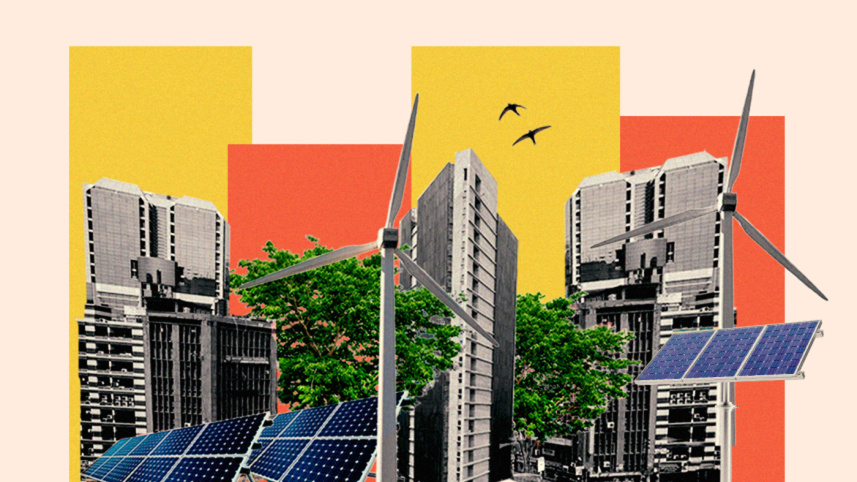
Around five years ago, headlines worldwide noted Beijing’s skyline darkened by pollution. On the other hand, IQAir’s World Air Quality Report recognised Bangladesh as the most polluted country on earth in 2019. It also found Dhaka among the top five most polluted capital cities globally. Two cities had this common ground for a while, but it did not last long.
Astonishingly, after implementing policy-oriented reforms, Beijing recorded 290 days of good or moderate air quality in 2024—the highest since monitoring began. Furthermore, the heavy pollution days decreased by 96.6 percent compared to 2013. Meanwhile, Dhaka still ranks among the most polluted capital cities in the world.

The contrast between Beijing and Dhaka is more than an environmental failure; it is a direct consequence of how we choose to power our nation. Much of the smog darkening our capital stems from reliance on fossil fuels, a dependency that drains both our public health and our economy.
According to the Institute for Energy Economics and Financial Analysis (IEEFA), Bangladesh’s peak power demand stood at 17,000 MW in FY2024-25. With an installed capacity exceeding 27,000 MW, we are sitting on a massive, unproductive reserve margin of 61.3 percent. Consequently, we are bleeding money on capacity charges for electricity we never even use. Then there is renewable energy. Following decades of policy recommendations and formulations, this source still accounts for less than five percent of our installed capacity. And every time a global crisis hits, our fossil fuel import bill takes another punishing hit, most recently threatened with a $4.8 billion spike from 2025 levels due to tensions in the Middle East. This is the cost of dependency.
The Centre for Policy Dialogue (CPD) put it plainly: Bangladesh needs to seriously consider alternatives. But considering is no longer enough. Beijing did not clean its air by issuing statements. Their robust policy enforcement, strategic industrial restructuring, and targeted investment made it happen. Our government must take up and move with the same drive. That means empowering frameworks, encouraging incentives, and pricing structures that make renewable energy the more obvious financial choice for both producers and consumers. While the Renewable Energy Policy, 2025 is a positive step, its success in sustainably securing our energy future depends entirely on strict implementation and institutional follow-through.
Our private sector must enter the picture. It has supply chains, distribution networks, rural market penetration, and institutional finance relations that government agencies cannot replicate at scale. The question is whether they have the coordinated will to use it. And the opportunity extends well beyond solar. Consider the capacity utilisation gap our own grid presents. By maintaining 27,000 MW of installed capacity for a peak demand of only 17,000 MW, we are wasting an enormous amount of energy generation headroom every single day. Energy Storage Systems (ESS) can be a direct solution. By storing surplus off-peak generation and releasing it at peak hours, ESS can energise our infrastructure in far more productive ways.
Global grid-scale battery storage deployments grew 38 percent year-on-year in late 2025. Considering this, the private sector in Bangladesh should invest in localising this technology as part of its clean energy commitment. Beyond solar and storage, our hydroelectric potential remains over 50 percent untapped, and the Rooppur Nuclear Power Plant’s first unit is expected to add 1,200 MW to the grid by early 2027. Private sector involvement in managing these projects and localising components is exactly what is needed to accelerate their timelines.
Electric vehicles (EV) present another deeply practical lever. Our government aims for 30 percent EV penetration by 2030, and despite infrastructural leakages, adoption has been growing steadily. If the private sector endeavours a policy-backed drive towards night-time EV charging infrastructure, two things will happen at once: off-peak grid capacity will get productively utilised, and the country will reduce its reliance on imported fuel for transportation.
And for all of this to reach the households that need it most, the microfinance model remains the indispensable bridge. The Infrastructure Development Company Limited’s (IDCOL) Solar Home System Program has already demonstrated that combining concessional finance with grassroots NGO networks and delivering the product first with repayment following in manageable instalments can bring clean energy to over two crore people. A solar home system costs between Tk 7,000 and Tk 20,000. For a lower-middle-income household, that is a barrier, not a purchase. Under a structured micro-credit plan, it becomes accessible. The model exists. The financing channels exist. What is missing is greater and deliberate institutional participation of private sector players who are already in the clean energy space.
The urgency goes far beyond environmental. The EU’s Carbon Border Adjustment Mechanism will be in effect in 2027. According to CPD’s analysis, Bangladesh’s garment and textile sector will need to demonstrate clean energy sourcing or face carbon-related trade penalties in European markets. Our largest industry depends on this transition. The private sector cannot afford to treat clean energy as a Corporate Social Responsibility (CSR) footnote when it is fast becoming a trade requirement.
Beijing looked at its grey skies and decided enough was enough. It took years of disciplined policy, private sector mobilisation, and institutional resolve to get from that smog to 290 clean days a year. We are still in the grey. The clean energy ecosystem in Bangladesh requires the government to lead with clarity, and the private sector to follow with the same urgency it brings to its balance sheets. The blueprint exists. The data is in. What remains is the will.
The author acknowledges meaningful guidance and insights from Sayed Joynul Abedin, chief executive officer at Akij Venture Group.
Nazma Sultana manages the business development of Akij Renewable Energy and Automobiles Limited.
Views expressed in this article are the author's own.
Follow The Daily Star Opinion on Facebook for the latest opinions, commentaries, and analyses by experts and professionals. To contribute your article or letter to The Daily Star Opinion, see our guidelines for submission.
 For all latest news, follow The Daily Star's Google News channel.
Comments