


Is Bangladesh ready to access international climate finance?
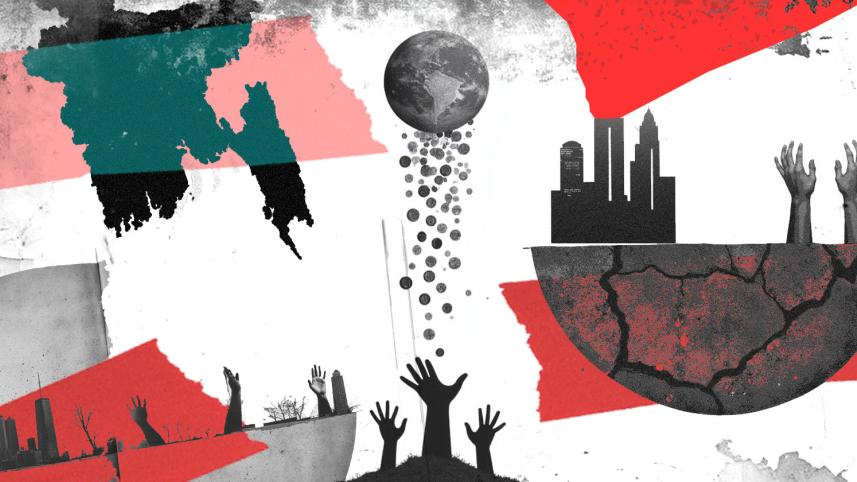
When it comes to the eligibility for receiving support from international climate funds in order to address climate-induced loss and damage, Bangladesh indeed has a strong case. Every year, a significant number of people lose their lives, homes, and livelihoods due to climate-induced disasters. Earlier in July, we saw how heavy rain triggered flash floods and landslides across the country, claiming the lives of at least 56 people and displacing some 10,854 people. However, a strong justification alone does not guarantee access. In most cases, affected people receive only short-term relief such as food and emergency medicine. Long-term recovery support—including compensation for losses, relocation aid for displaced populations, and rehabilitation efforts—remains largely unavailable. To make matters worse, Bangladesh lacks a comprehensive mechanism to provide compensation for unavoidable loss and damage resulting from climate change.
A potential source of such support is the Fund for Responding to Loss and Damage (FRLD), established under the United Nations Framework Convention on Climate Change (UNFCCC) in 2022. This fund is designed to help vulnerable countries recover from climate-related losses and damages by supporting post-disaster recovery, rebuilding damaged infrastructure, restoring livelihoods, and facilitating the relocation of climate-displaced communities. Recently, the FRLD published the initial status of its funding pipeline as of 29 June 2026, which indicates the highly competitive nature of accessing this fund. The FRLD issued its first call for funding requests at COP30 in November 2025 and received some 198 funding requests, of which 176 entered the formal pipeline. The remaining 22 funding requests were marked as non-compliant. The pipeline also shows that funding requests submitted earlier already advanced to technical review, whereas many later submissions remain at the preliminary stage due to capacity constraints within the FRLD. This highlights the importance of country readiness and timely engagement in accessing this fund.

As Bangladesh is one of the world's most climate-vulnerable countries, every year, floods, cyclones, storm surges, and other extreme weather events cause losses estimated at around $3 billion, equivalent to about one percent of national GDP. Moreover, climate-related factors, including sea-level rise, water scarcity, river erosion, and declining agricultural production, are driving large-scale displacement. Between 2008 and 2024, around 21 million people in Bangladesh were displaced due to climate-related factors. So, the FRLD can truly be beneficial to Bangladesh. However, initial experience of Bangladesh reveals significant weaknesses in its readiness to access this fund. For example, Bangladesh submitted two funding requests: one through the Palli Karma-Sahayak Foundation (PKSF), a national access entity, and another through the Food and Agriculture Organization of the United Nations (FAO), an International Entity (IE). However, PKSF's funding request was pending pipeline entry during the first round of screening because it was submitted without the letter of endorsement from the national focal point of Bangladesh. This rejection for a basic compliance requirement should not be viewed merely as an administrative mistake; instead, it should be treated as a warning about broader institutional weaknesses in accessing international climate finance, as such shortcomings can delay access to finance.
Failure to access funding through national entities reduces Bangladesh's chances of strengthening country ownership. Direct access to FRLD through national institutions is important because it allows Bangladesh to set its own priorities, manage funds, and implement projects through its own institutions. Meanwhile, the IE and FAO submitted a funding request on behalf of 17 climate-vulnerable countries, including Bangladesh, which is currently at the initial review stage. This entity generally has greater experience and technical expertise in accessing climate finance and is therefore more likely to meet the FRLD's technical and compliance requirements.
However, concerns arise when funds are mobilised through IEs. First, country ownership may be constrained, as key decisions regarding project design, management, and implementation are often influenced by international organisations. Second, reliance on IEs may limit opportunities for national institutions to develop the technical and institutional capacities needed to access climate finance directly in the future. Third, although Bangladesh has an urgent need for funding, it appears that this proposal was submitted later than those of several other vulnerable countries. This delay raises questions about whether Bangladesh's urgent funding needs were adequately reflected in the proposal development and submission process. Early submission may increase the likelihood of timely access to funding, as the FRLD Secretariat can start evaluating the funding request earlier.
Notably, the FRLD will not automatically distribute money to all vulnerable countries. Like other international climate finance mechanisms, it is expected to support countries that submit well-prepared, evidence-based, and technically sound funding requests. Other South Asian countries such as Pakistan and Sri Lanka submitted funding requests through both national entities and IEs, and these funding requests are progressing well. They submitted their funding requests earlier; therefore, the review of these funding requests has been completed, and feedback has been provided to the countries. On the other hand, these countries are actively strengthening the readiness and capacity of their national institutions to access the fund while simultaneously enhancing collaboration with IEs. Their experience suggests that institutional preparedness and early engagement are equally important for accessing international climate finance.
Competition for FRLD funding is expected to be intense, as available financing remains limited relative to global needs. The fund currently has total pledges of approximately $822.06 million, far below estimated global needs of roughly $130 billion to $940 billion in 2025 alone. Developing countries have submitted 176 funding requests worth around $2.8 billion, while only $342 million will be allocated for the first round. Countries with strong institutional readiness and technical capacity will be in a stronger position to secure funding. The importance of institutional readiness becomes even clearer when viewed against Bangladesh's wider climate-finance gap. The country needs approximately $29.3 billion annually to address the impacts of climate change, while it currently mobilises only around $2.76 billion from national and international sources, most of it in the form of loans. Under the UNFCCC climate finance framework, Bangladesh had mobilised only $801.7 million up to 2025.
Bangladesh has consistently argued that developed countries do not provide sufficient climate finance, which is true, but an equally important question is how much effort Bangladesh is making to secure available finance. The debate is no longer about whether Bangladesh deserves support; its vulnerability to climate change and its development needs are well recognised. The more important question is whether Bangladesh is sufficiently prepared to mobilise climate finance when opportunities arise. Without stronger institutional readiness and proactive engagement, Bangladesh risks missing a potential opportunity to access finance that could help millions of people recover from unavoidable climate losses and damages.
 For all latest news, follow The Daily Star's Google News channel.
Comments