


Fix energy supply for existing industries first
Bangladesh must fix its worsening energy crisis and secure supplies to existing industries before courting new investment, business leaders and experts warned at a Dhaka seminar yesterday, cautioning that costly and unreliable energy is eroding industrial competitiveness.
They made the remarks at a seminar on “Bangladesh’s Energy Security Challenges: Powering a More Competitive Business Climate”, jointly organised by the Metropolitan Chamber of Commerce and Industry (MCCI) and Policy Exchange of Bangladesh (PEB) at the MCCI office in Gulshan.

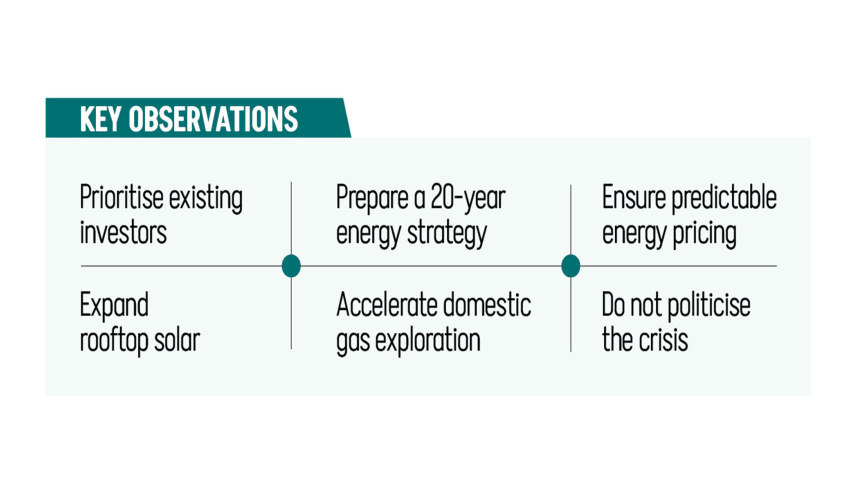
Mohammad Iqbal Chowdhury, CEO of cement producer LafargeHolcim Bangladesh, urged the government to prioritise existing investors before seeking new ones.
“We have been spending so much time on seminars and programmes to invite new investors. My humble request to the current government is: please do not go for any new investor yet,” he said.
“First, come to the existing investors. First supply us properly, first make us happy, and then go for new investors. If you do not have the raw material, you cannot produce,” he added.
He called for a 20-year energy strategy, saying investors cannot plan around short-term policies. “Energy has to be sustainable, affordable and reliable.”
Fazlul Hoque, administrator of the country’s apex trade body, The Federation of Bangladesh Chambers of Commerce and Industry (FBCCI), said he too had advised authorities not to seek new investment in the industrial sector until existing industries achieve stability.
“I am not an investment expert, but I have urged against new industrial investment and suggested exploring other sectors for investment,” he said. “If I cannot survive today, I don’t need to know what happens after 10 years. That’s the truth.”
Showkat Aziz Russell, president of the Bangladesh Textile Mills Association, said gas shortages had become a major problem for textile mills, many of which rely on captive power generation.
“My job is to flag the problem -- what went wrong, how we can fix it and what the interim policy should be. But the question is, are the policymakers listening to us?” he said.
Showkat complained that Bangladesh had failed to secure long-term energy contracts when prices were low, unlike India.
“We were happy buying gas at spot rates instead of going for long-term contracts,” he said, adding that the current situation was foreseeable.
He urged the government and experts to formulate an interim policy to keep industries running.
Ijaz Hossain, chairman of ESTex Foundation, a consultancy organisation specialising in industrial sustainability, said the energy crisis had gone beyond a supply problem and become an economic one.
“The number one problem we created for ourselves is that we did not price gas correctly,” he said, noting that industries once paid Tk 8 per cubic metre but now pay around Tk 40 while struggling to receive adequate supplies for the past three years.
“Who is going to, in their right mind, invest with this kind of gas situation?” he asked, calling for a comprehensive energy policy, greater use of renewables and realistic pricing.
Moynul Islam, president of the Bangladesh Ceramic Manufacturers and Exporters Association, said the crisis was threatening the industry’s survival.
“Throughout my career, I have failed to convince the government that gas is the raw material for ceramics. Without gas, you cannot produce ceramics,” he said.
“When factories start closing, the pressure will fall on the government, banks and ordinary people,” Moynul said.
Asif Ibrahim, vice chairman of apparel manufacturer New Age Group, said inadequate gas pressure was slowing production, delaying orders and hurting exports.
 For all latest news, follow The Daily Star's Google News channel.
 He urged the government to prioritise export-oriented industries and provide credible load-shedding schedules so factories can plan.
“The private sector is not asking for cheap energy. They are asking for competitive, transparent and predictable energy pricing,” Asif said.
He informed that his factory invested around Tk 3 crore to Tk 3.5 crore to install 566kW of rooftop solar, meeting about 25 percent of peak demand.
Yet, reliance on diesel remains costly and is further eroding competitiveness, he said.
M Masrur Reaz, chairman and CEO of PEB, described the energy crisis as the “number one constraint” on businesses and warned that it threatens growth and exports.
He said Bangladesh had faced energy problems for at least three years, largely due to domestic policy mismatches, but the situation had now become acute.
“Bangladesh needs short-term measures as well as medium- and long-term steps to build robust energy security,” Masrur said.
Farooq Ahmed, secretary general of MCCI, said factories were operating below capacity because of gas shortages and frequent power outages.
He said better management of the existing system alone could resolve nearly half of the problems.
Comments