


Could atmospheric water harvesting help Bangladesh tackle water scarcity?

Omar Yaghi, as a boy, and his family in Amman, Jordan, used to get water only once every week or two. As a scientist, he later helped develop a material that can capture water from even the driest air. In 2025, he shared the Nobel Prize in Chemistry with two others for pioneering a class of materials known as metal-organic frameworks (MOFs).
An MOF is a highly porous crystalline material built from metal ions and organic molecules. Its enormous internal surface allows capturing water vapour from the atmosphere and release it when heated. MOF-based systems can work with very little energy and in very dry conditions. Yaghi's research has demonstrated water harvesting at humidity levels as low as 7 percent in desert conditions.

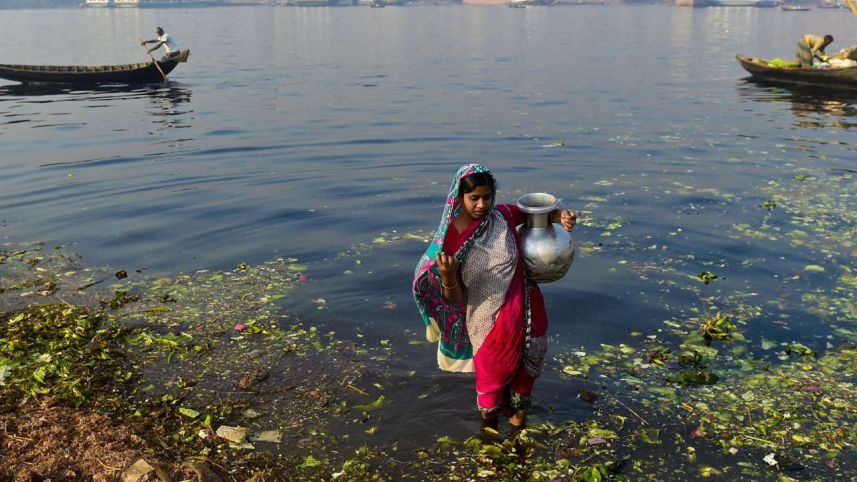
Making water from air is scientifically remarkable. Making enough of it, at a cost people can afford, is a very different challenge. Bangladesh presents a curious paradox: a riverine delta drenched by monsoon rain can still struggle to provide safe drinking water in many communities. Along the coast, salinity has made groundwater increasingly difficult to use. In other parts of the country, arsenic contamination has made an abundant underground water supply unsafe.
The real problem, then, is not water scarcity, but the lack of safe drinking water. That should shape how we think about technologies such as atmospheric water harvesting. In the coastal belt—Satkhira, Khulna, Bagerhat, Barguna, and other vulnerable areas—salinity increasingly limits the use of groundwater and surface water, particularly during the dry season. Cyclones and tidal surges can make the situation worse. Meanwhile, the widespread adoption of tubewells provided affordable drinking water and reduced reliance on contaminated surface sources, but it also exposed millions to naturally occurring arsenic. What makes arsenic especially dangerous is that it has no smell, taste or colour.
Atmospheric water harvesting may not solve Bangladesh's larger water crisis, nor should it replace groundwater treatment, rainwater harvesting, desalination, and other improved public water systems. But where these options are expensive, unreliable or difficult to maintain, it offers a source of drinking water that does not depend on saline groundwater or an arsenic-contaminated aquifer.
That makes it worth considering where conventional water sources fall short. A small atmospheric water-harvesting unit at a coastal school, clinic or cyclone shelter could provide an independent source of drinking water. Larger systems could potentially serve remote communities where extending conventional infrastructure is difficult. During disasters, portable units could supplement emergency water supplies when ponds and wells are contaminated. The most promising applications may ultimately be places where conventional water cost is high.
Bangladesh often looks for one big solution to problems that require a combination of smaller ones. Water is no different. One community may need rainwater harvesting, another desalination, another arsenic removal or a reliable piped-water network. In a remote coastal community, perhaps the answer is water from the air. The point is not to choose one technology and impose it everywhere. It is to match the technology to the problem. Yaghi's story also offers another lesson: his scientific career has crossed borders repeatedly. Born to Palestinian refugees in Jordan, educated in the US and now working in China, he is a product of the international movement of people and ideas. His work is a reminder that useful breakthroughs do not belong to one country. That matters for Bangladesh. We do need to become better at recognising which technologies are relevant to our problems, testing and adapting them to local conditions.
Dr Sabbir Ahmad is CEO of Silicon Array Ltd. He can be reached at sabbir@ieee.org.
Views expressed in this article are the author's own.
Follow The Daily Star Opinion on Facebook for the latest opinions, commentaries, and analyses by experts and professionals. To contribute your article or letter to The Daily Star Opinion, see our guidelines for submission.
 For all latest news, follow The Daily Star's Google News channel.
Comments