


Imports from India rise despite trade restrictions

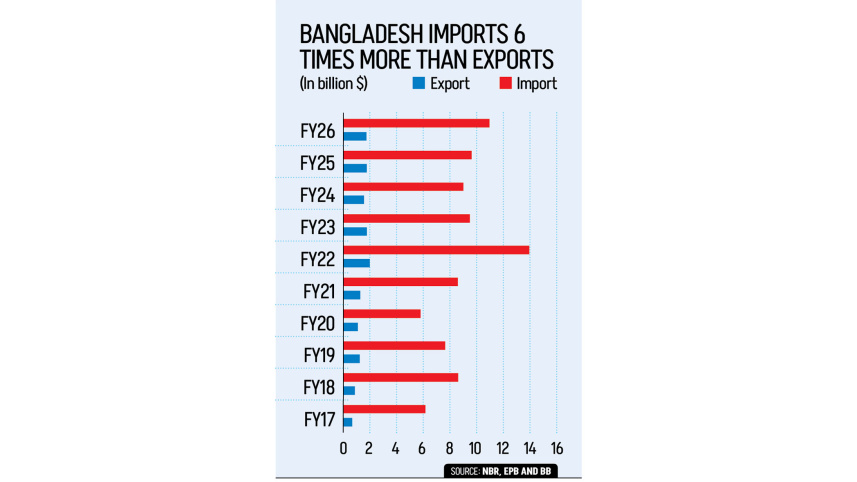
Bangladesh’s imports from India continue to rise despite restrictions imposed by both countries on the movement of some goods, while exports to the neighbouring country remained almost unchanged.
The country imported goods worth $10.96 billion from India in fiscal year 2025-26, up from $9.62 billion a year earlier, according to National Board of Revenue (NBR) data.

In contrast, exports to India stood at $1.75 billion in FY26, compared with $1.76 billion in the previous fiscal year.
The figures show that trade between the two neighbours has continued despite restrictions introduced over the past two years, particularly on the movement of goods through land ports.
Bangladeshi businesses say Indian yarn, cotton, fabrics and other industrial raw materials remain in demand because of their competitive rates, and because some international buyers specify particular fabrics or yarn from India.
After China, India is Bangladesh’s second-largest trading partner and the country’s largest trading partner in South Asia.
The trade gap between the two countries, however, remains wide, with Bangladesh importing more than six times as much from India as it exports to the country.
Businesses and economists say Bangladesh has scope to raise exports to India, but the country’s export basket remains heavily concentrated in apparel.
India granted Bangladesh duty-free market access in 2010, with one year of retrospective effect, for all products except 25 alcoholic and beverage items under the South Asian Free Trade Area’s (SAFTA) least developed country category.
Although exports have increased since then, the growth has not been enough to narrow the trade gap.
M Masrur Reaz, chairman of the Policy Exchange Bangladesh, said three factors are limiting Bangladesh’s exports to India.
“Firstly, India has its own import-substitute goods such as garments; secondly, India has a long list of standard requirements, and thirdly, both Bangladesh and India could not establish a regional value chain yet,” he said.
He suggested signing the Comprehensive Economic Partnership Agreement (CEPA) between the two countries to expand bilateral trade.
The two countries have introduced a series of trade restrictions since the political changeover in Bangladesh in 2024.
In March 2025, Bangladesh’s commerce ministry asked the National Board of Revenue to take steps to restrict yarn imports through land ports to protect the local textile and spinning sector. In early April, India suspended a transhipment facility used by Bangladesh to send garments to third countries through Indian airports.
The NBR restricted yarn imports from India through land ports. Yarn imports from India are now allowed only through Chattogram port.
India later imposed restrictions on the import of garments, agro-processed food, jute goods, furniture and some other Bangladeshi goods through land ports.
Despite the restrictions, imports of Indian goods continued to rise.
Showkat Aziz Russell, president of the Bangladesh Textile Mills Association, said yarn imports from India doubled to around Tk 30,000 crore in FY26 from Tk 14,000 crore a year earlier.
“The higher import of yarn through the seaport is the real reflection of yarn imports from India. Because when yarn was allowed to be imported through the land ports, a lot of yarn used to be imported through informal channels, meaning it was smuggled in,” he said.
 For all latest news, follow The Daily Star's Google News channel.
 Russell said restrictions on yarn imports through land ports should not be lifted. He argued that local textile mills are facing higher production costs and competition from imported yarn.
Mahmud Hasan Khan, president of the Bangladesh Garment Manufacturers and Exporters Association, said businesses have raised trade-related issues in different forums to increase exports to India.
He said Bangladesh should be able to export more goods through land ports and gain greater access to the Indian market.
Mohammad Hatem, president of the Bangladesh Knitwear Manufacturers and Exporters Association, said the recent trade disputes have commercial implications but require a political solution.
“It needs a political solution from the top-level leaders of both countries,” Hatem said.
MA Razzaque, chairman of Research and Policy Integration for Development, said the issue of land ports is part of a wider bilateral relationship.
“The land port is not an issue alone; it is a matter of a warm relationship between Bangladesh and India,” he said.
He said better bilateral relations could support stronger trade because both countries stood to gain from greater commercial engagement.
Md Abdul Wahed, former honorary joint secretary general of the India-Bangladesh Chamber of Commerce and Industry, said trade could increase if the movement of major goods through land ports resumes.
Md Fazlul Hoque, administrator of the Federation of Bangladesh Chambers of Commerce and Industry, called for discussions between the two countries to ease trade rules.
Comments