


Pedagogy, power: Teacher-student relationships in our universities

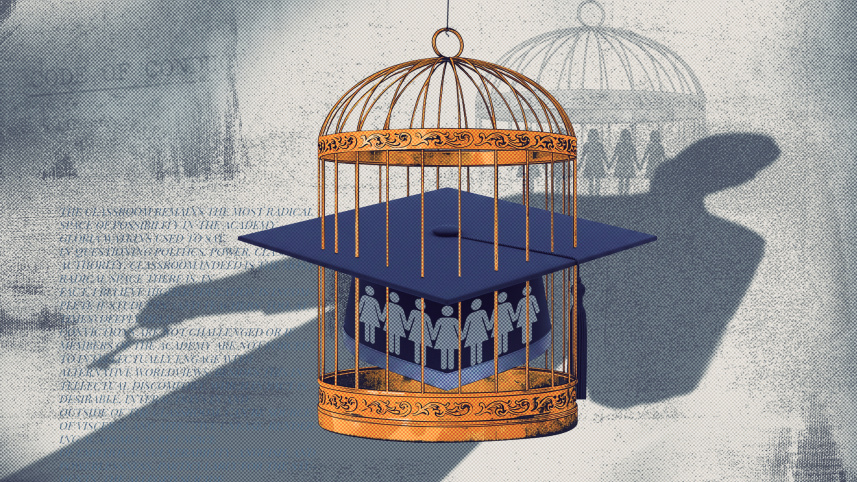
“The classroom remains the most radical space of possibility in the academy,” Gloria Watkins (more widely known as “bell hooks”) used to say. In discussions of politics, power, class, and authority, the classroom can indeed be such a space. In fact, higher education is incomplete if students’ and even teachers’ deeply held convictions are not challenged, or if members of the academy are not forced to intellectually engage with alternative worldviews. Besides this intellectual discomfort, interactions in and outside the classroom can be sources of visceral and affective unease, rendering academia a space of emotional vulnerability, anguish, and powerlessness, particularly for the students.
The alleged suicide of Munira Mahzabin Mimo, a student of the Department of Theatre and Performance Studies at the University of Dhaka, brings to the fore critical questions on the latter. Sudip Chakraborty, an associate professor in the same department, has been arrested after a case of abetment of suicide was filed by Munira’s father. Following the arrest, the department has relieved Chakraborty of all academic duties, including teaching and participation in exam committees. The case remains pending.
 For all latest news, follow The Daily Star's Google News channel.
 I do not wish to comment on the specifics of the case or on the culpability, if any, of the accused, who is also my senior colleague. Munira’s family and Chakraborthy are both entitled to due process as well as a fair and impartial trial, leading to judgment based on evidence rather than prejudice or pressure. I would rather discuss a system that continues to fail, one that neither prevents harm with any predictability nor reliably redresses it, and that lacks an appropriate code of conduct governing interactions within and beyond the classroom.
Complaints of sexual harassment and abuse of power against faculty members and fellow students at universities are more common than we may assume because, as harsh as it may sound, we have grown apathetic to violence, so much so that anything other than deaths, or deaths by suicide, seems rather benign to us. This piece is not to be read as some claim of moral high ground, because I, too, am somewhat complicit as part of the system myself.
At the University of Dhaka, complaints against teachers and fellow students are generally handled ad hoc at the department level and may also be referred to the central authority (the committee on sexual harassment, for instance) if needed. The “need” for referral by and large inhabits a grey area, and in many cases, students feel discouraged to take their claims further due to uncertainty and lack of clarity about the process and about what to expect. Notably, there is still no written policy categorically defining sexual harassment or laying down a process of redressal.
In this context, the university follows the guidelines formulated by the High Court Division in a writ petition filed in 2009 by the Bangladesh National Women Lawyers’ Association. Nonetheless, my experience as a student advisor shows how the lack of a clearly written policy, specifically tailored to the university, grossly fails survivors, adds to their quandary and agony, and in many cases, undermines due process, at times bringing in disproportionate punishment. More importantly, our university does not have a written code of conduct to guide relationships between university staff (including teachers) and students.
In most higher education institutions in the West, policies on sexual harassment are categorical, clearly defining the terms to identify and establish claims and elaborating the specific processes to pursue if and when such incidents occur. Similarly, there are written policies to guide and regulate relationships between members of the staff and students. Notably, since 2020, there has been a growing overlapping consensus among universities in the United Kingdom on banning or prohibiting intimate staff-student relationships. From around 2010-2015, leading universities in the US began categorically banning intimate relationships between students and staff.
These changes were introduced in response to the longstanding failure to adequately address sexual harassment and abuse cases at these universities. However, these prohibitions still operate, as critics say, largely within a risk-management or adult-control framework, as opposed to an equal rights paradigm. Nonetheless, some form of progress is better than chasing perfection or continuing with no code at all.
Indeed, for a long time, universities in the West by and large only discouraged, or deemed “inappropriate,” intimate relationships between staff and students. Putting a complete ban on such relationships used to be frowned upon by both libertarians and some sections of feminists. Libertarians worried that a complete ban would curtail liberty, and some feminists would argue that such a ban would be read as condescending, disregard women students’ agency in particular, and infantilise them. The view that relationships between teachers and students preclude consent due to a power imbalance became pronounced later as a radical feminist claim. It is not even about consent, as feminist scholars eventually noted, but rather about equal rights in pedagogical contexts. Intimate relationships, even if consensual, between faculty members and students often reinforce the latter’s unequal status, knowledge asymmetry, and pervasive lack of power in higher education settings. Even when there is no physical violence, abuse, or harassment, such relationships can lead to acute emotional vulnerability for the students involved.
University policies in the West now aim to categorically define prohibited forms of relationships and describe what such prohibition entails. For instance, as per the policy in force at the University of Oxford: “‘Intimate relationship’ includes sexual or romantic relationships, marriage or life partnerships, regardless of gender, gender identity or sexual orientation, including a brief relationship and one-off occurrences, and whether they are conducted in person and/or online and/or via electronic or any other form of communication.” The policy further regulates “close relationship” between staff and students, the definition of which excludes intimate relationships and refers to “a relationship where the nature, content, emotional involvement and/or frequency of interactions and/or communications between a staff member and a student transgress the boundaries of professional conduct, or may be reasonably perceived to do so.”
In cases where there is a pre-existing close relationship or one developed afterwards, the member of staff remains obligated to declare it to the appropriate authority (usually the head of a department or faculty). The Oxford policy also provides the caveat that it is “impossible to cover every potential situation which might involve (or be perceived to involve) transgression of the boundaries of professional conduct.” Accordingly, it notes that any relationship “which involves (or is perceived to involve)” characteristics such as any form of dependence (whether emotional, practical, financial or otherwise) from either party and/or favouritism towards any student will always transgress the boundaries of professional conduct and must be declared. If in doubt, the policy notes, “the best course is to declare a relationship, or any interaction with a student that is of concern, so that appropriate measures (to protect both the student and the member of staff) can be considered by the authority.”
Some policies also prohibit teaching staff from communicating with students outside of office hours or meeting them outside the university without declaring it to the appropriate authority.
In Bangladesh, in the absence of any written policies whatsoever, staff-student relationships are largely left to intuition, discretion, and instinct. At times, there are seemingly minor complaints of favouritism and hostility. In the worst cases, this may enable more serious dynamics of manipulation, harassment, and abuse.
We often approach crises in isolation, blinded by privilege and disabled by myopia, without understanding or appreciating the overarching system and power structure within which the so-called isolated incidents occur. Ad hoc fixes are ad hoc after all, and there is no alternative to predictable remedials when it comes to coexisting as a community and navigating potential contestation. While awaiting credible investigation and answers in Munira’s case, we must also pause and look inward to interrogate the continuum of power and privilege we navigate, and address the reprehensibly consequential lack of written policies to govern our conduct and relationships with our students, as well as among the students themselves, as members of the academic community.
Psymhe Wadud currently on study leave, teaches law at the University of Dhaka.
Views expressed in this article are the author's own.
Follow The Daily Star Opinion on Facebook for the latest opinions, commentaries, and analyses by experts and professionals. To contribute your article or letter to The Daily Star Opinion, see our guidelines for submission.
Comments