


Empowering CMSMEs can strengthen our economic foundation

The World Bank’s Bangladesh Development Update, released last month, rings out a warning bell for us. The country has been weathering severe difficulties because of an economic slowdown and rise in poverty for three consecutive years, further worsened by external shocks. As per the report, our GDP growth is expected to decline to 3.9 percent by the end of FY2026. The inflation rate has remained above eight percent throughout the fiscal year. In December 2025, the non-performing loan (NPL) ratio reached 30.6 percent. The national poverty rate grew to 21.4 percent in 2025 from 18.7 percent in 2022. Large exporters continue to face disruption in the global supply chain, currency instability, and externalities stemming from conflicts in the Middle East that have spiked the costs of energy, contributed to inflation, and therefore constrained poverty alleviation efforts.
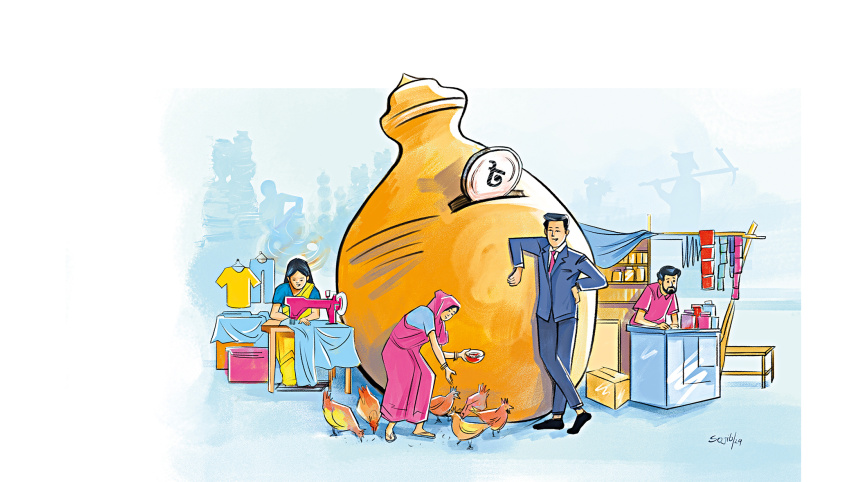
In this situation, the cottage, micro, small, and medium enterprises (CMSME) sector is a major buffer for the country’s economy. But within the current set-up, founding a small business requires various permits and certifications. For CMSMEs, complications in administrative procedures, VAT issues, and high regulatory costs are significant obstacles. It’s high time Bangladesh transitioned from its current subsidy-centric system to deregulation and reforms focused on fostering entrepreneurship and innovation in the sector.

The county has already made some inroads in this regard. The Bangladesh Investment Development Authority (BIDA), together with the Japan International Cooperation Agency (Jica), recently launched BanglaBiz Phase 2, a digital platform streamlining the process of establishing a business in the country. The business starter package under BanglaBiz Phase 2 offers services to acquire five major permits: name clearance, temporary bank account opening, company incorporation, e-TIN, and trade licence. This allows entrepreneurs to establish a business in three days.
A similar system was launched by the National Board of Revenue (NBR) in January 2025, called the Bangladesh Single Window (BSW) system. The NBR made the BSW system mandatory for the submission of certificates, licences, and permits for imports and exports starting on July 1, 2025, by bringing 19 government agencies under it. It is necessary to integrate the system in the backend and apply risk-based methods if there are to be major reductions in clearance times. For CMSMEs, instituting a “compliance holiday” of two to three years may encourage innovative enterprises.
The SME Houses of Azerbaijan is a prime example of such an integrated system. The SME Houses offer centralised services including business registration, licensing, financial consulting, and access to export markets. They have been recognised as efficient in simplifying business processes. Bangladesh can adapt this proven model and implement it in local industrial clusters or district levels, building on the foundations laid by the Bangladesh Small and Cottage Industries Corporation (BSCIC).
Modernising the country’s industrial clusters and strengthening local supply chains can meaningfully reduce import dependency and enhance competitiveness. A circular economy, whereby waste generated from big factories is used as raw materials in small factories, should be encouraged as it helps to lower production costs, minimise imports, and save foreign currency. Traditional collateral-based lending must give way to digital credit scoring and cash-flow-based approaches. In December 2025, Bangladesh Bank reduced the mandatory provisioning requirement for short-term agricultural and CMSME loans to 0.50 percent, allowing scheduled banks to maintain this lower provision until December 31, 2026. The relaxation was introduced to support banks in financing cottage, micro, and small enterprises which are considered vital for employment generation and inclusive growth. The experiences of South Korea and Singapore show how shifting to cash-flow- and alternative-data-based approaches can transform small industry financing. Bangladesh’s expanding digital payment and credit bureau infrastructure provide a solid base to build upon.
Due to unstable energy supply, decentralised renewable energy sources have become more popular. The government approved new net metering guidelines for 2025, allowing 100 percent of the sanctioned load for net-metered rooftop solar—up from 70 percent previously—and extending net metering eligibility to single-phase consumers for the first time. In December, the Power Division issued a revised circular making rooftop solar installation mandatory for buildings with at least 1,000 square feet of usable roof space seeking new electricity connections. Clusters that utilise independent renewable sources tend to have more reliable operations and reduced costs.
It is clear that the CMSME sector can no longer be viewed through the lens of aid or welfare. It is a highly potential and productive ecosystem, capable of driving inclusive growth, job creation, and economic diversification beyond the RMG products. The recent developments—the Bangladesh Bank’s relaxed provisioning rules, rollout of BanglaBiz and BSW platforms, and the new rooftop solar policy—show that elements of smart deregulation are already underway. Nevertheless, rapid execution, complete digitalisation, and stabilisation of the banking system can take this progress all the way.
The World Bank’s 2026 assessment highlights the need for immediate policy and institutional reforms to create employment and continue inclusive growth in the country. We need to restore macroeconomic stability, boost revenues, strengthen the financial sector, and improve the business environment. Through the use of single window systems, integrated hubs, digital finance, decentralised energy sources, and circularity, the country will be able to move from fragility to resilience. The new government’s early signals on improving the business environment are encouraging. The coming months will determine whether the CMSME sector can live up to its potential and become the driving force behind a stronger economy.
Md Rakibul Hasan works with the Bangladesh Small and Cottage Industries Corporation (BSCIC). He can be reached at rakib4457@gmail.com.
Views expressed in this article are the author's own.
Follow The Daily Star Opinion on Facebook for the latest opinions, commentaries, and analyses by experts and professionals. To contribute your article or letter to The Daily Star Opinion, see our guidelines for submission.
 For all latest news, follow The Daily Star's Google News channel.
Comments