


Removing vendors won’t fix Dhaka’s streets

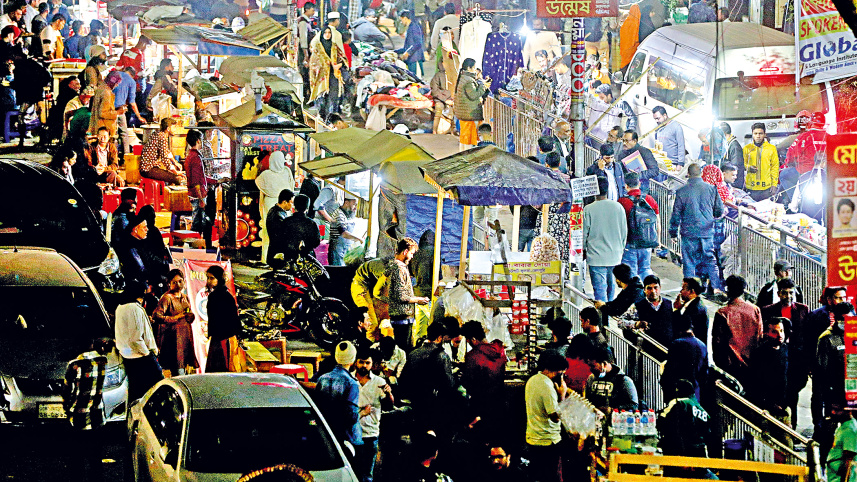
Some days ago, while passing through Panthapath on my way to work, I saw many people, including day labourers and rickshaw pullers, gathered with sombre expressions: the roadside food stalls they depended on for affordable meals had been removed. This highlighted for me how urban street vendor removal disrupts essential economic and social lifelines and made me wonder whether city management can move beyond short-term clearances towards a more sustainable approach.
Dhaka’s city administration has stepped up efforts to remove street vendors to improve traffic flow, urban aesthetics, and commuter safety. From a commuter’s perspective, this may feel like a necessary intervention as stalls often block sidewalks and streets, causing congestion and making movement difficult. However, informal markets are an integral part of the economic chain. Small producers handle production of goods, middlemen handle transport to the vendors, and vendors sell directly to low-income consumers. Removing stalls disrupts this chain, reduces income, and limits access to affordable food and essentials. Policies aimed at improving urban order can therefore unintentionally harm thousands of livelihoods and prove to be largely ineffective.
 For all latest news, follow The Daily Star's Google News channel.
 We have seen it before: authorities clear the streets of vendors, protests erupt and, within days, streets are reoccupied. Even after designated markets like Bangabazar and the Dhanmondi hawkers’ market were established, thousands of vendors have continued to operate across the streets of Dhaka and other urban areas. Removing such a significant number of vendors is a measure that carries substantial risks, including breaking existing supply chains, triggering protests, and possibly disrupting the livelihoods of some of the most vulnerable people in our society. In this case, what long-term, formalised solution can protect the interests of citizens, aid in traffic management, and simultaneously safeguard the livelihoods of the street vendors while ensuring that low-income consumers are not overlooked?
One approach is to test solutions in a single zone before scaling up. Authorities could designate a street or cluster where vendors operate under regulated conditions, monitor the results, and refine policies based on lessons learned. Interim measures might include time-bound vending permissions or temporary zones, ensuring that income and access to food continue while longer-term plans are developed. Physical measures can also prevent unsafe or unplanned vending. Raising dividers along busy roads can discourage vendors from setting up in the middle of traffic lanes. Footpaths—often used by informal shops—can be made unavailable with the installation of trees, benches, and waste bins, thus discouraging vendors from occupying these spaces. On the road, careful placement of bus bays, traffic signalling, and speed regulation can prevent vendors from setting up in unsafe places. These well-planned measures will not only keep streets safe for commuters but also prevent the recurring cycle of vendors setting up shop in dangerous or obstructive locations.
A long-term strategy may begin with rehabilitating existing vendors, although this requires further resources and planning. The government could develop a database capturing vendors’ skills, experiences, and locations to guide pilot projects. Migrants from rural areas could be offered alternative employment, vocational training, loans, or support for freelancing or overseas opportunities. Dedicated vending zones could help generate government revenue, provide consumers with convenient access to goods, and sustain livelihoods. Allowing vendors to operate during off-peak hours—such as in the early morning for breakfast stalls—ensures commuters can move safely while consumers retain access to affordable food. With thoughtful urban planning, areas where informal markets can coexist with city traffic can be identified, supported by infrastructure such as shelters, waste management, and pedestrian pathways. Formalisation is also essential as licensing of vendors provides legal recognition, access to training, and support for hygiene, business management, and microfinance. In return, the government could collect revenue systematically, improving city finances while supporting small-scale entrepreneurship.
Dhaka’s planners face a complex challenge: modernising infrastructure and managing traffic while keeping the informal economy alive. Current practices, which prioritise street clearance over inclusive planning, fail to serve commuters, residents, or vendors effectively. The solution must be holistic; balancing traffic management, pedestrian safety, urban aesthetics, and economic sustainability. Policymakers must seek solutions where all stakeholders see their interests reflected. The goal is not merely to remove vendors but to rethink urban management in a way that balances order and opportunity. When cities are planned to account for both mobility and economic activity, they give way to spaces where growth, social equity, and order can coexist. In a rapidly expanding metropolis like Dhaka, such an approach is essential.
Nazmun Naher is a water resources expert with extensive experience in regional and international integrated water resources management. She can be reached at nnazmun.mita@gmail.com.
Views expressed in this article are the author's own.
Follow The Daily Star Opinion on Facebook for the latest opinions, commentaries, and analyses by experts and professionals. To contribute your article or letter to The Daily Star Opinion, see our guidelines for submission.
Comments