


The budget has revived focus on blue economy, but there's a lot of catching up to do

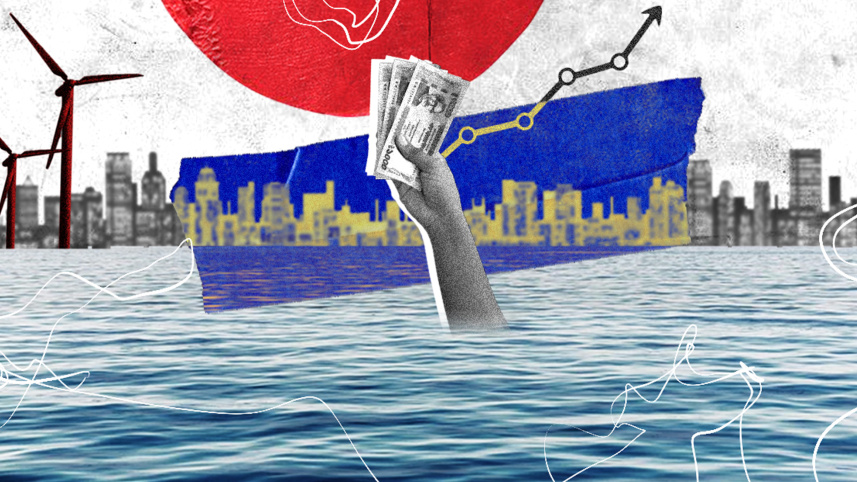
On July 7, 2014, the Permanent Court of Arbitration in The Hague handed Bangladesh the second half of its maritime triumph. Two years earlier, judges at the International Tribunal for the Law of the Sea (ITLOS) in Hamburg had done much the same against Myanmar. Between them, the two awards left Bangladesh with sovereign rights over roughly 1,18,813 square kilometres of the Bay of Bengal, an aquatic territory close in size to the land we already had. Since then, there has been much discussion framing the collective victory as the start of a “blue economy revolution.” Twelve years on, however, that promise remains largely untapped.
The Blue Economy Cell, established in 2017 to map opportunities in the new maritime estate, identified more than two dozen potential sectors: fisheries, deep-sea hydrocarbons, shipbuilding, salt, marine biotechnology, ocean renewables, tourism. Yet, marine fish catches in FY 2023-24 fell to their lowest level in nine years, at just over 6,28,000 tonnes, and the figure reportedly dropped even further in FY 2024-25. Multiple bidding rounds for deep-sea hydrocarbons have yet to produce a single commercial discovery run by a domestic firm. The marine spatial plan the World Bank flagged years ago as the prerequisite for everything else still sits in draft. Inter-ministerial coordination, divided uneasily among the navy and four civilian ministries, works much as it did before the verdict: indifferently.

Amid these, the proposed budget for the next fiscal year has set aside Tk 200 crore for the blue economy. This includes Tk 100 crore for a new “Blue Economy Research Fund” and Tk 100 crore for development, alongside plans to run commercial vessels for deep-sea tuna, scale up seaweed cultivation, declare new marine protected areas at Kuakata and Salimpur, build a fishing port at Matarbari and upgrade the landing centre in Cox’s Bazar. It is a welcome line in the ledger, and an instructive one. For the first time in years, the blue economy has been given not only some significance but also dedicated allocations. But this is only a start. A research fund is not the same as research capacity. The real test will be to see whether this allocation builds the standing human and institutional architecture needed to decide what to do with the sea portions that Bangladesh won.
It is also relevant to look at how the above mentioned cases had been won. For The Hague and Hamburg, the state had spared no expense on counsel. Foreign barristers had been briefed and international advisers retained; a technical record was assembled with care. Unfortunately, to govern the gains, the government has built no comparable bench at home. We have no national maritime commission of the kinds Singapore or Norway use to drive strategy. We have no steady pipeline of marine geophysicists, fisheries economists, or offshore engineers feeding into policymaking. The country that knew to hire world-class counsel to win 1,18,813 square kilometres of sea never thought to hire a local cadre to govern it.
Meanwhile, the sea around us has filled up. In March 2025, India retired the SAGAR framing it had used for a decade and announced MAHASAGAR (Mutual and Holistic Advancement for Security and Growth Across Regions) as the new banner for its maritime engagement, now stretched well past the Indian Ocean. China’s Maritime Silk Road has thickened into a steady traffic of port deals, undersea cables and logistics agreements. The US’s Indo-Pacific Strategy now binds together security pacts, technology controls, and supply chain initiatives that converge on the Bay. Bangladesh’s own Indo-Pacific Outlook of April 2023, a careful and non-aligned 15-point document, was a sensible attempt at staying out of trouble.
But hedging is not a posture; it is a workload. Every port concession, security memorandum, dual-use logistics agreement has to be read against a sovereignty checklist that only the country’s own experts can credibly write. When three competing powers arrive at the same time with detailed proposals on deep-water terminals, undersea cable landings, hydrographic surveys, joint exclusive economic zone patrols or rare-earth prospecting, the negotiating table requires not goodwill but specialists who can tell a commercial partnership from a strategic mortgage. We do not have enough of such specialists.
The real problem is the gap between the complexity of what is offered and our ability to interrogate it. Call it epistemic vulnerability if you like, or call it being out-staffed. It rarely makes the front page. It surfaces, instead, in fine print: in clauses we did not push back on, in side-letters we did not read closely, in strategic doors we left a little ajar because we weren’t entirely sure what we were signing.
This gap has only widened, for obvious geopolitical reasons, since August 2024. The political transition effectively cooled the historically close Dhaka-Delhi axis. Across the Naf, and in the waters around Saint Martin’s, the Arakan Army’s effective control of much of Rakhine State has made the eastern flank of Bangladesh’s maritime border one of the most volatile in the region. We are negotiating from a tighter spot than we’ve had to at any point in time since 2014, but with much the same institutional toolkit we had over a decade ago.
There is, however, one asset we have not yet begun to draw on. Across the International Maritime Organization (IMO), the International Seabed Authority (ISA), major shipping conglomerates, the world’s leading naval academies, and a number of well-funded ocean-science laboratories, several hundred Bangladeshis hold senior-level technical positions. Many of them spent years inside the very institutions whose rules now shape our maritime fate. Almost none of these experts is formally connected to Dhaka’s policymaking architecture.
This is odd, and out of step with what other countries do. India treats its diaspora as a strategic resource: through Pravasi Bharatiya Divas (a day to recognise the contributions made by Non-Resident Indians), overseas advisory councils, and the quiet practice of seconding civil servants to multilateral bodies. China does much the same through Maritime Silk Road technical networks. Even Vietnam, with less to spend, regularly calls back its IMO and ISA personnel to shape national positions on seabed mining or shipping decarbonisation. Bangladesh, alone among countries with a serious maritime stake, has built no such mechanism. The diaspora’s willingness to help is not in doubt; the issue is that institutional response has been silence.
A standing Ocean Affairs Advisory Council, attached to the Prime Minister’s Office or a future Ministry of Maritime Affairs, could pair domestic policy officers with diaspora specialists by sector: hydrocarbons, deep-sea mining, port concessions, fisheries, IMO, ISA, and Indian Ocean Rim Association (IORA) negotiations, and maritime law. Its work would be to carry out technical reviews of inbound proposals, mentoring of junior officials, continuous horizon scanning, and so on. Its annual cost would be a rounding error against the Tk 200 crore the budget has just earmarked. A sliver of that research fund, redirected towards the people who would actually read the contracts, would do more for Bangladesh’s blue economy than acquiring another vessel. The question is no longer whether Bangladesh will spend on the sea, but whether it will spend to build the people and institutions capable of governing it. Think of it as “intellectual remittance.” And unlike the financial kind, this one the state can structure on its own terms.
The lesson of the past 12 years is uncomfortable but plain: winning at a tribunal is not the same as governing the space won. The 1,18,813 square kilometres will go on existing on the map whether or not we do anything about it. Whether this portion of the sea ends up as an economy of our own or becomes a buffer in someone else’s calculations will depend on the decisions Bangladesh makes in the coming days and the institutional capacity we choose to build around these decisions.
Md Syful Islam is a PhD research fellow in the Department of Maritime, Transport Law, and Politics at Ankara University in Türkiye. He can be reached at syful@ankara.edu.tr.
Views expressed in this article are the author's own.
Follow The Daily Star Opinion on Facebook for the latest opinions, commentaries, and analyses by experts and professionals. To contribute your article or letter to The Daily Star Opinion, see our guidelines for submission.
 For all latest news, follow The Daily Star's Google News channel.
Comments