


We need stronger digital systems to seize the China-plus-one opportunity

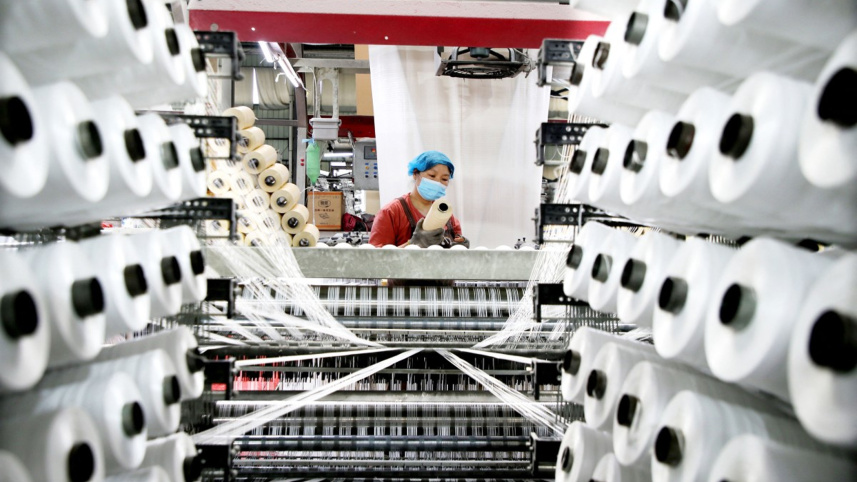
Between April and June last year alone, Bangladesh received more than $53 million in fresh Chinese investment, nearly $30 million of it flowing straight into textiles. More than twenty apparel factories here now carry Chinese capital, some brand new, others leased from local owners squeezed for capacity. This is not an act of charity, but a calculation. Faced with tariff pressures in their largest markets, Chinese manufacturers are doing what manufacturers have historically done when the math no longer adds up: relocating their production bases. The question is whether Bangladesh is actually built to catch the shift.
In 1990, Bangladesh and Vietnam exported roughly the same amount, about $2 billion each. Today, however, Vietnam’s annual exports have reached $270 billion, whereas Bangladesh’s stand at approximately $40 billion. Both countries had cheap labour and garment factories. What Vietnam built, and Bangladesh mostly did not, was everything around the factory: logistics, product diversity, and, increasingly, the digital systems that let a small manufacturer in a provincial town find a buyer in Hamburg or Chicago without ever leaving home.

That last part is where my own research comes in. Over the past year I have studied the latest wave of World Bank Enterprise Survey (WBES) data covering thousands of manufacturing firms across Bangladesh, India, Pakistan, and Sri Lanka, asking a simple question: does having a website or a social media page—nothing more sophisticated than that—actually change whether a firm exports, and how much? After controlling for other explanatory factors, the answer is yes, and the effect is highly significant.
Surprisingly, the country where this effect is most pronounced is Bangladesh; notably, it is the country in the sample with the lowest rate of manufacturers going online—less than 30 percent. It seems that in a market where hardly anyone possesses a functional website, having one is enough to catch the eye of overseas buyers. Put plainly, Bangladesh’s manufacturers are sitting on an unusually high-return opportunity, and most of them are not using it. Not for lack of ambition. The barrier sits underneath the ambition, in the infrastructure that ambition depends on.
Bangladesh’s internet penetration is around 53 percent, behind Bhutan’s 88 percent and the Maldives’ 85 percent, and barely ahead of India’s and Nepal’s, as reported in the Asian Development Bank (ADB)’s Digital Public Infrastructure (DPI). Step outside Dhaka and Chattogram, and rural connectivity falls below 38 percent, precisely the regions where much of the country’s light manufacturing and agro-processing capacity actually sits. A garment subcontractor in Gazipur can easily get online. A leather workshop near Bhairab or a light-engineering unit outside Bogura often cannot, not reliably, and that gap shows up directly in who is found by a foreign buyer and who does not.
The payments layer is thinner still. International payment processors like PayPal or Stripe do not operate in Bangladesh. A freelancer or small exporter here has to route around through Payoneer or bank wires, absorbing costs and delays a competitor in India or Vietnam does not need to pay. Surveys of Bangladeshi freelancers find nearly two in five name payment friction as one of their biggest constraints, not a small operational nuisance, but a structural handicap sitting on top of every cross-border transaction.

The government-drafted “National Artificial Intelligence Policy (2026–2030)” sets out the right strategic direction. The policy proposes the establishment of a “national digital architecture” and “national data exchange platform,” aiming to provide enterprises with a standardised mechanism that enables them to be discovered, verified, and granted access to financing. That is the right instinct. Bangladesh is home to 1.17 crore small and medium enterprises—over 13 times as many as Vietnam. Yet, our SMEs contribute a mere 27 percent to the national GDP, whereas Vietnam’s account for roughly half of theirs. That gap is explained by the absence of a system connecting those entrepreneurs to finance, verification, and buyers at scale. But written policies do not lay cables or open payment gateways. The real challenge is taking buzzwords like ‘digital architecture’ out of draft documents and turning them into practical tools a small garment maker in Narayanganj can actually rely on to start their workweek.
Dhaka division cannot keep absorbing Bangladesh’s industrial growth alone. Relocating labour-intensive manufacturing to coastal and riverine areas such as Chattogram, Cox’s Bazar, Khulna, and Barishal would not only alleviate pressure on the capital but also place new factories closer to ports and low-cost inland maritime transport, offering exporters tangible logistical advantages. Bangladesh must put diversified categories in export basket, from basic apparel to high-tech textiles, including electronics-integrated fabrics and sustainable materials.
Three things would most effectively accelerate this process. First, expand substantial investments in broadband and mobile internet beyond Dhaka and the export processing zones to the manufacturing heartlands that truly need to diversify, specifically the coastal industrial zones (a strategy adopted by both China and Vietnam) rather than merely investing in areas that are already well-equipped. Second, directly address payment bottlenecks, whether by introducing international payment processors or establishing a domestic equivalent that overseas buyers can trust and use seamlessly (akin to China’s Alipay model). Third, transform the long-promised national exporter directory and digital data exchange platform into a practical tool that primarily serves micro and small enterprises, rather than a mere showcase project designed for large companies that already possess the necessary resources.
The China-plus-one window will not stay open indefinitely. Vietnam, Cambodia, and India are chasing the same relocating factories, and each is investing in exactly the digital groundwork described here. Bangladesh has, for once, a genuine head start in the return on that investment, according to data. What it does not yet have is the foundation to seize that opportunity before someone else does.
Md Saikat Hosen is PhD candidate at the School of International Economics and Politics of Jiangxi University of Finance and Economics.
Views expressed in this article are the author's own.
Follow The Daily Star Opinion on Facebook for the latest opinions, commentaries, and analyses by experts and professionals. To contribute your article or letter to The Daily Star Opinion, see our guidelines for submission.
 For all latest news, follow The Daily Star's Google News channel.
Comments