


What Bangladesh's golden fibre needs to become a climate-era export

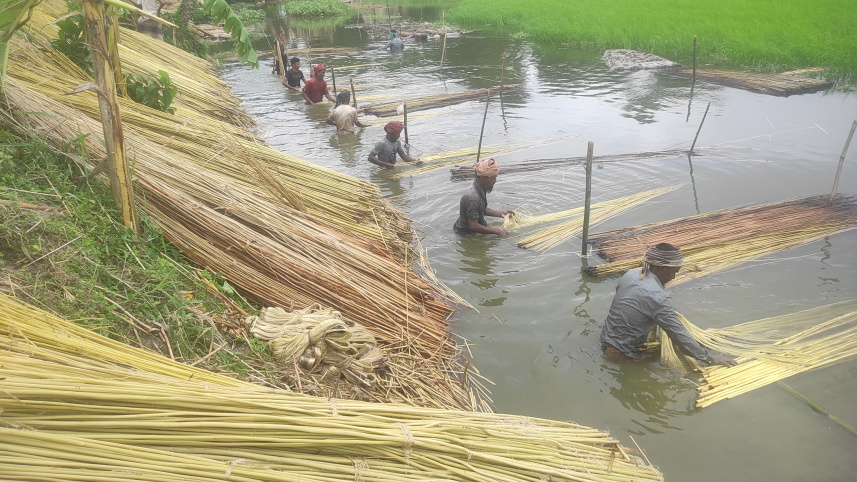
Bangladesh has spent five decades protecting the reputation of one raw commodity: our golden fibre, jute. But what it has not built is the industrial ecosystem that could turn that commodity into commercial products the world demands as environmentally friendly alternatives to various synthetic goods. While on July 15, Faridpur Jute received the Geographical Indication (GI) status, which the Agriculture Secretary Dr Rafiqul I Mohamed said would help establish the fibre’s identity abroad, it must be noted that a GI protects a name; it does not build a factory.
Jute and jute goods earned $883.69 million in FY2025-26—a recovery of nearly 8 percent from the previous fiscal year’s exports. However, it is still well below the $1.16 billion earned in FY2020-21 after the sector lost close to a third of its exports to synthetic yarn for four straight years. Compared to ready-made garments’ export earnings of $38.7 billion in FY2025-26, that of jute was meagre, making up under two percent of our export basket, down from close to 90 percent in the 1970s.

The case people usually make for jute leans on nostalgia, terming it the golden fibre, the delta, the heritage crop. However, the argument for boosting jute production is regulatory because European product law is being rewritten in ways that favour exactly the properties jute already has.

The Ecodesign for Sustainable Products Regulation, which
aims to make products sold in the EU more durable, repairable, recyclable, and transparent, came into force in 2024. Between 2026 and 2030, product-specific laws will be rolled out. For instance, large European companies can no longer destroy unsold clothing and footwear due to a rule introduced last month. Buried in the same architecture is a Digital Product Passport demanding batch-level data on fibre origin, plus a producer responsibility fee expected to reward simple, single-fibre garments over blended ones. A biodegradable crop spun into one fibre fits that system well. However, Bangladesh’s commercial pathways appear to be moving towards blended fabric such as jute-cotton and jute-viscose, exactly what this fee structure discourages. We cannot claim the regulatory upside while pursuing a blending strategy without deciding, honestly, which market we are building our strategy for.
Moreover, a wider shift is taking place beyond the EU. Industries that use carbon-intensive composites and synthetics are under pressure to find alternatives. For example, aircraft makers such as Airbus and Boeing are now being pushed to account for the emission created while making the materials that go into an airplane, not just the fuel burned during a flight. Besides, a large share of the world’s synthetic and composite fibre inputs still route through Chinese supply chains, which leaves buyers exposed to costs and geopolitical issues.
A natural, biodegradable fibre grown at scale in Bangladesh offers companies another option for diversifying their sources of fibre. Bangladesh has not really made the pitch related to this fibre option anywhere yet.
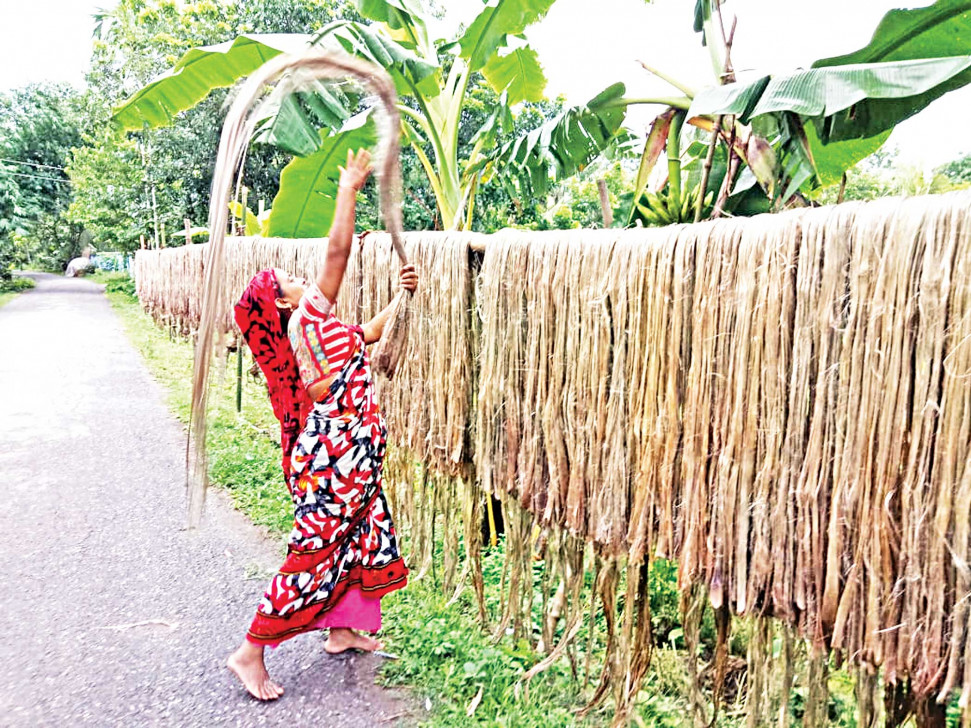
Of course, caution must be exercised when making claims about natural fibres’ environmental footprint. Laundry testing has found cotton and wool shed microfibres at rates comparable to treated polyester. The honest claim is: what jute sheds is cellulose, which is degradable unlike a polymer that lasts two centuries. That claim is likely to survive a buyer’s compliance review.
Sadly, our story of commercially manufacturing natural fibre products is not satisfactory. Mubarak Ahmad Khan developed the jute cellulose biopolymer Sonali Bag in 2015. Eleven years later, it is still not in commercial production, despite a pilot at the state-run Latif Bawany Jute Mills. Without scale, production cost also remains uncompetitive against polythene that is sold without a carbon price attached. This illustrates that science was never the barrier in the jute story; policy was.
Besides, the real value sits in geotextiles, composites, and by-products. The global geotextiles market is worth around $9.3 billion in 2026 and biodegradable natural-fibre variants are gaining ground. Jute composites are already used in automotive interior panels, and every tonne of fibre produces about 2.5 tonnes of jute stick, mostly burnt today. These sticks can be processed into activated carbon and particle board. Although Bangladesh Bank has set cash incentives at 10 percent for diversified jute products for FY2026-27, the response has been thin because a small workshop in Tejgaon cannot produce a life-cycle assessment or Global Organic Textile Standard-equivalent certification. Without such paperwork, the factory cannot enter a European supply chain at all.
Thankfully, there is a simpler opportunity sitting in plain sight. The Ministry of Foreign Affairs, in collaboration with the Ministry of Textiles, has launched an initiative to promote jute as a Bangladeshi product abroad. In this regard, they could include the Bangladesh Garment Manufacturers and Exporters Association (BGMEA) and the garment houses already supplying major international buyers. Our RMG exporters have spent years building the relationships and compliance history that luxury and mass-market buyers demand. Adding jute as a product through those same channels would be an upsell to buyers who already have a running business relationship. A single meeting between the relevant ministries, BGMEA, and existing buyers could open a door that five decades of GI applications never have done.
In addition, Bangladesh can arrive at COP31 in Türkiye on November 9 with a natural-fibre proposition, ideally alongside India, Kenya, and the Philippines, thus pushing for recognition of biogenic fibres in procurement standards.
However, there is one point of caution that we must heed. The carbon numbers floating around jute vary wildly. Depending on whether a study measures gross uptake or net exchange, estimates for jute plants’ carbon dioxide consumption range from 1.5 tonnes per hectare a year to even 15 tonnes. Bangladesh has no nationally verified life-cycle assessment of its own for the plant. Publishing figures we cannot defend under audit would do more damage than publishing none. Commissioning the assessment to the Bangladesh Jute Research Institute and an accredited European verifier would therefore be the highest-return option.
Jute is not only compelling because it is our region’s heritage. It is also compelling because global regulation is finally moving towards properties jute already has: renewable, biodegradable, single-fibre, low-input, and grown where the delta floods. But flax, hemp, and engineered cellulosic are building certification and traceability infrastructure faster than Bangladesh’s jute is. Therefore, the task before us should be to industrialise jute properly this time, connect it to export channels we have already built, and stop selling the world our raw material and our nostalgia in the same shipment.
Ashfaq Zaman is founder of Dhaka Forum and a strategic international affairs expert.
Views expressed in this article are the author's own.
Follow The Daily Star Opinion on Facebook for the latest opinions, commentaries, and analyses by experts and professionals. To contribute your article or letter to The Daily Star Opinion, see our guidelines for submission.
 For all latest news, follow The Daily Star's Google News channel.
Comments