


Why our education reform keeps missing the mark

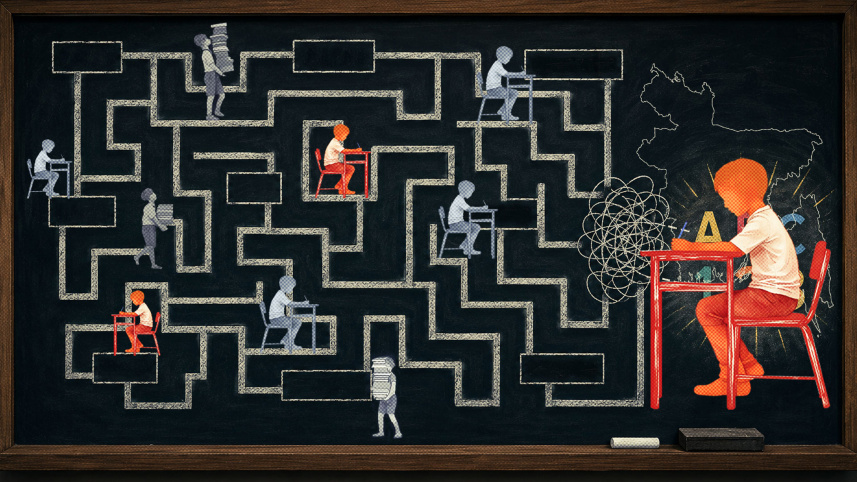
That school education does not work for most of our children cannot be passed off as a hyperbole anymore. When most children cannot read, write, or count at a functional level after completing five years of primary education, how can it be called an effective system?
The situation has not arisen suddenly, and the complaints are not new. Various development projects in the education sector have been carried out with national funds and external assistance. The failures and absence of results have accumulated over decades. Can the upcoming budget for FY2026-27 portend a reversal of the trend?

With the benefit of hindsight, it can be said that the development projects labelled as sector-wide approaches (SWAps) for the comprehensive development of primary and secondary education for all children have failed to live up to their promises. The Primary Education Development Programmes (PEDPs 1 to 4) were designed to cover schools under the Directorate of Primary Education, leaving out almost half of the children, including some of the most disadvantaged groups, who do not or cannot attend government schools. Similarly, at the secondary level, at least one-third of the children attending non-government institutions and madrasas have been outside the scope of the development projects. Moreover, as it turns out, highly centralised, top-down management of project activities often did not mesh with the specific conditions and needs of schools across the country. The activities were disconnected from each other and had specific quality and equity barriers.
In each five-or-more-year project, detailed lists of activities were compiled for each area, following the 178-page manual for preparing the Development Project Proforma (DPP). A DPP is not supposed to change once approved. Funds were spent. Tick marks in monitoring reports against each activity indicated that the tasks were accomplished. The time period for every development programme was extended multiple times, and even then, funds remained unused. Most critically, even though claims were made of completion or major progress, the results have not been visible in student learning outcomes in schools. It is a case, as it were, of a successful surgery, but the patient died.
The education minister, state minister for primary and mass education, adviser to the prime minister on education, and the prime minister himself have spoken about the importance of education and how it is the government’s priority. These are commendable expressions of intent on the new government’s part. Concerned citizens and many educationists ask whether the targets and actions, and the decision-making approach followed, will ensure that the key problems in education will receive attention and a real change in the system will happen. Some of the early decisions with an eye to symbolic actions that may catch public attention give rise to such questions.
The prime minister told a recent parliament session that education development work had been initiated in 43 areas. The number itself is not the problem. But could too many diverse activities become fragmented and disconnected if not made integral parts of a total, holistic and coherent strategy for effective education reform? Education analysts have emphasised that fragmented and incoherent actions unconnected to an overall reform priority and strategy have been, for decades, the most serious problem in our education system.
A priority indicated in the government’s 12-point policy agenda is the compulsory learning of a foreign language for students, along with Bangla and English, even though we have yet to do a good job in core Bangla and English language skills. Public examinations, rather than effective learning in the classroom, seem to be the preferred strategy for improving quality. High-stakes scholarship exams in the early years are being brought back, which takes teachers’ time and attention away from the majority of students. Admission tests have been proposed to replace the lottery system for school admission. Admission by test in early grades is discriminatory and promotes commercial coaching and illegal admission business.
The proposal for tuition-free schooling up to Class 8, a commendable idea, appears to have revived the plan to bring schooling up to Class 8 under the jurisdiction of the Directorate of Primary Education. However, a trial of this approach with over 700 primary schools was previously scrapped. The curriculum from Class 6 onwards is qualitatively different from that of the primary level and requires teachers with specialised subject-based competencies. The state should aim to take responsibility for universal schooling from pre-primary to pre-tertiary in phases and to bring all school education under one ministry.
Other symbolic and populist measures have also been announced: school uniforms, schoolbags, and shoes for students; school meals; waiver of tuition fee for girls up to tertiary education; and “one teacher, one tab,” among others. Each has a justification in its own right and can be helpful when implemented as elements of a holistic plan to achieve key objectives of quality, equity, and inclusion. The comprehensive plan and strategy, however, are still missing.
Several of the actions are intended to attract students to school, whereas the main problem is to make teaching and learning in school meaningful and attractive to students and thus keep them engaged in learning. School meals have proven to be beneficial for learning and nutrition. These have to be scaled up and managed to avert health and safety risks for children. Involvement of the local community and education NGOs can help. There is much to be done to improve teachers’ skills and performance through immediate and longer-term measures. Devices and digital portals could be part of these. However, various technology initiatives, when done in isolation, have been mostly a waste of resources.
A comprehensive reform perspective focusing on selected strategic objectives is needed to bring together various initiatives within a coherent plan. The objectives that deserve particular attention should comprise:
- In every school, teachers as a team, led by the headteacher, need to develop a short-term (one-year) and a medium-term (three-year) plan for improving teaching and learning in every classroom. The team will be accountable for the visible and measurable learning outcomes of students.
- In each class, lagging students should be given remedial lessons beyond regular class hours in the school.
- It must be ensured with a time-bound plan that the poverty of a family will not be an obstacle to children’s participation in school.
- To achieve these objectives, upazila- based and school-based decentralised plans and programmes should be developed under national guidelines and implemented as a pilot project.
Experience suggests that a creative and innovative approach is required to move forward. Remaining bound to the present structure will not take us there. To kick-start the process, a high-level expert task force should be appointed to guide the effort. Its work will face resistance from various vested interests, which can be overcome with high-level government and political resolve.
Dr Manzoor Ahmed is professor emeritus at BRAC University. He was the convener of the consultation committee on primary and non-formal education appointed by the Ministry of Primary and Mass Education, as well as of the consultation committee on secondary education appointed by the Ministry of Education.
Views expressed in this article are the author's own.
Follow The Daily Star Opinion on Facebook for the latest opinions, commentaries, and analyses by experts and professionals. To contribute your article or letter to The Daily Star Opinion, see our guidelines for submission.
 For all latest news, follow The Daily Star's Google News channel.
Comments